Currently viewing the tag: "weight loss"

blood testsIt’s hard to believe that this is only my second post for the year.  Where did it go?  I’ve not been sitting idle. First,  a big thanks to ALL of the people that contributed to the open source fund for the Metabolic Winter Hypothesis paper.  Not only did we reach the goal in under a week, but the paper has been a huge success. It broke all download records for the journal and remains their number one downloaded paper.  Thank you for helping and thank you for sharing it with so many people.

I am currently working with the collaborators of the first paper, along with an expanded set of top notch new collaborators on the second and third paper.  These will go much deeper into the issues of metabolism, Calorie, and assorted myths that we (yes, me too) have propagated during our quest to be the most obese human generation of all time.

Of course it can be said in a simple summary: “protein, carbohydrate, and fat” – speak  doesn’t tell you much and you can’t out-exercise your mouth.

Today of course, one would believe weight loss and health requires a degree in molecular biology, but I can assure you that there are millions of words propagated in thousands of blogs by people repeating, not measuring.  I don’t intend on wasting your bandwidth here and that requires a not-so-profitable diligence to do science first and promote second.  For this I appreciate your patience and support.

But it is FALL!

At least in the northern hemisphere and that means mild cold stress season.  Let’s take a few minutes to talk about some great papers that published in the last few months and some practical tips for easing into metabolic winter and getting the most out of  it. Rather than plunging into shivering water or eating buckets of ice, it’s more important to focus on achieving mild exposure over longer durations.  As the summer ends, we are warm adapted and we  have an exaggerated response to cooler temperatures.  65F/18C might very well seem cool in the middle of the summer, but in the middle of the winter coming in from a ski run that same temperature is comfortable and warm.  I explain more in Ch-Ch-Changes (you need to be a registered user to see archives – it’s free and I don’t send you junk mail to buy stuff).

The take home summary here is that we don’t really sense/judge absolute temperature very well and we can become accustomed to a warmer/cooler environment without much effort; this isn’t akin training for a marathon.   One IDEAL way to become more accustomed to the warm-cool “shock” and acclimate is through contrast showers.  I highly recommend these to everyone getting started.   Check out Mitochondrial Anarchy for details on why, but I’ve included the photo here if you just want to jump right in.

As we explain in Metabolic Winter Hypothesis, there seems to be a strong interdependence with mild cold stress, caloric restriction, and sleep.   These not only impact higher level interaction like found in the HPT-Axis, but also seem to play a strong role at the cellular biogenesis level.  It seems that our circadian clocks are intertwined with both the season and energy management.  That’s not a surprising idea, but we currently seem to be one seasoned in our approach to health: bright, active, and warm.   For example, it’s well known that Seasonal Affective Disorder may be addressed by bright light therapy (thinkla spring/metabolic summer) and yet widely unknown that cold stress can have similar results.  The question one then brings up: is it too little light or too much warmth that is causing the problem? No one can answer for certain, but our  “fear of cold” learned response is to reach for the bright, happy light.  We do the same thing with the “fear of hunger” and sugar, salt and fat.

Not everything we crave is necessarily what we “need.”  Alcoholics and heroin addicts are just two examples of this change from have to have not that inserts a craving that is neither healthy or natural.   We see  it’s the sudden change that seems to rock the boat and contrast showers are one way to not only mute your response to that change, but further to begin an easy, comfortable adaptation to the lower temperatures ahead.

Una Siesta Fresca

We discussed in Beauty Sleep the wonderful advantages of cool sleep and some scientists at National Institutes of Health (NIH) , National Institute of Diabetes and Digestive and Kidney Diseases have beautifully demonstrated this in a recent study.   Impact of Chronic Cold Exposure in Humans (ICEMAN) is a bit misleading (everyone wants to make it sound extreme), looked at 5 men ranging in age from 19-23 and looked at metabolic response.  Over a 4 month period they were subjected to sleeping in rooms that varied from 66°F (19°C) and 81°F (27°C). Daytime activities were normal.  BAT and metabolism was measured at the end of each month and researchers concluded that the warm, 81°F (27°C), suppressed BAT and metabolic activity, while the mild cold 66°F (19°C) increased the men’s BAT and metabolic rates.

Figure 1 Map showing the 100 clusters included in the study grouped according to their mean annual temperature.  from S. Valde

Figure 1 Map showing the 100 clusters included in the study grouped according to their mean annual temperature. from S. Valde

A second study that I haven’t seen reported much was conducted by researchers in Spain.   They found, after adjusting for lifestyle (physical activity, Mediterranean diet score, smoking) and socio-demographic (age, gender, educational level, marital status) that a clear association in obesity with mean annual temperature existed.   The first question many ask me when I discuss my research is, “well, why aren’t people fat in that live in cold climates?” I typically respond, because we avoid the cold by layering and ubiquitous warm shelter and transportation. What is interesting about this study is that it’s somewhat a homogeneous culture and diet and the temperature range is 10.4-21.9C (50.7-71.4F).  This is a perfect span of mild cold stress – reinforcing the point I always make here (and yet the media NEVER quotes me correct on) extreme is not necessary.  Cool, not cold is the best approach.  This was a final sample size of 5061 men/women and there is clearly a significant trend.

From the warmest to the coolest quartile, obesity prevalence rose from 26.9% (Q1)…30.5% (Q2)…32% (Q3)…33% (Q4).  I think these both underscore the power of mild cold stress and also reinforce the metabolic winter hypothesis.  I doesn’t take much over a long time to make a huge difference. As well, lipids are likely prefered in non shivering thermogenesis over glucose, conserving precious glucose to fuel red blood cells (they have no mitochondria and can’t metabolize lipids or ketones).   If you ever see my name associated with an article or quoted in one that discuss crazy cold stuff, please know right then that I told the journalist, perhaps pleaded with them, to not make this article about extreme.  They rarely listen, but just know I NEVER have a conversation with one that I don’t emphasize that point.

Gloves before sweater makes you look better – cover your symptoms of cold (nose, face, ears, feet, and hands) first and carry layers with you.   Layer as needed and don’t layer and remove.  Use caution in long duration exposures and don’t fool with water temperatures below 60F (15.5C) or air 32F (0C).  Be safe as you can have a big impact without resorting to epic extreme.

Open Source Body

Besides writing, one of my main activities the last couple of months was setting up a non-profit 501(c)3 foundation to fund continued research.  Having selected a founding board and kicked it off with an initial investment, it’s underway.  We’re working on setting up a website and establishing a working relationship with several other organizations.  We have the founding board in place and are actively seeking our science advisory board.

Our Mission is simple:

osb logoWith worldwide pandemics of chronic disease and obesity, Open Source Body is a network created to facilitate the collaborative research that might halt or reverse this trend. All data submitted or research paid for by OpenSourceBody.org will be available for public access.

The mission of Open Source Body is to extend the successful open source efforts that fueled the internet revolution to areas of health, fitness and nutrition. We operate under the simple principle that good health can be found in every body.

I am encouraged by the participation and support you have given me and I think this can be scaled. The internet is loaded with blogs that preach health under a never ending drum beat of selling supplements, plans, and you name it.  I’m certainly not against anyone making a living, but it doesn’t play well when they turn out to be wrong and have an entire business built on a house of cards.  That ends up in senseless attacks or bullying and really, I don’t want to participate in this sort of fiasco.   We only learn when we are wrong – every good scientist understands this.   What I seem to encounter more often than not on blogs are people with science backgrounds that just repeat, repeat, repeat. The story is now down to such a reductionist level that one needs a degree in molecular biology to keep up or go grocery shopping. It appears to be a never ending contradiction to the public.   This ever increasing techno talk bodes well as people end up being easily bamboozled with techno-talk.

Carl Sagan had this to say:

“One of the saddest lessons of history is this: If we’ve been bamboozled long enough, we tend to reject any evidence of the bamboozle. We’re no longer interested in finding out the truth. The bamboozle has captured us. It’s simply too painful to acknowledge, even to ourselves, that we’ve been taken. Once you give a charlatan power over you, you almost never get it back.”

So rather than rant more about this, I want to do something proactive to make a difference and my first self test is under way.  I’m trying not to be tricked and I know the human brain, more importantly my brain, is biased to patterns.  It’s tough to escape it, but with good measurement it is possible.   About a year ago you might remember I did a small, 6 week self test and it was an incredible success with some unexpected outcomes.  Knowing I didn’t have enough data to fully capture what was going on, I decided to repeat it and up the ante a bit.  I have a team of researchers that helped me design and carry out this test and it’s been pretty damn exciting.

SelfTest.012To start, I gained (0ver 3 months) 15 lbs and held that weight for over 2 months before I began. I have been weight stable for nearly 6 years outside of the couple of short experiments I did over a year ago.  That stable weight was  about 20 lbs above my ideal weight.  The goal was simple: track it all and lose 30 lbs in 6 weeks without exercise or supplements and test some of the fundamental notions of the “nutritional emergency/deficiency” everyone seems to bellow on about in an endless onslaught of advertisements.

I began the Phase 3 on November 8, coincidentally my 50th birthday, and as of today I haven’t eaten for 11 days.  Over the weekend, we did full amino acid profiles every  4 hours over 24 hours.  I look like a junkie with track marks in both arms and both hands. It required me to pack my lab and drive 2400 miles to California. I’ve measured my metabolism daily throughout this 6-week test and despite losing 30.3 lbs already and not EATING for 11 days, my body is not going into “starvation mode” >gasp<, which is oft reported by fitness, blogs, and media (and researchers, physicians and dietitians).  I suspect most that proclaim these metabolic doomsday have likely never measured a single metabolism in their lives; they might not even know a person that has.   Am I a genetic freak? I’m not betting on it as my data matches almost identically the results of the great scientists of the 19th century that studied this subject back when this was actually cutting edge research.

There are too many repeaters.
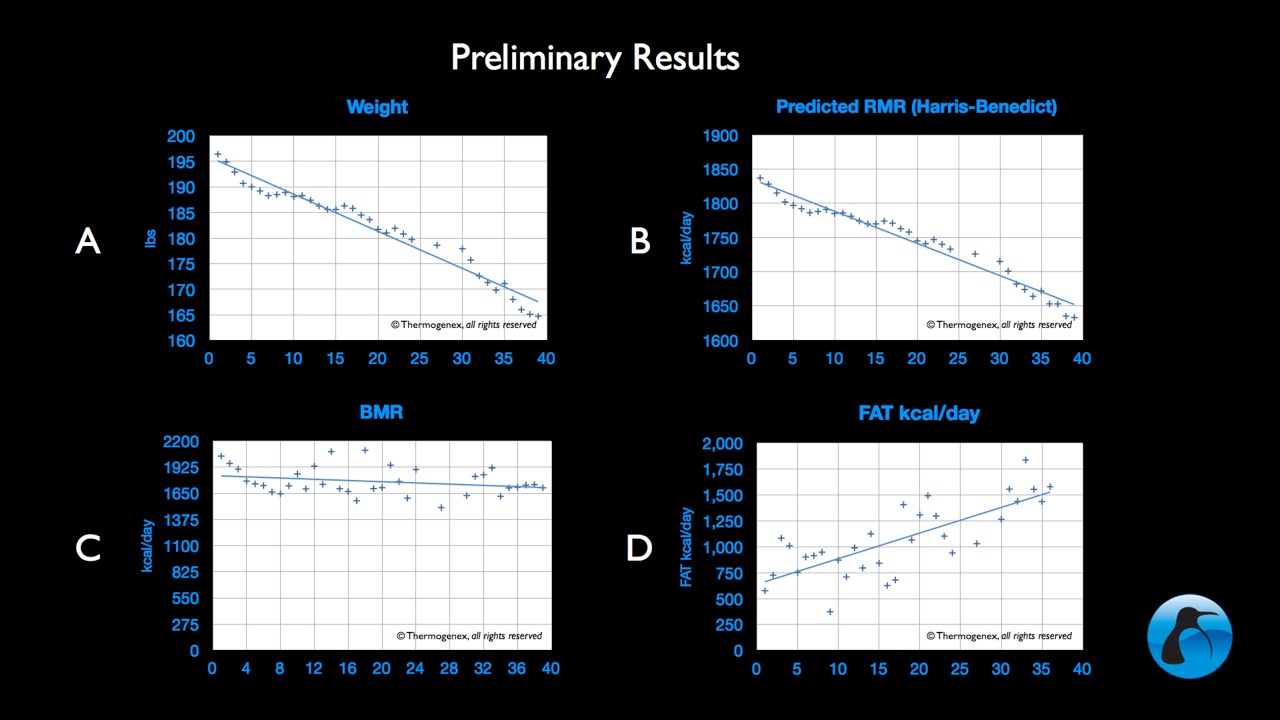
self test prelimToday I decided to plot some data, after all  I have to do is take needles and drink water and how much of that can one take?   I  exceeded my goal of 30 lbs today with 3 days of water left,  but it’s pretty exciting to share this with my blog followers.  If you are new to the blog, I highly recommend you stop now and go back to the Muscling Your Metabolism posts  and work your way though.  Once again, it’s respiratory quotient that everyone leaves out of the “broken metabolism” drama that is key to understanding what is happening.

Take a look at the graphs.  You see my weight loss (A) is is pretty constant and of course if one just goes by the RMR of the Harris-Benedict equation (B), it predicts a declining metabolism. Remember, metabolism scales with MASS not lean mass.  The bigger you are, the more calories you’ll burn.  It’s similar to the riddle, which weighs more, a ton of feathers or a ton of bricks? Likewise, whether you lug around an extra 30, 50 or 100 lbs of fat or steel all day long, it’s going to amp up metabolism. More on this in our next paper.

Okay, this is where the FUN begins.  As you can see (C) my BMR does drop over the first 8 days or so. Can this be the dreaded “starvation mode” that we are warned about? Will it crash to zero and cause me to balloon back to 230 lbs? What if I skip breakfast????  There is an ever so slight downward trend of BMR as you see in the linear curve fit, but as I have have often warned, the magnitude of metabolism is almost irrelevant.  Think of it like a business.  What do annual sales tell us about the health of a company?  Not much.  They could be making $100 million a year and losing $25 million a year in a slow (fast) bleed.  We need to see the balance sheet. Tell me about net income or EBITDA.

The same is true with metabolism and we need to know how the metabolism is partitioned between carbohydrate or fat so take a look (D).  Clearly my FAT metabolism is not staying level, in fact it’s zooming up. That’s because starvation mode is BURNING OUR RESERVES.  How simple can this be? I mean, why do we have fat anyway if not to burn it in times of caloric scarcity. As we point out in Metabolic Winter Hypothesis, that used to be an annual stressor. Now, winter never comes. We need to stop making things so difficult.

More Work To Do

I’m so excited by the results and it’s been an incredible journey and learning experience. There’s a lot more, but I wanted to share that with our community now and ask for your help.  I am raising $15,000 to help defer the costs of the testing and travel associated with this test. As well I’d like to begin the Open Source Body website development and design.  I am done self testing (at least for weight loss) as I intend on staying within my ideal weight from this point forward. I’ll finally put exercise back into my regular activity and continue to work with mild cold stress and calorie restriction to help define ways more people can practically adopt it into their lifestyle.


Hypothermics Donation

As always I am grateful to all of the regular donors, emails, FaceBook Friends, and  commenters for allowing me to pursue this passionately for the last 5 years.  It’s been such an unexpected adventure and there’s much more work to get done.   I’m going to get back to my water now – have to be well hydrated for that massive amount of blood to be drawn tomorrow morning.

Thanks!
Ray


References

Lee, Paul, et al. “Temperature-acclimated brown adipose tissue modulates insulin sensitivity in humans.” Diabetes (2014): DB_140513.

Valdés, Sergio, et al. “Ambient temperature and prevalence of obesity in the Spanish population. Di@ bet. es study.” Obesity (2014).


Irisin transforming fat to BATWe take a quick break from our macronutrient discussion to talk about some really exciting news in the hypothermics world that showed up in the last two weeks. It’s great when new data shows that old thoughts might be wrong.  This one comes from researchers at Harvard Medical School (and a host of other institutions).(1)  These scientist discovered a new hormone, irisin, named after the greek goddess iris – the personification of the rainbow and messenger of the gods.

What is most exciting is that this hormone could be another piece of the “calorie” controversy – the irritating paradox of calorie in, calorie out.  So let’s take a look at what they found.

Only the Good Die Young

In the past we have discussed the role of the uncoupling protein, UCP1, that instructs the mitochondria to generate excess heat instead of producing ATP.  This protein is mediated by another very important co-activator, PGC1-α. You may have heard about it in connection with what are called the Sirtuin proteins. If not, let’s back up and review a little on these before getting into this new discovery.

By regulating the production/activation of this family of molecules, scientist have not only been able to vastly alter obesity in mammals, they also are able to affect animal longevity.  You’ve heard of Resveratrol by now and these are the very same metabolic pathways altered by that molecule. (2-4)

PCG1-alpha altered mice show dramatically different aging.

Increased PGC-1α expression in skeletal muscle prevents age-associated weight gain and improves exercise capacity during aging. (A) Comparison of mice expressing the PGC-1α transgene in skeletal muscle (MCK-PGC-1α) and wild-type littermates (control) at different ages. (B and C) Lean and fat mass of 22-month-old wild-type and PGC-1α animals as determined by DEXA scans, (D) Relative hindlimb mass of 22-month-old wild-type and PGC-1α animals (E) Treadmill performance test at different ages for wild-type and PGC-1α animals; Source: Proc Natl Acad Sci U S A. 2009 Dec 1;106(48):20405-10. Epub 2009 Nov 16.

For example, if you look the the photo to the right, you’ll see a pair of mice. One mouse (left),  was genetically modified to have enhanced PGC1-α and compared to a normal control mouse (right).  Just a scan of the photos and you will quickly see that the modified mouse ages “gracefully.”  Its control cage-mate gets plump like the rest of us even though it’s in the same environment. The genetically modified mouse stays healthy.

It doesn’t stop there. Take a look at graph “E” to on the bottom right.  That is the difference in performance of Treadmill tests (I wonder if they used Livestrong?).  Look at the difference of performance at 22 months! Like a fine red wine, these mice get better with age.  In addition to the lack of weight gain and increased running skills, these mice showed no age-related bone loss or insulin resistance and the typical systemic inflammatory response was mitigated.

Despite what people might say, you’re not going to get these results from drinking red wine (sorry), but these are incredible first steps to unlocking the mystery of aging and metabolic syndrome.

Message to My Blubber

The new research identifying the irisin hormone is just as exciting.  This hormone was hidden as part of a much larger molecule and these researchers were able to  isolate it.  Irisin is secreted as a result of exercise in both these transgenic (modified) mice and Humans.  It turns out that this is way for the muscle to “communicate’ with the forming white adipose cells, signaling them to become the more energetic brown adipose tissue (BAT).  The concentration of this hormone jumped sharply after exercise (Human and mice).

The researchers went a step further.

By doing experiments in cultures, they discovered that nano molar levels (tiny amounts) of this hormone cause a 50-fold increase in the UPC1 protein. When delivered in vivo (in the animal) they still saw a 10-20 fold increase of in UCP1, which resulted in an increased energy expenditure and improvement in the glucose tolerance of mice fed a high fat diet.  But a nagging question remained. What purpose would be served by a hormone being released in response to exercise that INCREASED energy consumption?  One might thing that the opposite would be true – evolution would dictate conservation of energy.

Cavemen Didn’t Exercise

A long time before 5-toe shoes and grown men (and women) running through NYC Central Park beating their chest and throwing boulders, we were far more like the bird sitting on your back porch (unless you are looking at a pigeon – they don’t count); we starved.  If you look all around you and ignore domesticated animals (including pigeons and rats), you will find that every animal is starving.  They live to eat every day and it is a struggle to find calorie.  It is THE struggle that anthropologist are still trying to unravel with Humans.

Where did we get the energy to become the modern-day intellectual giant?

You should see the conflict. If we were starving and now find that a hormone is released in response to strenuous activity, which turns energy storing white fat into energy burning brown fat, that would be a NEGATIVE not a positive evolutionary trait. The quest to find food would be a downward energy spiral.

Ah, but we really had no reason to run through the park or roll giant tires around. Why would our ancestors need to exercise?  It turns out that there is one activity that WOULD cause a lot of muscle activity, yes it’s shivering.  It was a way for animals to keep warm and in response to the biological stress of cold, muscle secreting a hormone to create more BAT to keep warm was a GOOD thing.  It meant staving off hypothermia.

A further interesting fact is that PGC1-α was originally discovered by scientists, because it was unregulated by cold exposure.  We also know that in addition to caloric restriction, mild cold stress is the only other way that we have demonstrated longevity in mice. Even more exciting is that recent tests (unpublished) have show a nearly 5-fold increase of BAT output of a 52 year old man vs 20 year old controls.  This increase was even though they had similar levels of BAT, so there is even more energy to tap into. You can adapt and cause increased metabolic activity.

Un-wrapping it All

I think we are seeing just the tip of where all of this is going. In the last decade we have moved from the idea that we lose all of our BAT with aging, to we have a fixed amount of BAT, to now understanding there are hormonal mechanisms to create new BAT.  Further the exact pathways that are responsible for longevity through caloric restriction also are affected by mild cold stress.  These systems respond to biological stress of starvation and cold, like a muscle responds to the stress of weight training,  by creating a more resilient biology.

Mild cold stress does not have to be miserable, or even cold.  It can come in a lot of different forms. In the David Agus new Book, The End of Illness, he discusses at great length the role of inflammation in aging. He even gives an example of a one of his “all-star” cancer patients. Diagnosed with prostate cancer at the age of nearly 80, he decided to make a life changes that include swimming every day. He is now almost 90 and doing incredible.

I have documented the profound ability to thermal load through swimming.  In addition we know that mild cold stress starts in warm water (27C/80F).  Today we have learned that a hormone has been identified that is not only increases PGC1-α, it’s causes all the benefits of longevity seen through sirtuin activation. It’s exciting to see this all come together and I know we’ll only learn more. This is not the ice cube diet or really even “freeze your ass off,” it’s a basic adaptation with millions of years of evolutionary excellence.

Turn the heater off, go for a walk, let go of a few layers, move,  or just swim – do something.  You have nothing to lose and we all look funny as hell in shorts, gloves and face masks.  If laughter is the best medicine, worse case is you’ll make someone live longer by laughing.

Ray


(1) Boström PA, et al.,  “PGC1-α-dependent myokine that drives brown-fat-like development of white fat and thermogenesis,” Nature. 2012 Jan 11. doi: 10.1038/nature10777. [Epub ahead of print]

(2) Wenz T, et al. “Increased muscle PGC-1alpha expression protects from sarcopenia and metabolic disease during aging,”Proc Natl Acad Sci U S A. 2009 Dec 1;106(48):20405-10. Epub 2009 Nov 16.

(3) Tong Shi, et al. “SIRT3, a Mitochondrial Sirtuin Deacetylase, Regulates Mitochondrial Function and Thermogenesis in Brown Adipocytes,” J. Biol. Chem., Vol. 280, No. 14, Issue of April 8, pp. 13560–13567, 2005

(4) Marcia C. Haigis and Leonard P. Guarente, “Mammalian sirtuins—emerging roles in physiology, aging, and calorie restriction,” Genes Dev. 2006 20: 2913-2921.

**************
Do you like these blogs and want to help me? Please take a minute to scroll up on the right side of the screen consider making a monthly donation to this program. You can also make a one time donation here:

Thanks!
Ray

the facts on Fat and weight loss. In Fat – Part 1 I explained some details about our body’s use of lipids (fat) and the role it plays in both survival and diet.  The most important concept to take away is that you MUST go on a naturally “high-fat diet,” digesting your OWN adipose tissue, to lose weight.  This may seem so incredibly obvious, but if you take a few minutes each day to think about it, I believe it will have profound impact on your results.

Why? because every calorie you put into your mouth will fuel your body and that will result in the part you WANT to lose remaining safely in place – the rainy day fund. You can juggle macronutrients (protein, carbohydrates and fat) to your heart’s desire and still it will not make any difference unless you run a caloric deficit.  No matter how frequently you pay your credit card bills, if you keep spending, you’ll never reduce the balance.

There is a yin yang to carbohydrate and fat and that is why they are presented as the evil sisters of the macronutrient triplets: protein carbohydrate and fat.

As we learned in the Carbohydrate posts, these starchy foods (natural starches – not french fries and chips) are not evil things to be “completely avoided.”  Glycemic index has a role, but it’s far from absolute. Fat is much the same.  It got its bad wrap in the 80s and became synonymous with weight gain.  When we look back in 100 years to the chronic obesity epidemic created at the end of the 21st century, the focus on fat in the 1980s will be shown to have started the health decline and launch us into record chronic illness. It will be our amazing mastery of calorie (food) that will be shown to have caused a decline in health after millions of years of battling starvation.

In fact, once fitness experts, media, and even physicians became obsessed with a “low-fat diet,” the food industry surged with advertisements: FAT FREE, low FAT, reduced FAT, no trans-FAT, saturated FAT-free and the list goes on and on. Of course you and I were lead to believe that fat-free = healthy, but all the food industry did was load up our food chain with simple sugar (high fuctose corn syrup, honey, sucrose, agave, etc…) and processed starches (flour, corn meal, wheat flour, etc).

Voilà, we began stuffing our mouths with healthy, low-fat “carbs” and now here we are 2 decades later and suddenly the new enemy is the carbohydrate. Can you sense the pattern here? It’s incredible to think our body’s entire energy economy is based on blood-sugar and yet the “new and improved” diet experts are now telling us our primary energy source is bad for you.

The Lizard Brain

You see, all of these concentrated energy foods give us that “lizard-brain” hit.  Simple sugars, processed starch, and fats (even OLIVE OIL) are all nothing more that concentrated energy with very little nutrient value. Ok, stop right there with the Omega-3 “good fats” thoughts.  Sure, we need omega-3s and we NEED fat (and carbohydrate) in our diet. The problem comes when it’s over processed, think concentrated and readily available.

If you’ve been reading this blog from the beginning (if not, start here), you should start to recognize a pattern and it doesn’t matter if you are paleolithic, vegan, body for life, The Zone, Atkins, Mediterranean or Ornish. No matter WHAT diet you decide to go on, the way you lose will be a caloric deficit.  It was clear to me after a few months of blogging on “boosting” your weight loss with mild cold stress that there was no way to boost, if everyone was confused about the primary issue at hand – burning ones own body fat as fuel.

So let’s think just a little more about fat and compare it to simple sugar.  In both cases you have something that is relatively unavailable in nature in it’s pure form. Rather, you find it in nature combined with other micronutrient your body needs.  Just try eating 250 lbs a year of sugar by gnawing on sugar cane – knock yourself out.

Your body needs more than energy and perhaps it’s seeking the plant-derived minerals, amino acids vitamins and other phytonutrients (light produced nutrients such as antioxidants) or maybe the amino acids found in meat.  Either way you will note that ENERGY (fuel) is ALWAYS packaged in nature with micronutrients or fiber – it just doesn’t exist in its pure form of simple sugars or fat.

We can go ahead and throw out the Inuit now as the exception that survived on seal and whale blubber. I might point out, selfishly, that they also had an ENORMOUS thermal load on their body, which called for extreme caloric intake (in excess of 5000 cal/day); they are not the healthiest culture despite their popularity to justify excessive fat consumption.

Low-carb and low fat diets are one in the same. Both limit ENERGY (fuel) and attempt to maintain the flow of micronutrients (maintenance) your body needs to function and repair while simultaneously living off your fat stores.

If it’s really that easy,  then why is it so difficult to resist?

It’s that damn lizard brain. Eat. Survive. Store. I don’t know when I might get a chance to drive through McDonalds again. WTF? That is the problem.  Your body is the result of millions of years of evolutionary starvation and we have been thrust into a world of plentiful, no EXCESSIVE calorie.

You know what is even worse than this excessive calorie? You are intelligent and you WANT to listen to all the experts that tell you it is okay to eat __________ and still lose weight. Here is what we can all be absolutely certain of: unless you begin to live off of the fat in the stomach, thighs, buttocks, or hips that you so desperately want to part ways with, no amount of macronutrient “juggling” will work.

Oh, and you can’t out-exercise your mouth.

If it Jiggles and Wiggles – Eat It.

So rather going into yet another scheme to juggle good fat from bad fat or good carb from bad carb, just know that simple sugars, processed carbs, and extracted fat/oils (including meats and excessive nuts) all contain a ton of energy (fuel) and will slow down the rate of loss. Its YOU and YOUR FAT that you want to digest. Don’t screw it up with olive oil and bacon. They might taste good and really give you that lizard brain hit, but it is only short lived. It’s only lasts as long as you are eating.

The reason I enjoy a vegan diet is that I  LOVE to eat and eating stops after you swallow.  I can simply eat a tremendous volume of food and not have to worry. Unlike most “vegans” (I use it as an adjective, not a noun), I don’t use oils (gasp – even olive oil) or  excess simple sugars, because I am focused on the maximum micronutrients with minimum calories and the MOST food I can joyfully stuff into my mouth (sorry – it’s true, I love to cook and eat). Besides, there are a lot of fat vegans and vegetarians. Just because it doesn’t have eyes or a mother, doesn’t make it automatically healthy.

For others you might still be addicted to simple sugars, or fat and so The Zone, BFL, paleo approach or Mediterranean might appeal. Just understand that if you tinker too much with fat (or simple sugars and processed carbs) you can easily over consume calories. If you do, your body will not be teased into burning “stomach, hips and thighs.”

So Fats, are necessary for good health, skin, nails, and brain function, but they contain a lot of calories per serving. What is worse is that one can EASILY hide an entire Snickers bar in the dressing on your salad…or cheese sauce on your broccoli…or the butter/sour cream on your baked potato without you even knowing it. Compounding this are the dopamine hits your lizard brain will get from these calorie-dense foods that did not exist when it evolved; eat more. eat more. eat more…thunder thighs.

Don’t kid yourself, sucking down loads of refined oils – even plant oils – are not going to help you in your battles. Afterall it was the vegetable oil and margarine surge of the 60s and 70s that lead to the 1980s “low fat” products that put us on the fast track to obesity.  Refined oils and fats and simple refined carbohydrates and highly processed starches (breads, crackers, chips, and milled grains) are both at the heart of the obesity surge and chronic illness we face today. The french fry, donut or potato chip are iconic images for me – fat-fried (even the “good fat” – LOL), sugar (oh yes, agave – the new, trendy “high-fuctose syrup”) and processed  starches. 

Is the answer protein? well, we will see about that in the next post.

Happy New Year to everyone and thanks for an amazing year in 2011!

Ray

**************
Do you like these blogs and want to help me? Please take a minute to scroll up on the right side of the screen consider making a monthly donation to this program. You can also make a one time donation here:

Thanks!
Ray

I’m not much of a swimmer, but I want to be.  In 2011 it is a major personal fitness goal to try to swim more frequently. The interesting irony is that I was in the pool and spa industry for about a decade and yet I wasn’t ever a swimmer. Most are not; in fact, health and fitness isn’t very common in the industry at all.  There seems to be more focus on fountains than fitness.

It’s the first day  of summer here the the Northern Hemisphere…to all of the readers in the Southern part of the world, you are in the thermal loading sweet spot right now – enjoy.

My initial thoughts of thermal loading came from a detailed analysis of Michael Phelps and his enormous caloric intake.  I was able to talk to him for a few minutes this fall and finally thank him for the inspiration.

If you google “weight loss and swimming,” you’ll find site after site that indicates swimming is bad for losing weight or that swimmers tend to put on body fat. I’ve done an exhaustive literature review and I am confident that both of these assertions are wrong. Most of the quotes comparing  swimming, running and cycling find their root in an 1987 study by Gwinup (1). In it, he compares the three activities in the absence of caloric restriction or monitoring of any kind.

Essentially this study followed moderately obese women in one of  three activities, walking, stationary bicycle, and swimming over a 6 month period.  This is probably one of the most extensively cited papers I have seen.  The results were that walking and cycling caused a drop in weight and swimmers actually gained.  It is astounding that it’s been 24 years ago and not much more has been completed.

The problem with the study as I see it is they didn’t ask the people to restrict diet in any way. If in fact swimming could result in a greater caloric burn due to the thermal load of the water, couldn’t that explain the increase hunger? If they were not instructed on how to specifically counter this, would that account for the weight gain? This is generally applied to everyone, but wouldn’t someone that is applying swimming as part of a comprehensive diet/exercise program understand they had to keep calories restricted?

It is plausible to expect that the additional drain of energy from the thermal load of the water could cause the body to signal hunger.  Remember, the body regulates heat (energy) not temperature, so we might expect the body to simply turn on the hunger mechanism in response to the energy deficit caused by increased heat drain. Most importantly, might we expect that armed with this knowledge, we could turn off, or resist, this hunger trigger with proper diet and nutrition?

I believe the answer is yes.

Gappmaier (2) had some VERY harsh words in 2006 retort to the oft-cited Gwinup paper. He felt that while the data Gwinup suggested from his study might substantiate the opinion offered, the other labs cited in the paper have never published any data/papers supporting it. Gappmaier’s view was that most of the research on modes of aerobic exercise had gone into the cardiorespiratory changes, not weight loss.  In the end, Gwinup didn’t control the very variable that was necessary to draw his conclusions, nevertheless, it has been cited over and over for the last 24 years.

Gappmaier found that with similar frequency, duration, and intensity, swimming results are comparable in terms of weight loss. This parity is good news, but of course it likely  is based on a relatively warm and  consistent water temperature and that is where I think the big opportunities to boost the results reside going forward.

In the last year, I really wanted to find a better way to thermal load in the summer. As well, I wanted to know exactly what the truth is concerning water thermal conductivity and the Human body’s loss of thermal energy (calories). There is no doubt it happens, but there is a question of rate. A somewhat exhaustive review of the literature on the thermoregulatory side found that the simple one dimensional math model I outlined two years ago gave a pretty good fit to actual Human data of the 50s & 60s.

This data was collected to assess macronutrient requirements of military personnel in a cold stress environment; ironically they were studies on how to keep weight on, not lose it.  I know it works, but what are the best methods and how quickly can one lose?

I’ve talked with MANY people following both the TEDMED talk and 4HB and I am astonished at just how much fear we have of cold as a society. In fact, the fear is so great that people often interpret “cool” as cold and begin to bundle at what was a very comfortable room temperature just a few years ago.

Over that last 2 months I have been putting in a new lab and looking at methods to better assess my own progress. Taking one for the “Team” out there, I put about 12 lbs on and want to take it off (with interest) using a solid diet/nutrition plan and swimming. I now have the capability to go down to 45F/7C water temperature for swimming in a swim spa…we’ll see how brave I get.

What I know for sure is that there are studies that seem to verify increased hunger associated with swimming. All of the other references you see, in one way or another, lead back to Gwinup 87.  The vast majority don’t control diet at the same time and suggest that increase hunger makes swimming a futile process for weight loss.

I am not buying it.

I have spoken to so many ex-swimmers that rave about weight loss when getting back into the water. The thermal models say it should work. Most importantly, swimming is probably one the very few physical activities that one can do for a lifetime. You can start at any age or level of fitness and if it IS hot and sticky, it’s a fantastic way to relax.

I still need your help in part of this. I am going to begin collecting data in the next few weeks. Part of what I really need to add to all of the current equipment is a thermal imager.  Be sure to click the voting widget up and to the right and I’ll be sending out requests soon in attempts to get this funded.

So, if you are a swimmer, get your suit on and dive in…even BETTER if you are a swimmer going into winter in the southern hemisphere >grin<. I’ll be subjecting myself to even more extreme self-experiments over the coming months and will report back what I learn.

If you haven’t learned to swim- I feel your pain. I too had an incredibly difficult time getting instruction as an adult. I wasn’t afraid of water (once an avid scuba diver), just didn’t know how to “swim laps;” thanks goes out to Al Bayhi @ iSport.com. If you are in the Bay-area, this guy is THE best.

After much personal study of the Total Immersion techniques, as Tim describes in 4HB, I was able to move from zero ability to swimming comfortably over a 5 day period, 3 hours of instruction a day. It was sort of a brutal immersion, but I REALLY learned a lot. From the aches and pains it is clear to me that I exerted a lot of physical energy during the process.

Swimmin is a great compliment to whatever exercise/diet program you are doing, so get into the swim of things and shed some unwanted body fat.

1.  Gwinup, G. (1987). Weight loss without dietary restriction: Efficacy of different forms of aerobic exercise. American Journal of Sports Medicine, 15, 275-279

2. Gappmaier E, Lake W, Nelson AG, Fisher AG.  Aerobic exercise in water versus walking on land: effects on indices of fat reduction and weight loss of obese women The Journal of Sports Medicine and Physical Fitness 2006, 46:564-569

Scott Parazynski Repairs damaged Solar panel on the International Space StationThe last few weeks have been an unbelievable adventure. Sorry to leave you hanging on calories, but we’ll get back to that soon.  The days have been full of travel ranging from an amazing party hosted by Tim Ferriss in San Francisco to hanging out with Wim Hof (aka iceman) and good friend Astronaut, Scott Parazynski.  It’s an honor to interact with all of these incredible minds and we are all starting to see a real momentum in the power of the chill.

My home state (and city) were also hit hard by a the tornados and on a brighter note, the 4HB prescription of beans and cold showers were an unexpected preparation for 5 days of no power.

Chilling Out

Wim Hof, aka Iceman, in an over one our immersion in Ice during a May demonstration in Orlando

Wim Hof, aka Iceman, in an over one our immersion in Ice during a May demonstration in Orlando

If you haven’t seen my TEDMED video, it’s posted on the right.  What an incredible opportunity to get the word out and it’s opened some fantastic doors.  I want to give you a sneak peak at some exciting work to come.  Many have asked for a “step by step” guide on how they can use the power of cool in their everyday routine and I’ve assembled an amazing team to bring that to you. You’ll see it posted here when it’s ready, but it’s extremely exciting to me.  It was great to finally meet Wim Hof and his son, Enahm in person. We’ve been in communication for a while over email, facebook, and twitter, but spending 2 quality days deep in discussion was amazing. I got to watch Wim do a 1 hour and 15 minute full body ice immersion and it was really incredible. Wim insists anyone can do it with training.

I also want you to consider contributing to our research.  On the right, I’ve asked a question about funding a thermal imager to document some of our crazy ideas. I put this up just after my last blog post (eeek –  almost TWO months ago) and it hasn’t had much input. Please take just a few seconds to vote. I really want to create a community here and you have my promise that this is not going to be another fad diet scheme. As you will see this site is dedicated to a thorough exploration of what the human body can achieve. We’re going to look at the best we ALL can be, not just focus on the extreme or elite. We do have an unbelievable research team and you can bet we’re not putting our life-long reputations on the line for junk science. We have a drive to understand this and help ANYONE that choses to succeed.

From Weightless to Weight Loss

John Glenn, Scott Parazynski, Steve Robinson training on STS-95 Aerogel Payload with Principle Investigator, Ray Cronise

John Glenn, Scott Parazynski, Steve Robinson training on STS-95 Aerogel Payload with Principle Investigator, Ray Cronise

So Today, I want to introduce a good friend, former “office mate,” and an die hard adventurer: Scott Parazynski.  He’s got the dream resume: Astronaut, MD, and Mountain Climber and that is just a START. Scott and I met in 1998 during a training session in preparation for his STS-95 mission along with crewmate, John Glenn. He was a backup to operate a science experiment I had proposed for the space shuttle on Aerogel; ironically, it was a extremely high tech transparent INSULATOR.

Scott and I spoke frequently in the time between his two Everest climbs, because he was the most knowledgeable person I knew on the subject of human adaptation and was willing to help me explain and verify my initial 2008  results.  I’m sure in the “heat” of being cold on Everest he thought back a time or two about our frigid fat loss conversations, but Scott has been in extremely good shape as long as I knew him. he didn’t have any body fat to lose.

So let me turn it over to Scott to tell you a little about his adventure and experience with cool…

…Take it away, Scott.

A summit climb up Everest conjures up images of raging winds, breathless exhaustion and bone chilling temperatures, but rarely does one think of fad diets and dramatic weight loss. I had the (dis)fortune of spending two climbing seasons on Mount Everest, for a total of 4 months at extreme cold and altitude. Both of these seasons entailed dramatic weight loss, to the tune of 25 pounds (12 kilograms) each Himalayan foray. In the frequent keynotes I’m asked to give, I often make reference to the future New York Times bestseller I need to write, entitled “The Everest Diet!”

My first trip to Everest in 2008 was the fulfillment of a life long dream. As a climber since high school and a 17-year NASA astronaut, I’d seen and dreamt of standing atop the tallest mountain in the world for many years. My early heroes were all great adventurers, including the pioneers of space, mountaineering and deep sea exploration. Years later, my photo of Everest, taken from 250 miles up during Space Shuttle mission STS-66, is still perhaps the finest ever captured from space: it was a cloud-free day in the Himalayas on November 3, 1994, and the telephoto image reads just like a topographic map (you should post the image if possible with the article, along with one of me on the summit?). Staring at Everest from space and the framed photograph of the peak I kept above my desk, it was perhaps inevitable that I’d one day travel to the mountain for the ultimate physical and mental challenge.

Scott Parazynski on the Summit of Everest. He lost 25 lbs on this climb in part due to the extremely cold conditions

On the 59th day of my 2008 expedition to Everest, while at 24,500 feet above sea level on my summit push, I developed excruciating lower back pain. I later discovered that this was due to a ruptured disc in my lower back. Hobbling down outrageously steep terrain to base camp, and later flying in a medivac helicopter to Kathmandu, I eventually underwent surgery to remove a ruptured lumbar disc. With hard training and a personal inability to leave the job left undone, I returned to the mountain in 2009, and was successful in summiting on May 20th of that year.

The punch line of this story, however, has to do with the cold, and lots of it. BOTH of my seasons resulted in substantial weight loss, despite a concerted effort to consume mass quantities of calories, often in excess of 5000 each day. Granted, substantial physical exertion is required to climb the world’s tallest peak, and it’s difficult to choke down that many calories because of the hypoxia and poor appetite common at high altitude. That said, I certainly ascribe many of the LB’s I lost to the cold. To be clear, I went to the Himalayas each year a “hard body,” without much if any excess fat, so the pounds I ended up losing came from lean muscle mass. I’m convinced much of this loss was from the chronic cold conditions: shivering burns many calories, as does just keeping comfortable in less austere temperatures typical of mid-day and in-the-sleeping-bag rest on the mountain.

In closing, it’s no mystery to me that keeping cool means keeping lean. Not many people would go to the extreme of climbing Mount Everest to lose big time weight, but dropping the thermostat or swimming in cool water may just be the ticket to shed those unwanted pounds…

Thanks Scott!  We’ll be hearing much more from Scott as we dive into some great self experimentation on thermal loading and weight loss.

In mean time, if you want to learn a lot more about Scott Everest/Space adventures and your chance at private space travel, please take a look at Scott’s TEDMED talk here:

7 M&Ms a are all it takes takes to gain 50 lbs in 20 years. Former Nasa scientist Ray Cronise thinks he can help with Thermal LodingIt was hard to believe when I scratched out the arithmetic on my weight gain in a notebook.  It was 50 lbs over 20 years.  It seems like a lot, but when we think about this in a more scientific light, what’s quite astonishing is that I didn’t gain MORE.

If you did gain more, then let me give you a little reassurance that you’re not the only one.  Today we will start delving into the other side of thermodynamics to give you a more complete picture of my research over the last three years.

As most of you know by now, especially those who have reached out with data and emails, my life and study does not center on some malevolent plan to make you miserably “freeze your ass off.” Read Full Article →


Does infrared sauna burn more than cold exposure?Last week, one of our site members posted a comment to Ch-Ch-Changes about the benefits of heat and cold in losing weight. I think that 36 months ago I would have completely agreed with his comments; now I am not so sure. With his permission, I turned this dialog into a post, because I think there is widespread confusion on our thermoregulatory system and its effect on metabolic rate.

Read Full Article →

BAT, Brown Adipose Tissue, Thermal diet and weight lossWe learned in Part 1 that not only do human infants start out with more fat than any other species, a higher percentage is brown adipose tissue (BAT). Women, in general have more than men and as Humans age, BAT seems to dwindle. It’s likely if you have ever been obese, you have less BAT then your skinny friends.Custom gummibåt

I have dozens of papers here on BAT. My interest with BAT began after Tim and I discussed it at length and started exchanging ideas and data. Honestly, I came to my conclusions from the complete opposite (but complimentary) approach – it was much more of a 30,000 ft level view on the subject. Read Full Article →

measuring and recording your progress is the only way to push through weight loss stagnation.If you want to progress, you must  measure. It’s true people win the lottery every now and then.  More often than winning the lottery, people get struck by lightning. The rest of us have to do something to see results. My observations are that  success is absolutely tied to measuring.  It can be predictive, suggestive, or sometimes compulsive, but I truly believe the more often one writes something down, the more likely it is they will succeed. Read Full Article →

With just two fingers you can prove how easy it is to adapt to cooler temperatures and lose weightIt’s a simple test to demonstrate that your body doesn’t require a perfect temperature to be comfortable, it has a range of temperatures that are comfortable.  Part of our amazing evolutionary survival is the ability to adapt. Not all adaptation happens genetically, it can be driven intellectually as well.

Changing the temperature of the environment around you is one of great examples. Read Full Article →