Currently viewing the tag: "Self experiment"

kickstarter, Our Broken Plate, Skip a meal and your body will begin to hold onto fat. We should eat frequently to keep our metabolism up (ugh-I said this all the time). The most important meal of the day is breakfast. I’m not getting all sciency today. I will ramble a bit.  We’ll talk at a much higher level. There’s been a lot of reductionism in nutrition and metabolism and it is spreading fast. While the internet has provided unprecedented access to information, it’s also allowed a lot of science babble to infiltrate every subject and diet has to be the gold medal champion. Everyone eats so we all must be experts.

I hear of quantum physics and love from people that don’t know the schrodinger equation or a microcanonical ensemble exist. Their “frequencies resonate.”   It’s widespread co-opting of science terminology to make things sound more well thought out and factual than they really are. In science, we celebrate the unknown. We don’t know how to define the emotional and it’s handled in the soft sciences.  They see trends, but science looks for fundamental rules that govern how things work. 2 + 2 = 4 is a mathematical relationship and as amazing as may sound, it’s true whether here or on voyager spacecraft that’s left our solar system.  If you have two marbles and your travel mate has 2 and  put them in a bowl  there will be 4. We have other scales and mathematical tricks that can make this equation an inequality, but in normal counting, it’s true and can be verified.

In 1996 Carl Sagan wrote a fantastic book, Demon-Haunted World. In it he warned (foreshadowed) a reality of the future:

” I have a foreboding of an America in my children’s or grandchildren’s time — when the United States is a service and information economy; when nearly all the manufacturing industries have slipped away to other countries; when awesome technological powers are in the hands of a very few, and no one representing the public interest can even grasp the issues; when the people have lost the ability to set their own agendas or knowledgeably question those in authority; when, clutching our crystals and nervously consulting our horoscopes, our critical faculties in decline, unable to distinguish between what feels good and what’s true, we slide, almost without noticing, back into superstition and darkness…

The dumbing down of American is most evident in the slow decay of substantive content in the enormously influential media, the 30 second sound bites (now down to 10 seconds or less), lowest common denominator programming, credulous presentations on pseudoscience and superstition, but especially a kind of celebration of ignorance.”

He went on to say,

“We’ve arranged a global civilization in which most crucial elements profoundly depend on science and technology. We have also arranged things so that almost no one understands science and technology. This is a prescription for disaster. We might get away with it for a while, but sooner or later this combustible mixture of ignorance and power is going to blow up in our faces.”

While that sounds all a bit cynical, I really am using it to give us a nudge. We need to be skeptical, but sifting and sorting through the blogs, diet books, media, and social discussions is a daunting task for even the best educated. There’s a saying that a specialist knows more and more about less and less until they know everything about nothing. Conversely, a generalist knows less and less about more and more until they know nothing about everything. We all fit this to a degree in some aspect of our lives.  Clearly the internet and media echo chamber has spoken on starvation mode and it’s doom and gloom if you don’t eat.

A Closer Look

Here is one example quote I found with a Google search that is quite interesting:

“Quite simply, your body goes into ‘starvation mode’. This mechanism, which is thought to have evolved as a defence against starvation, means the body becomes super efficient at making the most of the calories it does get from food and drink. The main way it does this is to protect its fat stores and instead use lean tissue or muscle to provide it with some of the calories it needs to keep functioning. This directly leads to a loss of muscle, which in turn lowers metabolic rate so that the body needs fewer calories to keep ticking over and weight loss slows down. Of course, this is the perfect solution if you’re in a famine situation. But if you’re trying to lose weight, it’s going to do little to help you shift those unwanted pounds.”

Let’s talk about basics. Fat is a storage organ. It is there for times of famine. The body constantly taps into this storage organ when we enter the fasted state (~4-6 hours after a meal). So here is what they are saying, in a nutshell – if you don’t eat the body holds onto the back up reserves.  That’s backwards thinking.  Further, it’s posited that the body will instead use lean tissue (from muscle/organs) and accelerate that loss – all to preserve our fat storage organ.

Reflect on that for a minute.

Why would the body hold onto this precious fat storage and instead cannibalize our vital organs and muscle tissue, because of food scarcity? How might that helped the evolutionary process? Seems to me that those who digested their heart or leg muscles before using fat reserves when there wasn’t any food wouldn’t have jumped into the gene pool with all the vigor as those of us that actually lived on our storage organ. Don’t you think? I’m imagining the number of people it took to build the pyramid stopping 3-6 times a day for a quick pick-me-up. Don’t you think they tossed them some water and said, “keep chiseling! pull the rope” and perhaps they ate some bread etc… a little later?

Now, the body absolutely has some adaptive changes to accommodate food reduction. There are metabolic shifts and changes in how we use fuel.  I learned last year that even after 30 days of a VLCD followed by a medically supervised 14 distilled water fast I wasn’t deficient in anything.  I don’t want to cloud the discussion with ketosis, fat adaption, etc… as it’s all somewhat tangential to the main point. Let’s for a minute put aside the debate over metabolism havoc. Let’s acknowledge we can’t explain everything and yet our bodies managed to get you right here staring at a screen from a single cell without help and perhaps in spite of what we swallowed. It’s remarkable.

When in the fasted state we use reserves. That’s why they are there. Fat and glycogen are long and short term (respectively) storage organs. You’ll be fine on the 4 hour flight without peanuts.

Magic Meals

Last year when I was coming home from the self-experiment, my daughter and I decided to stop in Vegas and visit with Penn & Teller.  I have known them for over 20 years and we hung out after the show. I’ll leave the bigger story for Penn to tell in his spring 2016 book, but he called me later and asked for help. Maybe you’ve seen the news by now, but essentially he lost a little over 100 lbs, most of it in a three month period we worked together. He’s off 8 BP meds and in fact his medication is down to almost nothing now. You can listen to us discuss this on his Penn’s Sunday School podcast here or download it on iTunes.

He’s looking and feeling great. While the media likes to toss around “1000 kcal/day” diet (or gastric bypass), he has no idea how many calories were consumed. I don’t either and as I will be explaining there are much better ways to think about food energy conservation that are not only predictable, but also repeatable.  Then there is the echo chamber – read this article and imagine that this otherwise well-educated physician makes all these WRONG diagnoses based on information in People Magazine. What physician or scientist uses People Magazine as a primary source and then does an analysis? This is how the echo chamber works.  I’d challenge his notion that nutrients are somehow deficient because he was at a caloric deficit. I wonder how Dr Ayoob would explain the successful results of this 382 day water fast (and btw, he didn’t gain it back)?

Speaking of Fast…

Today happens to be the 5 year anniversary of my TEDMED talk that slipped me into this entire world of food. I had no idea this was coming and if it hadn’t been for Tim Ferriss urging, I wouldn’t even have a website. I didn’t do this for a business. It was an intellectual curiosity.  My friend Tim Jenison had an amazing project I helped on back in 2009 that became the inspiration for my research. If you haven’t seen Tim’s Vermeer, it is a REALLY great documentary.

I was staying with him and beside the bed on a shelf were stacks of history and art books about Vermeer. Tim, as you will see, was obsessed with how this artist did these incredible paintings. Vermeer captured on canvas that which the eye can’t see.  The movie tells the rest of the story and I have my tiny appearance with our 2am decision to start building walls for the room – look for the forklifts scene. After The 4 Hour Body came out there was a little backlash about the veracity of my work. Keep in mind, I did the cold stress work, because I was desperate to lose weight. It wasn’t a research project, but I did jot down notes as it’s habits for me.  That was the seed that went into 4HB and you can read the rest elsewhere on this blog.

What puzzled me was still the Calorie and the apparent contradictions. I wasn’t buying the Good/Bad or even the “high fat/low carb” (or any variation thereof) dogma.  I wanted to understand it.  Well, I did as my budget would allow to dig into this project like Tim.  Having a midlife crisis calorimeter in a lab adjacent to the kitchen is a great way to test anything you want about food.  I learned a lot and especially that most of the older studies were easy to reproduce. I don’t think they are wrong, but I believe a lot of things we repeat, that  I repeated, aren’t correct. You all know very well by now that I don’t think “protein, carbohydrate, or fat” serve us anymore as food groups/categories.  We need a new paradigm.

FullSizeRender-1Today is day 16 of a medically supervised 21 day water fast for my book.  I feel fine and perfectly normal (as normal as I get). Hanging out with new and old friends here, reviewing 5 years of research and writing.  I may have to go out to 24 days depending on how some tests turn out at the end (more in future blog or book). As I mentioned, I wasn’t deficient in anything last time at day 14 and I performed a midpoint blood panel (~$1500 each) to see how well that tracks my last fast. Of course I will do a blood panel at the end.

This time I am focused on “muscle loss” particularly urinary nitrogen. As we learned in Passing the Protein (part 1, part 2), urea is the metabolite of amino acid metabolism and so one can track loss by collecting 24 hour urine samples. We need the indispensable amino acids (~9 of 20 depending how one counts them – not 2 +2), the rest we make. It’s been 2 weeks of drinking water and peeing in a jug.  This will supplement the dexa results from last year and give a more complete picture. If all else fails, I guess it’s training for the reality show, Naked and Afraid.

Take a look at my results above and what you’ll see, like last year, my metabolism is fine. It’s not crashed, but scaled with my mass and my fat burn is through the roof.  Yes, as evolved, our body actually uses our fat STORAGE organ in times of no food. That’s not a difficult concept, but wow, is there a lot of confusion. I want to try to nudge this. I’d like to change the dialog.

Cool not Cold

I don’t want to sound opportunistic, but you may have read about the recent tragic death in a Las Vegas cryotherapy spa. It is a horrible loss to her family and they have my condolences. This is probably an isolated incident, but nonetheless it’s an opportunity for me to reiterate my position. As anyone that follows this blog for a while knows, I am an advocate of mild cold stress not extreme.  One does not need to go to extremes to get the benefits of cold therapy.  If you are new to the blog, use the tags at the side and you’ll be able to navigate to the many posts that discuss this.  Mild cold stress begins in water temperatures below 80F (26C) and air temperatures below 60F (15.5C).  There is no reason to go below 60F(15.5C) water or 32F (0C) air.  Generally speaking one can get all the benefit they need from just a 10 degrees or so on the thermostat or to carry layers and use as needed.

Ideal temperatures are 75F (24C) water and 55F (13C) air.  These are the most comfortable and are likely plenty to get the beneficial impacts.  Remember the “reverse ski layering” strategy – take them along and wear as needed instead of leaving the house bundled and losing layers throughout the day.  A quick walk from the office parking lot to the front door won’t likely result in hypothermia. It’s fall in the northern hemisphere and we are naturally adapting to the cooler temperatures. The photoperiod is also getting shorter.  These are all biological cues that signal winter is coming (wow has that phrase changed meaning in 5 years). As we explain in the Metabolic Winter Hypothesis, the combination of sleep, dietary restriction and mild cold stress may have a synergistic effect with activation of the sirtuin genes – those that we have shown in animal models to increase healthspan/lifespan. Contrast showers can aid in this adaptation process and it’s helpful in sleep.

As well my close friend, Wim Hof, has been on many blogs lately and I don’t want this to sound contradictory to what Wim teaches. His main message is what our body is capable of doing with training and that he’s not a unique superhuman (I’m still impressed). In fact, when I visited him a few years ago in Amsterdam, he noticed one day that he wore a jacket on our walks to the grocery store and I had a t-shirt and gloves. In his warm laugh and great accent he said, “look at that. The iceman has a coat and you are in a t-shirt.” We opened the windows that evening and slept amazing. He was grateful for reminding him that he’d been locked up in the apartment.  Wim is pushing science to go past the handed down dogma on extremes and human limits and he’s doing amazing work with the autonomic immune system.  I don’t want this to be misunderstood.

Kickstarter- Our Broken Plate

our broken plateIn the next week I will be launching a kickstarter campaign for my book, Our Broken Plate (update: Campaign went live on November 1st and closes on December 13th). I’ve had a lot of requests over the years to write one and so it is now a “done deal.”  I’ve had some discussions with publishers, but feel that I can be more true to my message if I at least write it first as a cohesive story. Honestly, they all want me to write a diet book and that may be way more successful, but I don’t want to write a diet book.  My goal was to examine how our social relationship with food changed over the last two centuries.  It’s been fascinating to  pile my own shelves full of old books and especially be emerged in the the 19th century when all the fun happens. By 1920s we are on a trajectory to where we find ourselves today. It’s surprising that many scientists predicted, and even warned about this situation.

There are no villains. It’s not an evil government conspiracy as many of the recent books have put forth. There’s no greedy corporate America that is just trying to kill us all with genetically modified food.  We don’t discuss big pharma or  big farms. It’s not a “fat vs carb” or eat meat/don’t eat meat story.  It’s not a textbook as we’ve already made food way too complicated. The book is more of a history-mystery with my self-experiments juxtaposed on some of the great science on metabolism and nutrition. I’m going to stretch it a bit in places with new explanations for old data.  I find it ironic that many of the players of the late 19th century would be perfectly comfortable, and to some extent know more, in a discussion today about metabolism then as it plays out in the blogosphere. We’ve forgotten so much and this valuable data is lying fallow on university bookshelves and used book stores around the world. I’ve collected some of the best and for me holding that 170-200 year old book in my hands and reading it is incredible. I don’t think we are all broken as is so widely claimed. To me it’s our relationship with food that’s broken.

I plan to finish the book in the coming months and hope to have it published by April 2016. We’ll have a crowd-sourced cover design and many other activities. I’ve learned so much from the people here and on the various Facebook groups. The questions have been fantastic.  Having worked now with over 100 people one on one has been a real eye opener. If there are any subjects that you’d like to see covered (the book is pretty far along at this point) please comment below.  I may not be following up as closely as normal as there’s lots of testing to do and I have my kickstarter campaign staring me in the face.

I appreciate your support and thank you for hanging in here even when there were extended times I had nothing to say. Perhaps this research project will make up for it.

In addition to the kickstarter (there are a couple of high end rewards, but most are books)  I’d like to immediately raise $5,000 to help defer the costs of the testing and travel associated with this test and as a jump start to the writing project. I appreciate your support! You can use this link or the one above near the goal donation meter.


Hypothermics Donation

As always I am grateful to all of the regular donors, emails, FaceBook friends, and  commenters for allowing me to pursue this passionately for the last 6 years.  It’s been such an unexpected adventure and there’s much more work to get done.   I’m going to get back to my water now.

blood testsIt’s hard to believe that this is only my second post for the year.  Where did it go?  I’ve not been sitting idle. First,  a big thanks to ALL of the people that contributed to the open source fund for the Metabolic Winter Hypothesis paper.  Not only did we reach the goal in under a week, but the paper has been a huge success. It broke all download records for the journal and remains their number one downloaded paper.  Thank you for helping and thank you for sharing it with so many people.

I am currently working with the collaborators of the first paper, along with an expanded set of top notch new collaborators on the second and third paper.  These will go much deeper into the issues of metabolism, Calorie, and assorted myths that we (yes, me too) have propagated during our quest to be the most obese human generation of all time.

Of course it can be said in a simple summary: “protein, carbohydrate, and fat” – speak  doesn’t tell you much and you can’t out-exercise your mouth.

Today of course, one would believe weight loss and health requires a degree in molecular biology, but I can assure you that there are millions of words propagated in thousands of blogs by people repeating, not measuring.  I don’t intend on wasting your bandwidth here and that requires a not-so-profitable diligence to do science first and promote second.  For this I appreciate your patience and support.

But it is FALL!

At least in the northern hemisphere and that means mild cold stress season.  Let’s take a few minutes to talk about some great papers that published in the last few months and some practical tips for easing into metabolic winter and getting the most out of  it. Rather than plunging into shivering water or eating buckets of ice, it’s more important to focus on achieving mild exposure over longer durations.  As the summer ends, we are warm adapted and we  have an exaggerated response to cooler temperatures.  65F/18C might very well seem cool in the middle of the summer, but in the middle of the winter coming in from a ski run that same temperature is comfortable and warm.  I explain more in Ch-Ch-Changes (you need to be a registered user to see archives – it’s free and I don’t send you junk mail to buy stuff).

The take home summary here is that we don’t really sense/judge absolute temperature very well and we can become accustomed to a warmer/cooler environment without much effort; this isn’t akin training for a marathon.   One IDEAL way to become more accustomed to the warm-cool “shock” and acclimate is through contrast showers.  I highly recommend these to everyone getting started.   Check out Mitochondrial Anarchy for details on why, but I’ve included the photo here if you just want to jump right in.

As we explain in Metabolic Winter Hypothesis, there seems to be a strong interdependence with mild cold stress, caloric restriction, and sleep.   These not only impact higher level interaction like found in the HPT-Axis, but also seem to play a strong role at the cellular biogenesis level.  It seems that our circadian clocks are intertwined with both the season and energy management.  That’s not a surprising idea, but we currently seem to be one seasoned in our approach to health: bright, active, and warm.   For example, it’s well known that Seasonal Affective Disorder may be addressed by bright light therapy (thinkla spring/metabolic summer) and yet widely unknown that cold stress can have similar results.  The question one then brings up: is it too little light or too much warmth that is causing the problem? No one can answer for certain, but our  “fear of cold” learned response is to reach for the bright, happy light.  We do the same thing with the “fear of hunger” and sugar, salt and fat.

Not everything we crave is necessarily what we “need.”  Alcoholics and heroin addicts are just two examples of this change from have to have not that inserts a craving that is neither healthy or natural.   We see  it’s the sudden change that seems to rock the boat and contrast showers are one way to not only mute your response to that change, but further to begin an easy, comfortable adaptation to the lower temperatures ahead.

Una Siesta Fresca

We discussed in Beauty Sleep the wonderful advantages of cool sleep and some scientists at National Institutes of Health (NIH) , National Institute of Diabetes and Digestive and Kidney Diseases have beautifully demonstrated this in a recent study.   Impact of Chronic Cold Exposure in Humans (ICEMAN) is a bit misleading (everyone wants to make it sound extreme), looked at 5 men ranging in age from 19-23 and looked at metabolic response.  Over a 4 month period they were subjected to sleeping in rooms that varied from 66°F (19°C) and 81°F (27°C). Daytime activities were normal.  BAT and metabolism was measured at the end of each month and researchers concluded that the warm, 81°F (27°C), suppressed BAT and metabolic activity, while the mild cold 66°F (19°C) increased the men’s BAT and metabolic rates.

Figure 1 Map showing the 100 clusters included in the study grouped according to their mean annual temperature.  from S. Valde

Figure 1 Map showing the 100 clusters included in the study grouped according to their mean annual temperature. from S. Valde

A second study that I haven’t seen reported much was conducted by researchers in Spain.   They found, after adjusting for lifestyle (physical activity, Mediterranean diet score, smoking) and socio-demographic (age, gender, educational level, marital status) that a clear association in obesity with mean annual temperature existed.   The first question many ask me when I discuss my research is, “well, why aren’t people fat in that live in cold climates?” I typically respond, because we avoid the cold by layering and ubiquitous warm shelter and transportation. What is interesting about this study is that it’s somewhat a homogeneous culture and diet and the temperature range is 10.4-21.9C (50.7-71.4F).  This is a perfect span of mild cold stress – reinforcing the point I always make here (and yet the media NEVER quotes me correct on) extreme is not necessary.  Cool, not cold is the best approach.  This was a final sample size of 5061 men/women and there is clearly a significant trend.

From the warmest to the coolest quartile, obesity prevalence rose from 26.9% (Q1)…30.5% (Q2)…32% (Q3)…33% (Q4).  I think these both underscore the power of mild cold stress and also reinforce the metabolic winter hypothesis.  I doesn’t take much over a long time to make a huge difference. As well, lipids are likely prefered in non shivering thermogenesis over glucose, conserving precious glucose to fuel red blood cells (they have no mitochondria and can’t metabolize lipids or ketones).   If you ever see my name associated with an article or quoted in one that discuss crazy cold stuff, please know right then that I told the journalist, perhaps pleaded with them, to not make this article about extreme.  They rarely listen, but just know I NEVER have a conversation with one that I don’t emphasize that point.

Gloves before sweater makes you look better – cover your symptoms of cold (nose, face, ears, feet, and hands) first and carry layers with you.   Layer as needed and don’t layer and remove.  Use caution in long duration exposures and don’t fool with water temperatures below 60F (15.5C) or air 32F (0C).  Be safe as you can have a big impact without resorting to epic extreme.

Open Source Body

Besides writing, one of my main activities the last couple of months was setting up a non-profit 501(c)3 foundation to fund continued research.  Having selected a founding board and kicked it off with an initial investment, it’s underway.  We’re working on setting up a website and establishing a working relationship with several other organizations.  We have the founding board in place and are actively seeking our science advisory board.

Our Mission is simple:

osb logoWith worldwide pandemics of chronic disease and obesity, Open Source Body is a network created to facilitate the collaborative research that might halt or reverse this trend. All data submitted or research paid for by OpenSourceBody.org will be available for public access.

The mission of Open Source Body is to extend the successful open source efforts that fueled the internet revolution to areas of health, fitness and nutrition. We operate under the simple principle that good health can be found in every body.

I am encouraged by the participation and support you have given me and I think this can be scaled. The internet is loaded with blogs that preach health under a never ending drum beat of selling supplements, plans, and you name it.  I’m certainly not against anyone making a living, but it doesn’t play well when they turn out to be wrong and have an entire business built on a house of cards.  That ends up in senseless attacks or bullying and really, I don’t want to participate in this sort of fiasco.   We only learn when we are wrong – every good scientist understands this.   What I seem to encounter more often than not on blogs are people with science backgrounds that just repeat, repeat, repeat. The story is now down to such a reductionist level that one needs a degree in molecular biology to keep up or go grocery shopping. It appears to be a never ending contradiction to the public.   This ever increasing techno talk bodes well as people end up being easily bamboozled with techno-talk.

Carl Sagan had this to say:

“One of the saddest lessons of history is this: If we’ve been bamboozled long enough, we tend to reject any evidence of the bamboozle. We’re no longer interested in finding out the truth. The bamboozle has captured us. It’s simply too painful to acknowledge, even to ourselves, that we’ve been taken. Once you give a charlatan power over you, you almost never get it back.”

So rather than rant more about this, I want to do something proactive to make a difference and my first self test is under way.  I’m trying not to be tricked and I know the human brain, more importantly my brain, is biased to patterns.  It’s tough to escape it, but with good measurement it is possible.   About a year ago you might remember I did a small, 6 week self test and it was an incredible success with some unexpected outcomes.  Knowing I didn’t have enough data to fully capture what was going on, I decided to repeat it and up the ante a bit.  I have a team of researchers that helped me design and carry out this test and it’s been pretty damn exciting.

SelfTest.012To start, I gained (0ver 3 months) 15 lbs and held that weight for over 2 months before I began. I have been weight stable for nearly 6 years outside of the couple of short experiments I did over a year ago.  That stable weight was  about 20 lbs above my ideal weight.  The goal was simple: track it all and lose 30 lbs in 6 weeks without exercise or supplements and test some of the fundamental notions of the “nutritional emergency/deficiency” everyone seems to bellow on about in an endless onslaught of advertisements.

I began the Phase 3 on November 8, coincidentally my 50th birthday, and as of today I haven’t eaten for 11 days.  Over the weekend, we did full amino acid profiles every  4 hours over 24 hours.  I look like a junkie with track marks in both arms and both hands. It required me to pack my lab and drive 2400 miles to California. I’ve measured my metabolism daily throughout this 6-week test and despite losing 30.3 lbs already and not EATING for 11 days, my body is not going into “starvation mode” >gasp<, which is oft reported by fitness, blogs, and media (and researchers, physicians and dietitians).  I suspect most that proclaim these metabolic doomsday have likely never measured a single metabolism in their lives; they might not even know a person that has.   Am I a genetic freak? I’m not betting on it as my data matches almost identically the results of the great scientists of the 19th century that studied this subject back when this was actually cutting edge research.

There are too many repeaters.

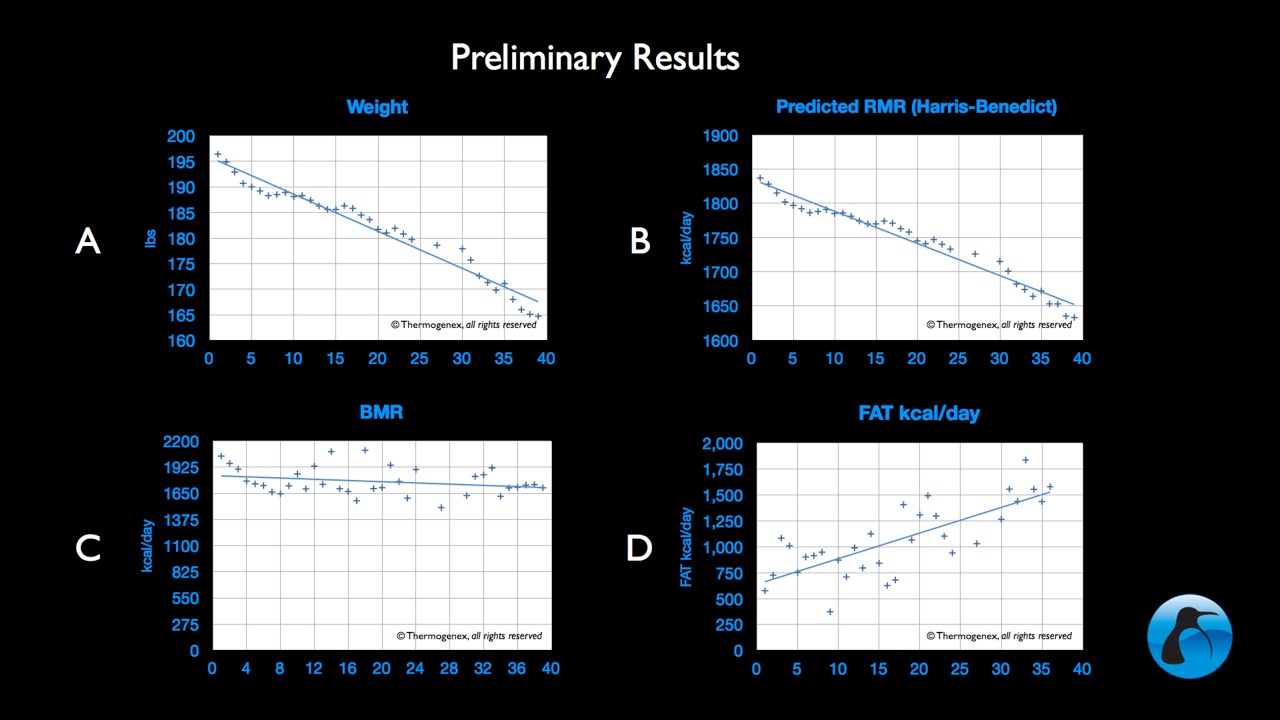
self test prelimToday I decided to plot some data, after all  I have to do is take needles and drink water and how much of that can one take?   I  exceeded my goal of 30 lbs today with 3 days of water left,  but it’s pretty exciting to share this with my blog followers.  If you are new to the blog, I highly recommend you stop now and go back to the Muscling Your Metabolism posts  and work your way though.  Once again, it’s respiratory quotient that everyone leaves out of the “broken metabolism” drama that is key to understanding what is happening.

Take a look at the graphs.  You see my weight loss (A) is is pretty constant and of course if one just goes by the RMR of the Harris-Benedict equation (B), it predicts a declining metabolism. Remember, metabolism scales with MASS not lean mass.  The bigger you are, the more calories you’ll burn.  It’s similar to the riddle, which weighs more, a ton of feathers or a ton of bricks? Likewise, whether you lug around an extra 30, 50 or 100 lbs of fat or steel all day long, it’s going to amp up metabolism. More on this in our next paper.

Okay, this is where the FUN begins.  As you can see (C) my BMR does drop over the first 8 days or so. Can this be the dreaded “starvation mode” that we are warned about? Will it crash to zero and cause me to balloon back to 230 lbs? What if I skip breakfast????  There is an ever so slight downward trend of BMR as you see in the linear curve fit, but as I have have often warned, the magnitude of metabolism is almost irrelevant.  Think of it like a business.  What do annual sales tell us about the health of a company?  Not much.  They could be making $100 million a year and losing $25 million a year in a slow (fast) bleed.  We need to see the balance sheet. Tell me about net income or EBITDA.

The same is true with metabolism and we need to know how the metabolism is partitioned between carbohydrate or fat so take a look (D).  Clearly my FAT metabolism is not staying level, in fact it’s zooming up. That’s because starvation mode is BURNING OUR RESERVES.  How simple can this be? I mean, why do we have fat anyway if not to burn it in times of caloric scarcity. As we point out in Metabolic Winter Hypothesis, that used to be an annual stressor. Now, winter never comes. We need to stop making things so difficult.

More Work To Do

I’m so excited by the results and it’s been an incredible journey and learning experience. There’s a lot more, but I wanted to share that with our community now and ask for your help.  I am raising $15,000 to help defer the costs of the testing and travel associated with this test. As well I’d like to begin the Open Source Body website development and design.  I am done self testing (at least for weight loss) as I intend on staying within my ideal weight from this point forward. I’ll finally put exercise back into my regular activity and continue to work with mild cold stress and calorie restriction to help define ways more people can practically adopt it into their lifestyle.


Hypothermics Donation

As always I am grateful to all of the regular donors, emails, FaceBook Friends, and  commenters for allowing me to pursue this passionately for the last 5 years.  It’s been such an unexpected adventure and there’s much more work to get done.   I’m going to get back to my water now – have to be well hydrated for that massive amount of blood to be drawn tomorrow morning.

Thanks!
Ray


References

Lee, Paul, et al. “Temperature-acclimated brown adipose tissue modulates insulin sensitivity in humans.” Diabetes (2014): DB_140513.

Valdés, Sergio, et al. “Ambient temperature and prevalence of obesity in the Spanish population. Di@ bet. es study.” Obesity (2014).


MetabolcWinterThe last year left enormous personal progress.  It’s been a difficult year in terms of time, but scientifically rewarding. There are many reasons people launch blogs. Some need attention. Others need authority. Then there are others that are bored.  Probably the most common are those that just want to make a contribution in an area that find passionate.  Health, fitness, and cooking are among the top blogs and there are many, often conflicting, opinions on the subject.  While people might “agree to disagree,” there are many opinions that are just wrong.

This blog really started, because Tim Ferriss insisted I put “something” up before our 4 Hour Body Nightline segment aired in late 2010.  I had no idea what direction my research would take at that point and certainly no idea how this blog would unfold. But make no mistake, I’ve had wrong ideas about the world

I’ve unintentionally held these wrong ideas throughout my science career.  Sometime it’s due to lack of data, the inability to see the picture clearly, which causes one to make a (wrong) educated best-guess.  Many times it’s simply a key element of information that is missing or present that skews opinion one side or the other of “correct.” More often than I care to admit, it’s because I blindly accepted something I read (ironically, just like you and this blog) and either didn’t care to verify what was said or I simply didn’t have the requisite background to see through the “trickery.”  Sometimes we are fooled, not merely by another author’s ignorance, but intentionally.

That’s not the spirit of science. The goal is to learn and of course we only learn when we are wrong about an idea. Simply repeating what we know isn’t learning – our view about the world must change to learn and hence those that haven’t given this any careful consideration might say, “these scientists, they are always conflicting, this week one thing, next week something else.”

Exactly. That is THE point. When our ideas conflict with what is observed in the universe, it’s not the universe that needs to be fixed.

The Emotion of Science

Recently a major milestone occurred with the collection of evidence that supports cosmic inflation theory.  A moment that’s repeated throughout time – a scientist’s ideas verified – was captured in this incredible video as Assistant Professor Chao-Lin Kuo surprises Dr. Linde at his home:

Did you get that?

“I always live with this feeling, what if I’m tricked? What if I believe into this just because it is beautiful…”

If you aren’t in science, this video portrays an emotion you might not be aware exists. Not to imply scientists are objective robots or blind to emotional trickery, but that what must be overcome is the human urge to find that beauty or pattern.  Before we push send, publish, or make the call, all good scientists have that queasy feeling and few put it into such eloquent and simple words as Dr Linde has here. That’s a different kind of beauty and it happened quite automatically in this extemporaneous interview.

Trying to chip away and find a nugget a truth in a noisy world is what drives many and while information is more plentiful than ever, blogs have unintentionally added  even more noise and created extra layers of difficulty. Who do we believe?

What if I’m Tricked

Two weeks ago one of several journal articles I’ve been working on was accepted. It’s finished peer review and I will update when it it publishes. Later in this blog you can help by donating to the Open Access Fee for the journal.   When I began my journey 5 years ago, I wasn’t doing a science project or an N = 1 trial. The goal wasn’t why I lose weight it was to simply lose it.  Soon thereafter, I was confronted with health issues that didn’t go away with the weight loss as surmised and that started me on yet another, parallel journey.

When Tim Ferriss asked if he could tell my story, I consented having no idea the magnitude of that agreement.  I had data only because that’s what I do by habit, not because I was trying to “prove” something.  As soon as one makes a claim that is unconventional, the “truth” police come out and one finds their ideas attacked. Much of it was nonsense that didn’t really deserve the rebuttal, but there was some honest criticism that was certainly welcome.

It necessitated digging in even further to demonstrate an idea I thought to be a simplistic and self-evident truth. Is it “out there” to suggest that it take more energy to maintain constant body temperature in a cooler environment?  I think most people reacted to this innate phobia of cold and it didn’t help that some wanted to summarize it as the “ice cube diet.” Either way, I needed good data – what if I’m tricked? In looking at the overall thermodynamics, mild cold stress was certainly important, but the thermodynamics of food was absolutely key.

There are a lot of smart people being “tricked.”  Thermodynamics is relatively sound and accountable – if one establishes the boundary conditions. My confidence was not born out of hubris, but because I had some of the greatest minds on my team. Richard Feynman said it best,

There is a fact, or if you wish, a law, governing natural phenomena that are known to date. There is no known exception to this law; it is exact, so far we know The law is called conservation of energy; it states that there is a certain quantity, which we call energy, that does not change in manifold changes which nature undergoes. That is a most abstract idea, because it is a mathematical principle; it says that there is a numerical quantity, which does not change when something happens. It is not a description of a mechanism, or anything concrete; it is just a strange fact that we can calculate some number, and when we finish watching nature go through her tricks and calculate the number again, it is the same.”

Our problem is understanding “nature and her tricks.” When our ideas don’t conform to the universe, it’s our ideas that need reformed. Some might make the absurd claim that obesity is proof that the conservation of energy is wrong. I’m betting the error happens when we “calculate some number.”

Fast forward to the review article that is about to publish. In it, we make an argument for a metabolic winter hypothesis. My collaborators are two esteemed researchers.  I am not saying this for an empty “appeal to authority argument” (attack logic flaws when one doesn’t have their own data is the vogue approach taken on many blogs these days), but out of genuine respect for both of them.

Dr. Andrew Bremer was at Vanderbilt Children’s Hospital serving as a pediatric endocrinologist and professor of medicine at Vanderbilt Medical School when we met.  Last November, he was tapped by the National Institutes of Health to become the Director for Type 2 Diabetes Prevention and Treatment Research and Digestive and Kidney Diseases Medical Officer.  Many of you know his work already if not by name, as he’s a co-author and first author on many of the fructose/endocrinology  articles by Robert Lustig.  He’s a PhD/MD and his publication record is phenomenal.

When I began describing some alternate explanations for the etiology of metabolic syndrome and obesity, he listened and ultimately it changed his perspective. He too, is not beyond being “tricked.”  He’s also an incredible mentor and researcher and I’ve learned so much from him in the process.  He was able to put aside things he was taught in medical and graduate school to explore new ideas. We now have a lifetime of future work to do after securing funding. When we originally met during one of my children’s office visits, I had no idea who he was and he asked me if I’d mind reading a paper he’d recently published.  Later that evening I was shocked to read it and a week later got the nerve to ask him about potential collaboration on my project.

My second co-author, Dr. David Sinclair, is at Department of Genetics Harvard Medical School and Department of Pharmacology School of Medical Sciences, The University of New South Wales, Australia.  He’s one of the world authorities on longevity, in fact voted Time Magazine’s Top 100 Most Influential People a few weeks ago.  He’s probably one of the people most responsible for the last few years of my exhaustive research. He is also an incredibly well-published author and most recently his paper in Dec 2013 Cell on NAD/HIF-1α has taken another critical step towards untangling the web of aging.

Like Andrew Bremer, I had no idea who David Sinclair was when standing in line the first day of TEDMED 2009.  He overheard me talking to another person in line and joined in the conversation.  He was very certain that mild cold stress had more application than just weight loss and really encouraged me to think very differently about the problem. Later, when he got up on the TEDMED stage  for his talk, I was shocked by just how much of an authority on the subject he was.  The entire TEDMED experience granted me the opportunity to brainstorm with top scientists – people I certainly would have never had access to without this event.

We continued our conversations and even picked them up the years following and he kept encouraging me to push.  There was, and still is, so much I don’t know about longevity, but he’s on top of it and it is a huge advantage to have someone like this on a collaborative team.

Together, we were able to create a fantastic multi-disciplinary team to tackle this first review and others are in preparation. Unfortunately I was drinking from a firehose and it took many hours to digest the several thousand papers, couple hundred textbooks, and do my own self experiments in the lab. These guys are way ahead of me and still are on so many facets of our research.   The blog wasn’t the top priority. I apologize for the absence, but it’s important to have an influence on the other publication machine that pushes all ideas forward as well.

Confidence in Nonsense

So this brings up the question we need to all ask ourselves about the things we repeat every day.

How do I know?

I ask myself this question all the time. Who did it come from and how do they know? Science investigation and curiosity has permeated my entire adult life and I think that begins with the natural curiosity of all children. I guess I just didn’t grow up. I’ve had the privilege to work with some of the most innovative, bright minds in the world. It’s help me to develop an arsenal of tools and disruptively innovate in many different industries. Attending various scientific gatherings allows me to work with others that disrupt and that moves everything forward. It also keeps me honest, people are quick to point out when I’m being tricked.

Konrad Dannenberg (original German Rocket Scientist) talks with Burt Rutan the morning after the successful SpaceShipOne first launch. I took Konrad to the launch that year. My all time favorite picture of two heros.

Konrad Dannenberg (original German Rocket Scientist) talks with Burt Rutan the morning after the successful SpaceShipOne first launch. I took Konrad to the launch that year. My all time favorite picture of two heros.

One of my mentors in creativity, Aerospace Maverick Burt Rutan, says, “you have to have confidence in nonsense If you want to innovate.” Rutan is arguably one of the most innovative aeronautical engineers of the past 50 years. Rutan adds, “an innovation is by definition something that half of the people think is impossible, and half say, well, maybe it can be done.”

Rutan knows innovation—he was the first to fly around the world nonstop without refueling. He was first to launch a privately funded spaceship, winning the $10 million Ansari X Prize. He joined forces with billionaire entrepreneur Richard Branson to build the first private suborbital spaceship for Virgin Galactic’s launch into space tourism. His very success in all these projects was a result of breaking all the rules and letting his goals define his approach. How else does one come up with an airplane design as unconventional as the Boomerang.

Aviation has certainly advanced over the years. Let’s focus our attention on the year 1894. Two significant, separate innovative events occurred – 120 years ago.  Karl Benz introduced the Velo, becoming the first production automobile and that very same year Wilbur Olin Atwater published the USDA’s first Bulletin on the Nutritive Value of Food.

What has happened in the intervening Century in Food Science versus Transportation? On the transpiration front we blew past trains, automobiles, airplanes, sound barrier and spaceships! Space is on the verge of privatization – companies I co-founded in the 90s have flow over 10,000 people in weightlessness (gozerog.com) and 7 people to Space Station (Space Adventures); one flew twice! Humankind has walked on the moon and sent probes to other planets and even out of our solar system! We’ve made huge progress on the shoulders of visionary, disruptive innovators. Today, the entire U.S. access to space rests on the work of PayPal founder, Elon Musk, and his company Space-X.

Now consider how much progress have we made in nutritional health as it relates to food science since the 1894 with introduction first USDA nutritional guidelines? Not very much. Our nutritionally driven chronic diseases have become MUCH worse.  Having now researched metabolism and nutrition reaching all the way back to Hippocrates (460-377 BC), I can certainly say that any one of the 19th century great nutrition researchers, Atwater, Rubner, von Voit, etc… would readily recognize and not be too terribly surprised by a modern day diet book. We are still obsessed with juggling mythical ratio of “proteins, carbohydrates, and fats” something I would argue is a somewhat irrelevant and certainly a dated way to look at food. We simply heap lots of multi-syllable organic chemistry, endocrinology, and molecular biology words onto these antiquated and overly simplistic organization of foods. It’s like strapping explosives onto a Velo with the idea that will take us to Mars.

What do you think Mr. Benz reaction would be sitting in a Mercedes SLS AMG GT as compared to a Benz Velo?  I’m certain that Lavoisier would be impressed with the simplicity of running a calorimetry experiment in my lab – vous appuyez sur le bouton?  Mais, c’est incroyable! But the data we collected would not differ significantly from what he knew to be true as I describe in Muscling Your Metabolism (part 1). How do I know? because I repeated it and generated numbers that were very close.

I am not suggesting we’ve made no progress in molecular biology, genetics, or physiology, but our ability to treat chronic disease through nutrition or public information about food is an utter failure.  The average walking around advice for diet and exercise is broken and most diet books are written by people that couldn’t possibly have measured many metabolisms.   Most importantly our relationship with food is broken. Nutritionism is broken.  Worse yet are the industry authorities and blogs that repeat unsubstantiated “facts” over and over again – insanity through inundation. I was guilty of the same thing not too long ago, but for the last 4 years, I haven’t taken anything at face value.

A Good Skeptic

In areas of food and metabolism we are inundated by an inordinate amount of untested hypotheses and anecdotal evidence. To be sure, the diet and fitness industry is loaded with R&D (rip off and duplicate), but where are the people with what Rutan calls “confidence in nonsense?” Does anyone else notice the sheer-volume of myths and urban legend that permeate every level of our daily discussion of food and nutrition?

I am not alone in this opinion.

In the January 31, 2013 issue of The New England Journal of Medicine article, Myths, Presumptions, and Facts about Obesity, the authors had this to say:

Why do we think or claim we know things that we actually do not know? Numerous cognitive biases lead to an unintentional retention of erroneous beliefs. When media coverage about obesity is extensive, many people appear to believe some myths (e.g., rapid weight loss facilitates weight regain) simply because of repeated exposure to the claims.

Cognitive dissonance may prevent us from abandoning ideas that are important to us, despite contradictory evidence (e.g., the idea that breast-feeding prevents obesity in children). Similarly, confirmation bias may prevent us from seeking data that might refute propositions we have already intuitively accepted as true because they seem obvious (e.g., the value of realistic weight loss goals). Moreover, we may be swayed by persuasive yet fallacious arguments (Whately provides a classic catalogue) unless we are prepared to identify them as spurious.

Wilbur Atwater's notebooks from the late 19th century and my Moleskine as I poured through archives of his  work.  Incredible to look through them knowing how the story ends.

Wilbur Atwater’s notebooks from the late 19th century and my Moleskine as I poured through archives of his work. Incredible to look through them knowing how the story ends.

This pretty much sums up my existence and excitement over the last 5 years. It is amazing to be able to walk out of my kitchen and into a lab to test dogma, spend days reading historic old textbooks, and visit locations where past and present ideas about our bodies and nutrition were born.

I decided not to take anyone’s opinion for granted and invested in my own laboratory. I have what you might call a scientist’s mid life crisis indirect calorimeter instead of a sports car. It’s allowed me to carryout experiments in an attempt to separate fact from fiction. We all need to be a little more skeptical, but at the end of the day the truth is in what is demonstrable and repeatable.

Much like the words protein, carbohydrate and fat, metabolism is another word that’s bandied around and in some sense has become meaningless. Do we all have slow metabolism? Does muscle burn more than fat and by how much? What happens to our metabolism if we skip meals? I have tried to answer some of these questions in previous posts and more informations is coming.  It’s my hope to help people see through the inundated insanity.

An Incredible Opportunity

I think many people overlook one of the best points in The 4 Hour Body. You can dismiss the individual ideas, or even dismiss the author, but there is one part about the book that rarely get’s highlighted and can’t be dismissed, the Appendix. So many love to read “freeze your ass off” sensationalism into the chapter on my work or imagine themselves as the modern day version of Woody Allen’s Ograsmatron, but I say dig in on pages 484-510 if you want to see what motivates me on a daily basis. That is the meat  of the book (cruciferous vegetables didn’t have the same ring) and that is why I agreed to allow my work to be featured. Tim does understand the world of self-experimentation.

It doesn’t matter if he is right or wrong about any of the chapters as long as he’s pushing the envelope, measuring, and aggregating data. I think his “confidence in nonsense” is a good contrast to a century of metabolic stagnation. If you want to see a glimpse at just how powerful this idea self experimentation can be, watch this TEDMED presentation by Jamie Heywood:

We are sitting on an unprecedented opportunity – the aggregation of N of 1 data that eclipses the expensive and slow clinical trials that now dominate science. These are necessary and will still go on, but I can’t imagine there’s much “confidence in nonsense” taking place in most funded proposals today. Conservative claims and reach has become the mainstay of academia.  Science isn’t halted and we still have plenty of risk takers, but the preponderance of funding is placed on incremental progress.  You have the opportunity to collect data – technology has never been more accessible. We have the opportunity to ferret out what’s right and wrong, and avoid focus on who.

Let’s all be more skeptical and open minded. They aren’t mutually exclusive efforts.

Copies of  Our Paper

One final request.  The open access fee for the journal, allowing anyone to download it without charge, is $3200.  I know many of you contribute monthly to the blog and I very much appreciate it. I am asking that you make a one time donation to help me defer that cost of 0pen access publication. Most don’t donate, so this is one of those few times I’ll ask you to think bigger.

If the fancy button doesn’t work, try this old-fashion hyperlink.

I will make sure to update everyone when it is available for download and if I can raise the Open Access fees, everyone will be able to access it.  This is just the foundation and I have conducted a lot of experiments in my lab that aren’t directly publishable, but give us a good idea of what to look at in future clinical trials and proposals.

After this series of review articles has made it through the peer review process, I’ll likely publish the book I’ve been researching for a couple of years. The notes and references are all in place as is the table of context and many chapters.   In the summer I will be announcing a crowd-sourced fund for another set of self-experiments I intend to do in late August and will need to raise money to cover the extensive cost of lab work and extended travel time  in the NYC/Boston area near my science collaborators.  This is all directly related to surprising things I learned last summer in my own lab.  I’m sorry again about the delay in sharing results, but so many things get duplicated (unattributed) these days that I really need to get the publications in first and that process is unfortunately slow.

I hope everyone understands.

I have the outline for another summary blog that goes over the many related publications that have come out in the last couple of months that support The Metabolic Winter Hypothesis and will put it up when the paper is released.

As always, thanks for your support, ideas, questions and participation.

Ray