Currently viewing the tag: "mild cold stress"

kickstarter, Our Broken Plate, Skip a meal and your body will begin to hold onto fat. We should eat frequently to keep our metabolism up (ugh-I said this all the time). The most important meal of the day is breakfast. I’m not getting all sciency today. I will ramble a bit.  We’ll talk at a much higher level. There’s been a lot of reductionism in nutrition and metabolism and it is spreading fast. While the internet has provided unprecedented access to information, it’s also allowed a lot of science babble to infiltrate every subject and diet has to be the gold medal champion. Everyone eats so we all must be experts.

I hear of quantum physics and love from people that don’t know the schrodinger equation or a microcanonical ensemble exist. Their “frequencies resonate.”   It’s widespread co-opting of science terminology to make things sound more well thought out and factual than they really are. In science, we celebrate the unknown. We don’t know how to define the emotional and it’s handled in the soft sciences.  They see trends, but science looks for fundamental rules that govern how things work. 2 + 2 = 4 is a mathematical relationship and as amazing as may sound, it’s true whether here or on voyager spacecraft that’s left our solar system.  If you have two marbles and your travel mate has 2 and  put them in a bowl  there will be 4. We have other scales and mathematical tricks that can make this equation an inequality, but in normal counting, it’s true and can be verified.

In 1996 Carl Sagan wrote a fantastic book, Demon-Haunted World. In it he warned (foreshadowed) a reality of the future:

” I have a foreboding of an America in my children’s or grandchildren’s time — when the United States is a service and information economy; when nearly all the manufacturing industries have slipped away to other countries; when awesome technological powers are in the hands of a very few, and no one representing the public interest can even grasp the issues; when the people have lost the ability to set their own agendas or knowledgeably question those in authority; when, clutching our crystals and nervously consulting our horoscopes, our critical faculties in decline, unable to distinguish between what feels good and what’s true, we slide, almost without noticing, back into superstition and darkness…

The dumbing down of American is most evident in the slow decay of substantive content in the enormously influential media, the 30 second sound bites (now down to 10 seconds or less), lowest common denominator programming, credulous presentations on pseudoscience and superstition, but especially a kind of celebration of ignorance.”

He went on to say,

“We’ve arranged a global civilization in which most crucial elements profoundly depend on science and technology. We have also arranged things so that almost no one understands science and technology. This is a prescription for disaster. We might get away with it for a while, but sooner or later this combustible mixture of ignorance and power is going to blow up in our faces.”

While that sounds all a bit cynical, I really am using it to give us a nudge. We need to be skeptical, but sifting and sorting through the blogs, diet books, media, and social discussions is a daunting task for even the best educated. There’s a saying that a specialist knows more and more about less and less until they know everything about nothing. Conversely, a generalist knows less and less about more and more until they know nothing about everything. We all fit this to a degree in some aspect of our lives.  Clearly the internet and media echo chamber has spoken on starvation mode and it’s doom and gloom if you don’t eat.

A Closer Look

Here is one example quote I found with a Google search that is quite interesting:

“Quite simply, your body goes into ‘starvation mode’. This mechanism, which is thought to have evolved as a defence against starvation, means the body becomes super efficient at making the most of the calories it does get from food and drink. The main way it does this is to protect its fat stores and instead use lean tissue or muscle to provide it with some of the calories it needs to keep functioning. This directly leads to a loss of muscle, which in turn lowers metabolic rate so that the body needs fewer calories to keep ticking over and weight loss slows down. Of course, this is the perfect solution if you’re in a famine situation. But if you’re trying to lose weight, it’s going to do little to help you shift those unwanted pounds.”

Let’s talk about basics. Fat is a storage organ. It is there for times of famine. The body constantly taps into this storage organ when we enter the fasted state (~4-6 hours after a meal). So here is what they are saying, in a nutshell – if you don’t eat the body holds onto the back up reserves.  That’s backwards thinking.  Further, it’s posited that the body will instead use lean tissue (from muscle/organs) and accelerate that loss – all to preserve our fat storage organ.

Reflect on that for a minute.

Why would the body hold onto this precious fat storage and instead cannibalize our vital organs and muscle tissue, because of food scarcity? How might that helped the evolutionary process? Seems to me that those who digested their heart or leg muscles before using fat reserves when there wasn’t any food wouldn’t have jumped into the gene pool with all the vigor as those of us that actually lived on our storage organ. Don’t you think? I’m imagining the number of people it took to build the pyramid stopping 3-6 times a day for a quick pick-me-up. Don’t you think they tossed them some water and said, “keep chiseling! pull the rope” and perhaps they ate some bread etc… a little later?

Now, the body absolutely has some adaptive changes to accommodate food reduction. There are metabolic shifts and changes in how we use fuel.  I learned last year that even after 30 days of a VLCD followed by a medically supervised 14 distilled water fast I wasn’t deficient in anything.  I don’t want to cloud the discussion with ketosis, fat adaption, etc… as it’s all somewhat tangential to the main point. Let’s for a minute put aside the debate over metabolism havoc. Let’s acknowledge we can’t explain everything and yet our bodies managed to get you right here staring at a screen from a single cell without help and perhaps in spite of what we swallowed. It’s remarkable.

When in the fasted state we use reserves. That’s why they are there. Fat and glycogen are long and short term (respectively) storage organs. You’ll be fine on the 4 hour flight without peanuts.

Magic Meals

Last year when I was coming home from the self-experiment, my daughter and I decided to stop in Vegas and visit with Penn & Teller.  I have known them for over 20 years and we hung out after the show. I’ll leave the bigger story for Penn to tell in his spring 2016 book, but he called me later and asked for help. Maybe you’ve seen the news by now, but essentially he lost a little over 100 lbs, most of it in a three month period we worked together. He’s off 8 BP meds and in fact his medication is down to almost nothing now. You can listen to us discuss this on his Penn’s Sunday School podcast here or download it on iTunes.

He’s looking and feeling great. While the media likes to toss around “1000 kcal/day” diet (or gastric bypass), he has no idea how many calories were consumed. I don’t either and as I will be explaining there are much better ways to think about food energy conservation that are not only predictable, but also repeatable.  Then there is the echo chamber – read this article and imagine that this otherwise well-educated physician makes all these WRONG diagnoses based on information in People Magazine. What physician or scientist uses People Magazine as a primary source and then does an analysis? This is how the echo chamber works.  I’d challenge his notion that nutrients are somehow deficient because he was at a caloric deficit. I wonder how Dr Ayoob would explain the successful results of this 382 day water fast (and btw, he didn’t gain it back)?

Speaking of Fast…

Today happens to be the 5 year anniversary of my TEDMED talk that slipped me into this entire world of food. I had no idea this was coming and if it hadn’t been for Tim Ferriss urging, I wouldn’t even have a website. I didn’t do this for a business. It was an intellectual curiosity.  My friend Tim Jenison had an amazing project I helped on back in 2009 that became the inspiration for my research. If you haven’t seen Tim’s Vermeer, it is a REALLY great documentary.

I was staying with him and beside the bed on a shelf were stacks of history and art books about Vermeer. Tim, as you will see, was obsessed with how this artist did these incredible paintings. Vermeer captured on canvas that which the eye can’t see.  The movie tells the rest of the story and I have my tiny appearance with our 2am decision to start building walls for the room – look for the forklifts scene. After The 4 Hour Body came out there was a little backlash about the veracity of my work. Keep in mind, I did the cold stress work, because I was desperate to lose weight. It wasn’t a research project, but I did jot down notes as it’s habits for me.  That was the seed that went into 4HB and you can read the rest elsewhere on this blog.

What puzzled me was still the Calorie and the apparent contradictions. I wasn’t buying the Good/Bad or even the “high fat/low carb” (or any variation thereof) dogma.  I wanted to understand it.  Well, I did as my budget would allow to dig into this project like Tim.  Having a midlife crisis calorimeter in a lab adjacent to the kitchen is a great way to test anything you want about food.  I learned a lot and especially that most of the older studies were easy to reproduce. I don’t think they are wrong, but I believe a lot of things we repeat, that  I repeated, aren’t correct. You all know very well by now that I don’t think “protein, carbohydrate, or fat” serve us anymore as food groups/categories.  We need a new paradigm.

FullSizeRender-1Today is day 16 of a medically supervised 21 day water fast for my book.  I feel fine and perfectly normal (as normal as I get). Hanging out with new and old friends here, reviewing 5 years of research and writing.  I may have to go out to 24 days depending on how some tests turn out at the end (more in future blog or book). As I mentioned, I wasn’t deficient in anything last time at day 14 and I performed a midpoint blood panel (~$1500 each) to see how well that tracks my last fast. Of course I will do a blood panel at the end.

This time I am focused on “muscle loss” particularly urinary nitrogen. As we learned in Passing the Protein (part 1, part 2), urea is the metabolite of amino acid metabolism and so one can track loss by collecting 24 hour urine samples. We need the indispensable amino acids (~9 of 20 depending how one counts them – not 2 +2), the rest we make. It’s been 2 weeks of drinking water and peeing in a jug.  This will supplement the dexa results from last year and give a more complete picture. If all else fails, I guess it’s training for the reality show, Naked and Afraid.

Take a look at my results above and what you’ll see, like last year, my metabolism is fine. It’s not crashed, but scaled with my mass and my fat burn is through the roof.  Yes, as evolved, our body actually uses our fat STORAGE organ in times of no food. That’s not a difficult concept, but wow, is there a lot of confusion. I want to try to nudge this. I’d like to change the dialog.

Cool not Cold

I don’t want to sound opportunistic, but you may have read about the recent tragic death in a Las Vegas cryotherapy spa. It is a horrible loss to her family and they have my condolences. This is probably an isolated incident, but nonetheless it’s an opportunity for me to reiterate my position. As anyone that follows this blog for a while knows, I am an advocate of mild cold stress not extreme.  One does not need to go to extremes to get the benefits of cold therapy.  If you are new to the blog, use the tags at the side and you’ll be able to navigate to the many posts that discuss this.  Mild cold stress begins in water temperatures below 80F (26C) and air temperatures below 60F (15.5C).  There is no reason to go below 60F(15.5C) water or 32F (0C) air.  Generally speaking one can get all the benefit they need from just a 10 degrees or so on the thermostat or to carry layers and use as needed.

Ideal temperatures are 75F (24C) water and 55F (13C) air.  These are the most comfortable and are likely plenty to get the beneficial impacts.  Remember the “reverse ski layering” strategy – take them along and wear as needed instead of leaving the house bundled and losing layers throughout the day.  A quick walk from the office parking lot to the front door won’t likely result in hypothermia. It’s fall in the northern hemisphere and we are naturally adapting to the cooler temperatures. The photoperiod is also getting shorter.  These are all biological cues that signal winter is coming (wow has that phrase changed meaning in 5 years). As we explain in the Metabolic Winter Hypothesis, the combination of sleep, dietary restriction and mild cold stress may have a synergistic effect with activation of the sirtuin genes – those that we have shown in animal models to increase healthspan/lifespan. Contrast showers can aid in this adaptation process and it’s helpful in sleep.

As well my close friend, Wim Hof, has been on many blogs lately and I don’t want this to sound contradictory to what Wim teaches. His main message is what our body is capable of doing with training and that he’s not a unique superhuman (I’m still impressed). In fact, when I visited him a few years ago in Amsterdam, he noticed one day that he wore a jacket on our walks to the grocery store and I had a t-shirt and gloves. In his warm laugh and great accent he said, “look at that. The iceman has a coat and you are in a t-shirt.” We opened the windows that evening and slept amazing. He was grateful for reminding him that he’d been locked up in the apartment.  Wim is pushing science to go past the handed down dogma on extremes and human limits and he’s doing amazing work with the autonomic immune system.  I don’t want this to be misunderstood.

Kickstarter- Our Broken Plate

our broken plateIn the next week I will be launching a kickstarter campaign for my book, Our Broken Plate (update: Campaign went live on November 1st and closes on December 13th). I’ve had a lot of requests over the years to write one and so it is now a “done deal.”  I’ve had some discussions with publishers, but feel that I can be more true to my message if I at least write it first as a cohesive story. Honestly, they all want me to write a diet book and that may be way more successful, but I don’t want to write a diet book.  My goal was to examine how our social relationship with food changed over the last two centuries.  It’s been fascinating to  pile my own shelves full of old books and especially be emerged in the the 19th century when all the fun happens. By 1920s we are on a trajectory to where we find ourselves today. It’s surprising that many scientists predicted, and even warned about this situation.

There are no villains. It’s not an evil government conspiracy as many of the recent books have put forth. There’s no greedy corporate America that is just trying to kill us all with genetically modified food.  We don’t discuss big pharma or  big farms. It’s not a “fat vs carb” or eat meat/don’t eat meat story.  It’s not a textbook as we’ve already made food way too complicated. The book is more of a history-mystery with my self-experiments juxtaposed on some of the great science on metabolism and nutrition. I’m going to stretch it a bit in places with new explanations for old data.  I find it ironic that many of the players of the late 19th century would be perfectly comfortable, and to some extent know more, in a discussion today about metabolism then as it plays out in the blogosphere. We’ve forgotten so much and this valuable data is lying fallow on university bookshelves and used book stores around the world. I’ve collected some of the best and for me holding that 170-200 year old book in my hands and reading it is incredible. I don’t think we are all broken as is so widely claimed. To me it’s our relationship with food that’s broken.

I plan to finish the book in the coming months and hope to have it published by April 2016. We’ll have a crowd-sourced cover design and many other activities. I’ve learned so much from the people here and on the various Facebook groups. The questions have been fantastic.  Having worked now with over 100 people one on one has been a real eye opener. If there are any subjects that you’d like to see covered (the book is pretty far along at this point) please comment below.  I may not be following up as closely as normal as there’s lots of testing to do and I have my kickstarter campaign staring me in the face.

I appreciate your support and thank you for hanging in here even when there were extended times I had nothing to say. Perhaps this research project will make up for it.

In addition to the kickstarter (there are a couple of high end rewards, but most are books)  I’d like to immediately raise $5,000 to help defer the costs of the testing and travel associated with this test and as a jump start to the writing project. I appreciate your support! You can use this link or the one above near the goal donation meter.


Hypothermics Donation

As always I am grateful to all of the regular donors, emails, FaceBook friends, and  commenters for allowing me to pursue this passionately for the last 6 years.  It’s been such an unexpected adventure and there’s much more work to get done.   I’m going to get back to my water now.

blood testsIt’s hard to believe that this is only my second post for the year.  Where did it go?  I’ve not been sitting idle. First,  a big thanks to ALL of the people that contributed to the open source fund for the Metabolic Winter Hypothesis paper.  Not only did we reach the goal in under a week, but the paper has been a huge success. It broke all download records for the journal and remains their number one downloaded paper.  Thank you for helping and thank you for sharing it with so many people.

I am currently working with the collaborators of the first paper, along with an expanded set of top notch new collaborators on the second and third paper.  These will go much deeper into the issues of metabolism, Calorie, and assorted myths that we (yes, me too) have propagated during our quest to be the most obese human generation of all time.

Of course it can be said in a simple summary: “protein, carbohydrate, and fat” – speak  doesn’t tell you much and you can’t out-exercise your mouth.

Today of course, one would believe weight loss and health requires a degree in molecular biology, but I can assure you that there are millions of words propagated in thousands of blogs by people repeating, not measuring.  I don’t intend on wasting your bandwidth here and that requires a not-so-profitable diligence to do science first and promote second.  For this I appreciate your patience and support.

But it is FALL!

At least in the northern hemisphere and that means mild cold stress season.  Let’s take a few minutes to talk about some great papers that published in the last few months and some practical tips for easing into metabolic winter and getting the most out of  it. Rather than plunging into shivering water or eating buckets of ice, it’s more important to focus on achieving mild exposure over longer durations.  As the summer ends, we are warm adapted and we  have an exaggerated response to cooler temperatures.  65F/18C might very well seem cool in the middle of the summer, but in the middle of the winter coming in from a ski run that same temperature is comfortable and warm.  I explain more in Ch-Ch-Changes (you need to be a registered user to see archives – it’s free and I don’t send you junk mail to buy stuff).

The take home summary here is that we don’t really sense/judge absolute temperature very well and we can become accustomed to a warmer/cooler environment without much effort; this isn’t akin training for a marathon.   One IDEAL way to become more accustomed to the warm-cool “shock” and acclimate is through contrast showers.  I highly recommend these to everyone getting started.   Check out Mitochondrial Anarchy for details on why, but I’ve included the photo here if you just want to jump right in.

As we explain in Metabolic Winter Hypothesis, there seems to be a strong interdependence with mild cold stress, caloric restriction, and sleep.   These not only impact higher level interaction like found in the HPT-Axis, but also seem to play a strong role at the cellular biogenesis level.  It seems that our circadian clocks are intertwined with both the season and energy management.  That’s not a surprising idea, but we currently seem to be one seasoned in our approach to health: bright, active, and warm.   For example, it’s well known that Seasonal Affective Disorder may be addressed by bright light therapy (thinkla spring/metabolic summer) and yet widely unknown that cold stress can have similar results.  The question one then brings up: is it too little light or too much warmth that is causing the problem? No one can answer for certain, but our  “fear of cold” learned response is to reach for the bright, happy light.  We do the same thing with the “fear of hunger” and sugar, salt and fat.

Not everything we crave is necessarily what we “need.”  Alcoholics and heroin addicts are just two examples of this change from have to have not that inserts a craving that is neither healthy or natural.   We see  it’s the sudden change that seems to rock the boat and contrast showers are one way to not only mute your response to that change, but further to begin an easy, comfortable adaptation to the lower temperatures ahead.

Una Siesta Fresca

We discussed in Beauty Sleep the wonderful advantages of cool sleep and some scientists at National Institutes of Health (NIH) , National Institute of Diabetes and Digestive and Kidney Diseases have beautifully demonstrated this in a recent study.   Impact of Chronic Cold Exposure in Humans (ICEMAN) is a bit misleading (everyone wants to make it sound extreme), looked at 5 men ranging in age from 19-23 and looked at metabolic response.  Over a 4 month period they were subjected to sleeping in rooms that varied from 66°F (19°C) and 81°F (27°C). Daytime activities were normal.  BAT and metabolism was measured at the end of each month and researchers concluded that the warm, 81°F (27°C), suppressed BAT and metabolic activity, while the mild cold 66°F (19°C) increased the men’s BAT and metabolic rates.

Figure 1 Map showing the 100 clusters included in the study grouped according to their mean annual temperature.  from S. Valde

Figure 1 Map showing the 100 clusters included in the study grouped according to their mean annual temperature. from S. Valde

A second study that I haven’t seen reported much was conducted by researchers in Spain.   They found, after adjusting for lifestyle (physical activity, Mediterranean diet score, smoking) and socio-demographic (age, gender, educational level, marital status) that a clear association in obesity with mean annual temperature existed.   The first question many ask me when I discuss my research is, “well, why aren’t people fat in that live in cold climates?” I typically respond, because we avoid the cold by layering and ubiquitous warm shelter and transportation. What is interesting about this study is that it’s somewhat a homogeneous culture and diet and the temperature range is 10.4-21.9C (50.7-71.4F).  This is a perfect span of mild cold stress – reinforcing the point I always make here (and yet the media NEVER quotes me correct on) extreme is not necessary.  Cool, not cold is the best approach.  This was a final sample size of 5061 men/women and there is clearly a significant trend.

From the warmest to the coolest quartile, obesity prevalence rose from 26.9% (Q1)…30.5% (Q2)…32% (Q3)…33% (Q4).  I think these both underscore the power of mild cold stress and also reinforce the metabolic winter hypothesis.  I doesn’t take much over a long time to make a huge difference. As well, lipids are likely prefered in non shivering thermogenesis over glucose, conserving precious glucose to fuel red blood cells (they have no mitochondria and can’t metabolize lipids or ketones).   If you ever see my name associated with an article or quoted in one that discuss crazy cold stuff, please know right then that I told the journalist, perhaps pleaded with them, to not make this article about extreme.  They rarely listen, but just know I NEVER have a conversation with one that I don’t emphasize that point.

Gloves before sweater makes you look better – cover your symptoms of cold (nose, face, ears, feet, and hands) first and carry layers with you.   Layer as needed and don’t layer and remove.  Use caution in long duration exposures and don’t fool with water temperatures below 60F (15.5C) or air 32F (0C).  Be safe as you can have a big impact without resorting to epic extreme.

Open Source Body

Besides writing, one of my main activities the last couple of months was setting up a non-profit 501(c)3 foundation to fund continued research.  Having selected a founding board and kicked it off with an initial investment, it’s underway.  We’re working on setting up a website and establishing a working relationship with several other organizations.  We have the founding board in place and are actively seeking our science advisory board.

Our Mission is simple:

osb logoWith worldwide pandemics of chronic disease and obesity, Open Source Body is a network created to facilitate the collaborative research that might halt or reverse this trend. All data submitted or research paid for by OpenSourceBody.org will be available for public access.

The mission of Open Source Body is to extend the successful open source efforts that fueled the internet revolution to areas of health, fitness and nutrition. We operate under the simple principle that good health can be found in every body.

I am encouraged by the participation and support you have given me and I think this can be scaled. The internet is loaded with blogs that preach health under a never ending drum beat of selling supplements, plans, and you name it.  I’m certainly not against anyone making a living, but it doesn’t play well when they turn out to be wrong and have an entire business built on a house of cards.  That ends up in senseless attacks or bullying and really, I don’t want to participate in this sort of fiasco.   We only learn when we are wrong – every good scientist understands this.   What I seem to encounter more often than not on blogs are people with science backgrounds that just repeat, repeat, repeat. The story is now down to such a reductionist level that one needs a degree in molecular biology to keep up or go grocery shopping. It appears to be a never ending contradiction to the public.   This ever increasing techno talk bodes well as people end up being easily bamboozled with techno-talk.

Carl Sagan had this to say:

“One of the saddest lessons of history is this: If we’ve been bamboozled long enough, we tend to reject any evidence of the bamboozle. We’re no longer interested in finding out the truth. The bamboozle has captured us. It’s simply too painful to acknowledge, even to ourselves, that we’ve been taken. Once you give a charlatan power over you, you almost never get it back.”

So rather than rant more about this, I want to do something proactive to make a difference and my first self test is under way.  I’m trying not to be tricked and I know the human brain, more importantly my brain, is biased to patterns.  It’s tough to escape it, but with good measurement it is possible.   About a year ago you might remember I did a small, 6 week self test and it was an incredible success with some unexpected outcomes.  Knowing I didn’t have enough data to fully capture what was going on, I decided to repeat it and up the ante a bit.  I have a team of researchers that helped me design and carry out this test and it’s been pretty damn exciting.

SelfTest.012To start, I gained (0ver 3 months) 15 lbs and held that weight for over 2 months before I began. I have been weight stable for nearly 6 years outside of the couple of short experiments I did over a year ago.  That stable weight was  about 20 lbs above my ideal weight.  The goal was simple: track it all and lose 30 lbs in 6 weeks without exercise or supplements and test some of the fundamental notions of the “nutritional emergency/deficiency” everyone seems to bellow on about in an endless onslaught of advertisements.

I began the Phase 3 on November 8, coincidentally my 50th birthday, and as of today I haven’t eaten for 11 days.  Over the weekend, we did full amino acid profiles every  4 hours over 24 hours.  I look like a junkie with track marks in both arms and both hands. It required me to pack my lab and drive 2400 miles to California. I’ve measured my metabolism daily throughout this 6-week test and despite losing 30.3 lbs already and not EATING for 11 days, my body is not going into “starvation mode” >gasp<, which is oft reported by fitness, blogs, and media (and researchers, physicians and dietitians).  I suspect most that proclaim these metabolic doomsday have likely never measured a single metabolism in their lives; they might not even know a person that has.   Am I a genetic freak? I’m not betting on it as my data matches almost identically the results of the great scientists of the 19th century that studied this subject back when this was actually cutting edge research.

There are too many repeaters.

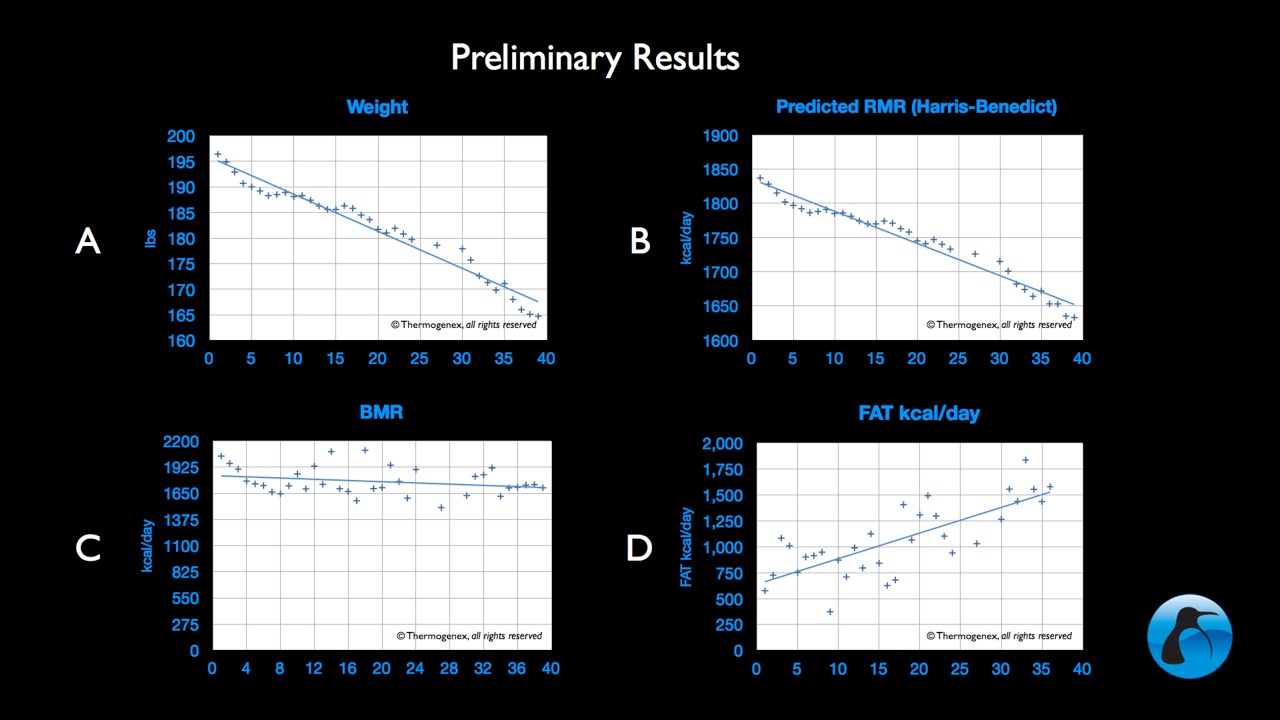
self test prelimToday I decided to plot some data, after all  I have to do is take needles and drink water and how much of that can one take?   I  exceeded my goal of 30 lbs today with 3 days of water left,  but it’s pretty exciting to share this with my blog followers.  If you are new to the blog, I highly recommend you stop now and go back to the Muscling Your Metabolism posts  and work your way though.  Once again, it’s respiratory quotient that everyone leaves out of the “broken metabolism” drama that is key to understanding what is happening.

Take a look at the graphs.  You see my weight loss (A) is is pretty constant and of course if one just goes by the RMR of the Harris-Benedict equation (B), it predicts a declining metabolism. Remember, metabolism scales with MASS not lean mass.  The bigger you are, the more calories you’ll burn.  It’s similar to the riddle, which weighs more, a ton of feathers or a ton of bricks? Likewise, whether you lug around an extra 30, 50 or 100 lbs of fat or steel all day long, it’s going to amp up metabolism. More on this in our next paper.

Okay, this is where the FUN begins.  As you can see (C) my BMR does drop over the first 8 days or so. Can this be the dreaded “starvation mode” that we are warned about? Will it crash to zero and cause me to balloon back to 230 lbs? What if I skip breakfast????  There is an ever so slight downward trend of BMR as you see in the linear curve fit, but as I have have often warned, the magnitude of metabolism is almost irrelevant.  Think of it like a business.  What do annual sales tell us about the health of a company?  Not much.  They could be making $100 million a year and losing $25 million a year in a slow (fast) bleed.  We need to see the balance sheet. Tell me about net income or EBITDA.

The same is true with metabolism and we need to know how the metabolism is partitioned between carbohydrate or fat so take a look (D).  Clearly my FAT metabolism is not staying level, in fact it’s zooming up. That’s because starvation mode is BURNING OUR RESERVES.  How simple can this be? I mean, why do we have fat anyway if not to burn it in times of caloric scarcity. As we point out in Metabolic Winter Hypothesis, that used to be an annual stressor. Now, winter never comes. We need to stop making things so difficult.

More Work To Do

I’m so excited by the results and it’s been an incredible journey and learning experience. There’s a lot more, but I wanted to share that with our community now and ask for your help.  I am raising $15,000 to help defer the costs of the testing and travel associated with this test. As well I’d like to begin the Open Source Body website development and design.  I am done self testing (at least for weight loss) as I intend on staying within my ideal weight from this point forward. I’ll finally put exercise back into my regular activity and continue to work with mild cold stress and calorie restriction to help define ways more people can practically adopt it into their lifestyle.


Hypothermics Donation

As always I am grateful to all of the regular donors, emails, FaceBook Friends, and  commenters for allowing me to pursue this passionately for the last 5 years.  It’s been such an unexpected adventure and there’s much more work to get done.   I’m going to get back to my water now – have to be well hydrated for that massive amount of blood to be drawn tomorrow morning.

Thanks!
Ray


References

Lee, Paul, et al. “Temperature-acclimated brown adipose tissue modulates insulin sensitivity in humans.” Diabetes (2014): DB_140513.

Valdés, Sergio, et al. “Ambient temperature and prevalence of obesity in the Spanish population. Di@ bet. es study.” Obesity (2014).


Mitochondrial AnarchyHe’s back.  Well, actually I never went anywhere, but it’s been a few months since I added to the blog.  In the mean time hundreds of pounds were lost by people I worked with directly, an invited commentary was submitted to a journal, and I have performed dozens of calorimetry, blood sugar, and food experiments.

Sometimes it’s necessary to isolate from all the bias and do the boring thinking part.  It’s far easier to hype, but at the root of all innovations is a break from status quo.  Like trucks drafting on the highway, it’s quite easy to get sucked into the popular dogma to avoid slamming into the guardrails.

My mentor in innovation, aviation rebel Burt Rutan, says you have to have “confidence in nonsense” to innovate.  That doesn’t mean that every nonsensical idea represents brilliance, but there is a certain break with the masses that occurs with each innovation.  In addition to crazy ideas (we can find a lot of those out there), one must measure carefully and that is the boring part, but I LOVE it. I also like old books, because they give one a much more grounded view of how our current ideas evolved and sometimes it’s easier to see the forks in the road that lead to the current (obviously wrong) idea about eating by stepping back and working your way through it.  If you love history and musty, stained books, then it’s really a joy to do it.

History not reflected, repeats.

There’s been a lot of ground covered in the nearly three years I have been blogging and it’s exciting just how much more research is coming out every year. So many people are doing great work.  I have much more on metabolism and the macronutrient shuffle, but I’d like to cover some new work that published over the last year and a few papers have been meaning to cover for some time.

Since it’s been a while since I last posted (yikes!) or you are visiting for the first time, let’s digest a few bits before going into the main topic. What I want you to know at the highest level is food, or fuel, is THE reason people fight obesity and many chronic diseases.  Further, I think macronutrient labels (protein, carbohydrate and fat) are  meaningless when discussing food, eating schemes or meals.  Exercise is incredibly beneficial with increasing performance and many health biomarkers, but it’s not the fastest way to lose body fat and can significantly impede weight loss.

Your metabolism isn’t broken or low – in fact it scales (gets larger), as does lean mass, with weight.  Hitting the gym to put on lean mass to burn calories and ramp the metabolism isn’t necessarily the solution.  If lean mass was the only thing needed to lose weight then why do bodybuilders or football players ever get fat? They certainly both have more lean mass than I or Aunt ethel will ever have. You know what?

You can’t out exercise your mouth.

It’s food. It is what they eat not how they burn it.  I didn’t say don’t go to the gym nor am I attacking bodybuilding or football, but I want to disconnect those activities from the notion that people are overweight because they aren’t “active” enough or don’t have enough “lean mass” to melt the fat away. It simply isn’t true and for the most part, exercise nowhere near as an effective way to lose weight as diet – especially for people with 50+ lbs to lose.  I am  not implying that there aren’t ways to boost metabolism, but what your diet has a much larger effect on the outcome.

For the last year,  I  had the luxury of measuring  many situations and conditions in a home metabolic lab. There is a seemingly unending list of myths I once believed, things that are repeated as fact in everyday conversation, which are not consistent with what I see in the lab or the peer reviewed literature.  It’s humbling and frustrating all at the same time.  Some of you see this and many more don’t, but anyone that carefully measures would come to similar conclusions. Part of the problem is the monolithic, group-think that seems to infect the fitness/diet community. Certainly the medical community isn’t immune.   I was as guilty as the next.

I’ve heard it said that a generalist is one that knows less and less about more and more until they know nothing about everything and a specialist is one that that knows more and more about less and less until they know everything about nothing. We have a lot of generalists and specialists parading dogma despite unprecedented understanding about how our body works.   I’ve reflected a bit on just how this happens and perhaps we can use it as a sub theme for today’s post.

In the northern hemisphere it is fall, and this is now ABSOLUTELY one of my favorite times of the year.  This is biologically a period  running up to winter’s conservation.  It’s a time when our metabolic system becomes stressed and will rebound with vigor in the spring. This is analogous to muscle hypertrophy in response to the biological stress of lifting a weight.  The overall endocrine system is not stressed by excessive nutrition; it’s stressed by caloric restriction and there is 70 years of data to support this hypothesis.

Every organism tested, from yeast to mammals, lives longer (40-50%) when Calories are restricted typically ~15-30% (up to 25-60%)  of normal for that species (1-3).  The ideal notion is to supply sufficient nutrition with minimum Calories.  Note: you don’t get life bonus points and extra Calories to eat by purposefully concentrating biologically active compounds [insert supplements] and ingesting them in huge doses not found in nature – health doesn’t come in a pill or powder. Chronic overnutrition isn’t solved with more food or nutrients. For over 150 years nutrient content is the catch-all buzz to market excess food.

This idea of Calorie restriction should invoke a similar curiosity in everyone:  if one continually restricts calories by 15-30% of normal, shouldn’t  a point of diminishing return eventually be reached?  In other words, if  a certain number of calories are “necessary” to maintain a person or organism, restriction below that number for a lifetime should  eventually catch up.  Can one truly be in “deficit” forever? Let’s not ask politicians; after all Lavoisier got decapitated for meddling in such political nonsense.  It’s still an interesting question: how much is enough food?

Creating Permanent Change

Over the last 5 years I took a decidedly different approach to the problem from the proceeding 20+ years of relative “failure;” I couldn’t control my weight and had biomarkers inching in the wrong direction.  Looking back now, especially after spending the last few months on a journal manuscript, countless self-experiments, and coaching dozens to success, I can summarize my perspective by offering  a simple shift in two questions that drove all of this work.

1) How do I lose weight -> Why do I gain weight? 

2) What do I eat? -> How is the food I eat processed?

While these might appear to be nearly identical questions, it turns out they are extremely different questions and the answers cause conflicts with many popular “schemes” about food and metabolism.  With that, let’s segue to one area of metabolism you absolutely can have a dramatic impact on even at the cellular level.

Power Plants and Fuel

mitochondrial activity can be compared to a rocket engine.  Fuel is combined with an oxidizer to create metabolic waste products and heat. We all know that in order for an engine to run an oxidizer and fuel must be supplied. The reaction creates new products and typically a lot of extra heat.  When the Space Shuttle Main Engine used to fire, hydrogen (fuel) and oxygen (oxidizer) were combined to make water and obvious extra heat.

The hydrogen and oxygen fuel/oxidizer were contained in the large External Tank in the center.  The solid rocket boosters (on each side of the ET) used Aluminum for fuel and ammonium perchlorate for oxidizer. I think it is fascinating to think that the same basic chemistry of a rocket engine is used by the power plant of cells, the mitochondrion, deliver energy to live and move.

The mitochondrion can be equated to a rocket engine - fuel and oxidizer are combined to create ATP and waste heatInstead of rocket fuel, hydrogen, mitochondria use amino acids, monosaccharides, fats, and alcohol for fuel. Combined  with atmospheric oxygen, they oxidizer,  they produces ATP + waste heat.  The waste heat is managed and that is what maintains our temperature – we are designed to live in environments cooler than body temperature in order to dissipate this excess heat.  ATP is the currency of energy in the cell and you can learn more if you want in this tutorial at Kahn Academy.

I am only dealing with FAT/CHO in the graphic, because ultimately the fate of the other macronutrients (amino acids/alcohol) end up inserting into the CHO pathway.  Later we’ll clear up some of the many myths of ingested versus endogenous sources, but suffice it to say one doesn’t store alcohol (in coolers doesn’t count).  Breaking down of tissues for either indispensable amino acid stores or back up energy is not as common as portrayed as it is easily avoided with even modest amounts of ingested whole-food Calorie.

So we have a fuel currency and everyone wants to believe the obesity “problem” is a simple macronutrient ratio. We hear it’s fat. No, it’s protein. No, it’s carbohydrate.   The  truth is that we all simply “eat” too much. Chronic overnutrition is THE problem, because  in the real world, Calories are scarce.  That is why I find the mitochondrion and mild cold stress so fascinating.  These are inextricably linked and our biology has provided a way to not only recycle that waste engine heat, much like the heater in your car, but in certain situations stop producing ATP altogether and just create heat.

What is even more fascinating is that while BAT seems to get the center stage in the press, every mitochondrion in your body has the ability to play in this ATP/heat exchange. It turns out that mitochondria even have their own DNA – separate from the genes that make you, “you.”  In the last few years, scientist have been toying on the edge of some incredible work that addresses a certain mitochondrial DNA diseases (4), and  you can explore that more  here and here.   I’m not thinking about jumping into mitochondrial DNA modifications at the moment, but it is important to ponder just how independent these tiny power plants are and consider the overall coordination involved in them working in unity.

With the exception of red blood cells,  all your cells contain these powerplants and they are not only at the center of this waste heat production I’m always tapping into, but also at the very root of aging.   What seems paradoxical is that caloric restriction actually increases mitochondrial biogenesis (formation of new mitochondrion); that’s  more power plants created on a diet of less fuel.  Overall, the point to keep in mind is that each mitochondrion decides: 1) what fuel to use based on a host of coordinated signalling, 2) whether or not to produce ATP, and 3) is capable of generating an enormous amount of heat.

Record Breaking Wisdom

1384195_523224227755404_1487382131_n

Wim Hof Breaks World Record for Remeha Sponsor.
October 18, 2013.

A little over a  week ago Wim Hof broke  another world record – one hour and 53 minutes in direct contact with ice.  He’s demonstrated numerous time this ability and although it’s been shown that he can generate up to 5 times the amount of heat of younger, healthy (untrained men) he would be the first to humbly say, anyone can do this.   He in fact has trained many people to adapt to mild cold stress and today we will look at science that backs up his claims.

There are numerous other medical benefits, but let’s move beyond. I think it is funny to note that when I visited him last during a Netherlands winter, he always reached for a jacket when we went for walks or to the grocery store and we laughed at the fact I just threw on a pair of gloves and a hat. The iceman has a coat.

Now, I am not trying to imply I can take him on in dueling cold, but wish to point out we all have these habits.  Today, I will give you a few things to change as winter approaches that will tweak these habits and help you adapt. Back to mitochondrial response to cold shock.  The first thing to recognize is that these responses happen at the cellular level.  Each cell is it’s own little domain, and although coordinated and affected by overall endocrine activity, they have the power to bypass ATP production in defense of cold shock (5).  Next is to understand that heat generation not limited to the mitochondria in BAT. Every mitochondrion contributes via the normal cellular activity resulting in  80% waste heat, but further, they can all take it up a notch and give us the the extra 20% in heat instead of ATP.

Adapting the cool approach

In 2008, researchers demonstrated that muscle cells also contribute significantly to adaptive thermogenesis. (6). In this study 11 lean men were tested at 22C and 16C inside a respiration chamber (a whole room indirect caloriemeter).  Even though activity actually fell during the period of mild cold stress, total daily energy expenditure (TDEE) increased.  After a baseline measurement of 34 hours at 22C, they were measured for 84 hours at 16C (60F).  This temperature was picked so as to not induce shivering.

Qualitatively, it happens to be exactly the temperature I find that the most people can tolerate with little period of adaptation. A biopsy from  leg muscle (M. vastus lateralis), was taken after each test period and later analyzed for mitochondrial uncoupling.  Those results clearly demonstrate it is present.  The authors also note that epinephrine  has been reported to increase total body energy expenditure of up to 40%.   What this means is that whether you have BAT or not, you can still adapt and create non-shivering heat.  Not only that, but it’s more energetically favorable to skip the ATP step (shivering/exercise) and just dump the high-calorie stored fuel (FAT) directly to heat.

We learned in A New Eye on BAT, that Irisin produced in a response to exercise promoted the “browning” of white adipose tissue and caused them to join the Muscle/BAT heat game.   The puzzling paradox was that of a tissue encouraged to “waste” energy by producing heat as a response to increased activity.  At first, these two actions would appear to conflict: excess activity causes tissue to be formed, which in turn creates 100% waste heat instead of ATP involved in cellular activity and survival.   As examined from the larger perspective it seems like an energy death spiral, but if exercise is viewed as a modern day mimic of shivering, this is a more effective way to keep the body warm – i.e. it conserves energy.

Even though exercise and shivering are primarily an activity of high respiratory quotients (i.e. glycogen/CHO, not FAT), the body does have a system to efficiently adapt to a dense fuel source (FAT) without the deleterious tissue breakdown associated with prolonged/intense muscular activity. Earlier this year, two related  research projects showed up.

The first looked at the simple acclamation progression of exposing  subjects to an environment temperature of 15-16C (60F) for 10 consecutive days and then looked at the activity level of non shivering thermogenesis (NST) and BAT. (7)  At the same time they surveyed three key indicators of comfort:  How are you feeling (temperature) now? Do you think this is….(comfortable to uncomfortable)? and Are you shivering?

What is not too surprising is that after 10 days all of the questions saw a significant improvement (move towards comfort/non shivering). We’ll discuss this below. The acclimation also increased NST by 10%. Remember, this is heat generated directly through mitochondrial activity bypassing the shivering/ATP step.  While no rise in RMR was detected (I suspect they didn’t measure during cold exposure), they also don’t report RQ, so there’s no way to tell if an increase in fat oxidation was associated with the acclimation. They do state that the mitochondria became sensitive to fatty acids with the exposure. The also briefly discuss the lack of skeletal muscle recruitment seen in earlier studies by same team (above), but suggest it might be linked to intermittent exposure vs the previous continuous exposure.

Finally, It was interesting that BAT was detected in 94% of participants before and 100% afterwards – a long way from just  decade or so ago when it was believed we lost all BAT by adulthood.   Overall the detectable BAT quantities increase by 37%.  And let’s go back to the test conditions…we are talking about 60F (15C) for only 6 hours a day!  This is a great fall/spring day whether you happen to now be in the Northern/Southern hemisphere.  This is NOT cold…nor is it an ice bath or extreme.  It’s the equivalent of spending a couple of hours in cool, not cold conditions. This is something everyone could easily accomplish.

Spice it up.

Figure 1-Contribution of BAT to whole-body EE. (A and B) FDG-PET/CT images of subjects with detectable (A) and undetectable (B) activities of BAT. (C) Whole-body EE at 27°C and after 2-hour cold exposure at 19°C. (D) CIT. (E) Fat-free mass. (F–H) Relationships of fat-free mass to EE at 27°C (F), EE at 19°C (G) and CIT (H). (I) BAT activity. (J–L) Relationship of BAT activity to EE at 27°C (J), EE at 19°C (K), and CIT (L). *P < 0.05; **P < 0.01; ***P < 0.001.

Figure 1 Contribution of BAT to whole-body EE.
(A and B) FDG-PET/CT images of subjects with detectable (A) and undetectable (B) activities of BAT. (C) Whole-body EE at 27°C and after 2-hour cold exposure at 19°C. (D) CIT. (E) Fat-free mass. (F–H) Relationships of fat-free mass to EE at 27°C (F), EE at 19°C (G) and CIT (H). (I) BAT activity. (J–L) Relationship of BAT activity to EE at 27°C (J), EE at 19°C (K), and CIT (L).


The second paper was from a team in Japan and looked at 2-hour mild cold stress (17C/62F) treatments for six weeks, 19C/66F 2-hour exposure on energy expenditure (EE), and compared these to daily ingestion of capsinoids (pepper extracts) for six weeks. (8)  Similar to the study above, a clear association of mild cold stress and increased metabolic activity was demonstrated.

In this study of 51 young men, a little over half showed BAT that was activated by the one time exposure to 19C (see Figure 1, E). Of the detected/undetected, both saw a significant increase in EE (c), but those with BAT saw 252 kcal/day vs 78.8 kcal/day. They also saw a strong association between fat-free mass and EE – in other words resting metabolic rate scaled with fat free mass.

Reflecting back on our  Part 3 of Muscling Your Metabolism,  don’t forget that lean mass scales with weight – ladies (and men), pay attention here – the more you weigh the more lean mass is under the “fat suit” to carry around those extra pounds and the higher your metabolism is to support such effort. (9) At the same time let’s also not forget that it’s also been demonstrated that the average daily energy expenditure of traditional hunter gatherers was no different than that of modern day Western (US and European) counterparts after controlling for body size; as such, “lifestyle had no effect on total energy expenditure.” (10)

So let’s look at this clearly, and accurately, in terms of my simple question above: if putting lean mass on to burn calories (clearly demonstrated in this and other studies) was our main concern, then the bigger you are the more lean mass you have and the higher the metabolic rate.

Further, if we are all just suffering from too much sedentary lifestyle and just need to go roll more boulders and chase a few antelope, then this isn’t very consistent. Your metabolism or lean mass is likely not the problem at all and that’s why one can continue to run marathons and not lose weight.   We eat too often, too calorie dense and too much.

Spread the word: you can’t out exercise your mouth. 

Now, back to the mild cold stress. What is also interesting in a cohort of similarly aged young men that fat-free mass was closely tied to EE at 27C, but not at 19C during mild cold stress (see: F-H). So this clearly distinguishes between BAT contribution to EE vs fat-free mass.  But like the study above, the 6-week, 2-hour a day exposure to 17C/60F resulted in an increase  in both BAT activity and BAT detection: individuals with no BAT detectable at the start showed active BAT at week 6 (see Figure 2A in the paper).

Obviously anyone paying attention here should see the conflict, maybe in these short term acclimation studies (intermittent) BAT becomes the first line of defense (if you have it). Further, if you don’t have BAT it seems that one can recruit it. Finally, there are also examples that even skeletal muscle can contribute in chronically cold (read natural winter exposure pre modern world).  We’ll address this in the practicum below.

Whole-body EE before and after chronic stimulation by cold and capsinoids. (A) Effects of repeated cold exposure for 6 wk. (B) Effects of daily  ingestion of capsinoids for 6 wk.

Whole-body EE before and after chronic stimulation by cold and capsinoids. (A) Effects of repeated cold exposure for 6 wk. (B) Effects of daily ingestion of capsinoids for 6 wk. ( from supplemental methods)


Finally, this study had this interesting twist of the effect of capsinoids from a specific pepper (do you hear the supplement companies beating your door down?).  This is actually an interesting class of non-pungent capsaicin from a sweet pepper (CH-19 Sweet, Capsicum anuum L.).  Reasoning that the increase in dietary induced thermogenesis was related metabolically to the heat rush stimulated by pepper exposure, they tested in a cross-over, randomized, single-blind trial comparing placebo/capsinoid capsules ingested daily for 4-6 weeks… and it worked!

Those receiving the capsiate had an increase in EE similar to the same treatment with mild cold stress.

That’s actually surprising and an interesting result.  Once again, they didn’t report the more important figure, RQ, which would tell us how much more of this EE activity is actually helping contribute disposal of stored fat.  I have first hand data that the cold exposure does decrease RQ over time (moving towards more fat metabolism).   It would be interesting to see if that played out here as well.

The Practicum – Your Autumn Experience

Ok, so we moved all over the place today and I am always asked for practical applications of all of these intellectual curiosities.  With a few extreme exceptions, the move-more message to burn fat and increase metabolism is pretty weak at best.  Further, the lean muscle burns fat argument, while true, is mostly irrelevant.  What you put in your mouth (future post) every day has far more effect on your results if fat-loss is the goal. If you want to run faster, jump higher and swim farther – exercise is the solution.  Wim is challenging the endurance portion of exercise, but that’s for another time.

This is not to say one can’t have a profound impact on metabolism with mild cold stress, but even that is not going to make up for the $1 buffet; you can’t out exercise your mouth.  The only exercise guaranteed to work is to isometrically clench one’s mouth in the presence of excess calories.  Let’s assume you’ve picked your dietary regime, be it paleo, vegan, body for life, whatever… and you want to lose.

Fall is an EXCELLENT time for the adaptation we see in all of these studies.  This is the natural period where cold ushered in and our bodies are designed to adapt – everyone can do it, don’t use the pathetic story of cold natured, big boned, or genetic destiny.  Instead, ease into it.

contrast showers help mediate cold shockI have given out one prescription for muting your immediate response to cold and increasing your cold (and paradoxically hot) tolerance.  I call it: 10-20-10x and it is a procedure Wim Hof and I developed together based on both of our experiences.  First, you need only a GYMBOSS timer (you can contribute by getting it on my Amazon store or there is a free App) and a shower (consider the silicone skin for $2).

Finish the cleaning part of shower at a normal temperature (hint, slowly reduce your shower from scalding to normal-warm over a week or so if steaming shower is your thing).  Then you’ll do 10 seconds of warm followed by 20 seconds of cold and repeat that interval 10 times (10-20-10x).  You want to end on cold for a minute or two.   It will suck pretty bad at first, don’t say you weren’t warned.  That being said, it gets not only tolerable, but the best description I’ve heard is you’ll eventually get the same “runner’s high” after a race. It really gets you going.

What is going on during this crazy exercise?  Vasoconstriction/vasodilation is alternating and blood is pulsing to and from the extremities. Believe me you will feel it in your fingers, toes and scalp.  Ladies, I am told a cold water rinse with hair closes the cuticle and my South American female followers SWEAR this tightens the buns  and skin – I don’t know, but it’s a bonus if true.  What you will find is a very perceptible increase in mood and well being – this boosts the endorphins and gives a great morning rush.  It also will slowly mute your response to sudden cold, be it opening the shower door, the office door, or cool water.  Your body eventually doesn’t panic in the “fight or flight” sense to sudden cold exposure and that helps with overall comfort.

As well, I think this is superior to just cold showers if that’s already your thing. The constrict/dilate method is additionally a great way to alleviate  post workout soreness.  Here is the modification I would make: fill the tub with cold tap water before you do this and then sit in that after the 10-20-10x for 5-10 minutes – need to submerge farther for upper body workout.  Even without ice, you will see a significant difference in following and next day in soreness – even if you are just starting to exercise.

Glove before sweater, make you look better.

So this brings me to my final couple of observations. Don’t be afraid of cool temperatures.  I am not suggesting you go out and brave dangerous cold levels (0C/32F air and 16C/60F water are the lower limits in my book), but do the reverse of common layering with skiing – bring your layers WITH you and layer as necessary; don’t wear them and remove when too hot.  Are you really going to freeze walking from the house to the car…in the garage? What about from your parking space to the warm office building? How do we dress different in summer and winter when the environments we inhabit are virtually the same?

These small times of exposure both condition you and as we have seen today have real, measurable effects on your overall metabolic pathways. Drop the thermostat a bit – it doesn’t take extreme and you will get used to it. This isn’t extreme as I have been suggesting for a few years and we don’t need super-human feats of ice endurance, not even Wim believes this as the champion of champions on the subject. What I want everyone to do if you want to get in touch with the real biological self is expose yourself to the seasons, they matter.  If you live in an extremely mild climate, then invent them.

Remember, the only species that get sick and chronically ill are us and the pets we keep warm and fed: they get the same diseases and struggle with obesity. It’s not their little doggie/kittie treadmills and the amount of “protein” in their food – it’s chronic overnutrition.  Animals conserver and so did our ancestors, despite what your rope climbing, tire-tossing, five-toed shoe friends want to believe.   I see consistently .6-.8 lbs a day loss in my clients with no exercise. Sorry again for the long delay. I am sure there will be a lot of discussion.

I don’t want to debate diet at the moment, so let’s stick to the subject and be respectful – I am thrilled that our many comments have avoided the trash-talk elsewhere. Have you been doing contrast showers for a while? Let us know your experience?

As always, I’m not selling books, supplements, or bad ideas and I self-fund my research, so if you like this PLEASE donate and perhaps consider a regular contribution. It’s appreciated and all of it goes to my mid-life crisis metabolic lab, gadgets and historical textbooks.


**************

Do you like these blogs and want to help me? Please take a minute to scroll up on the right side of the screen to consider making a monthly donation to this program. You can also make a one time donation here:


Thanks!
Ray

References

(1) Guarente, Leonard. “Mitochondria—a nexus for aging, calorie restriction, and sirtuins?.” Cell 132.2 (2008): 171-176.

(2) Haigis, Marcia C., and Leonard P. Guarente. “Mammalian sirtuins—emerging roles in physiology, aging, and calorie restriction.” Genes & development 20.21 (2006): 2913-2921.

(3) Koubova, Jana, and Leonard Guarente. “How does calorie restriction work?.” Genes & development 17.3 (2003): 313-321.

(4) Tachibana, Masahito, et al. “Mitochondrial gene replacement in primate offspring and embryonic stem cells.” Nature 461.7262 (2009): 367-372.

(5) Fujita, Jun. “Cold shock response in mammalian cells.” J Mol Microbiol Biotechnol 1.2 (1999): 243-255.

(6) Wijers, Sander LJ, et al. “Human skeletal muscle mitochondrial uncoupling is associated with cold induced adaptive thermogenesis.” PLoS One 3.3 (2008): e1777.

(7)  van der Lans, Anouk AJJ, et al. “Cold acclimation recruits human brown fat and increases nonshivering thermogenesis.” The Journal of clinical investigation 123.8 (2013): 3395.

(8) Yoneshiro, Takeshi, et al. “Recruited brown adipose tissue as an antiobesity agent in humans.” The Journal of clinical investigation 123.8 (2013): 3404.

(9) Prentice, Andrew M., et al. “High levels of energy expenditure in obese women.” British medical journal (Clinical research ed.) 292.6526 (1986): 983.

(10)  Pontzer, Herman, et al. “Hunter-gatherer energetics and human obesity.” Plos one 7.7 (2012): e40503.

calories burned with kettlebell swings - boost metabolismYou can’t out-exercise your mouth.

It is a fundamental truth and a brilliant evolutionary strategy.  Exercise has many interesting impacts, both positive and negative, but if you’ve been chronically obese, I want to encourage you not to start here. Not only are you putting your heavy, out of shape body into an increased risk of injury, but until you’ve been successful in the one exercise that ALWAYS works, you’ll simply eat your way through any progress.

What is this magical exercise? Isometrically clench your teeth in the presence of fattening foods and excess calories.  It’s necessary to control appetite, not “fuel your body” with even more energy. Those shakes are only helping to the degree they are displacing higher calorie food. Take a look at any study that shows statistically significant effects usually has paltry overall results (normally far less than 2 lbs a week).

It seems many emails, blogs and conversations all end up with the word cravings sprinkled on top.  Somehow we are to believe that because we crave something it’s an indication of need.   Our cravings are about as good of indication of nutrition as the food pyramid or the Hot and Fresh sign at Krispy Kreme. I’d argue they are practically worthless and craving is a term of addiction, not survival and health.

You can’t out-exercise your mouth.

Let’s take a look at a few exercises and some of the claims about metabolism and I think it will be clear that exercise has many of benefits, but burning fat is not at the top. I apologize in advance that this is going to get a little technical, but it’s absolutely necessary if we ever want to expunge the nonsense from the weight loss and fitness industry. This was the most difficult blog to write to date, because I really want everyone to understand this concept. It is so critical and I hear EVERYONE throwing around the M-word as if it is undeniable fact.

Wired For Truth

When Steven and began discussing a proposed article (read Wired article here), he kept coming back to the same question: how can we know that cold had a certain impact on your progress?  I guess the simple answer was that I changed so few variables that the impact was self-evident, but the far more certain way is to measure. My goal was to lose weight back in 2008 – not write a book, a blog, interviewed in magazines and TV, or give a talk.  I didn’t really care much about ANY of this until June/July 2009 when so many others, like Tim Ferriss, made such a big deal out of the results.  I just did it because it made sense to me and it did have a solid technical basis. I didn’t know for certain that it would work.

Since then a combination of defending the results and being encouraged by scientists I enormously respect to take it further has fueled the crazy self-experiment obsession.  Along the way I haven’t given much thought to proving a point as much as understanding the underlying science. That gives one a certain intellectual freedom, because it doesn’t matter what the answer is as long as it is the truth.

We now have seen in Muscling Part 1 and Part 2 that metabolism has two important components: RMR and RQ.  The first, RMR,  is a short term measure of a person fasted at rest and that measurement (typically about 15 minutes) is projected over the next 24 hour period as an estimate  of total energy should be used if no additional activity occurs.  It’s in a sense a minimum, or floor measurement and your total expenditure will likely be higher over the day. RQ (respiratory quotient) is a breath by breath analysis during the period measured of the % Fat and % Carbohydrate being utilized.  It tells us how much of each fuel is being used. Like RMR, RQ is EXTREMELY sensitive to activity and is constantly changing to accomodate the body’s fuel needs.

When Atwater and others performed their experiments a century ago, they were not only collecting the carbon dioxide exhaled, but also the heat that evolved from each test subject.  This would be direct calorimetry, because the heat evolved during this oxidation (burning process) is related to the fuel burned.  Not only can it be measured – it can be measured very accurately with simple thermometers of the day.  Today, indirect calorimetry, measuring O2 consumed and CO2 produced,  indirectly determines the energy dissipated and it matches what they measured over 100 years ago.

Over a century…that’s pretty incredible.

So if someone is talking about boosting metabolism, lean mass burns more than fat, or  post exercise/eating metabolic boosts, remember that one can’t simply repeat these things and it suddenly makes them true. We actually have to verify that it is as stated.   The simple question one should ask is: how do you know?  So let’s blow a few more metabolism myths out of the water.

What’s Your RQ?

alcohol lamp used to calibrate RQ and RMR on an indirect calorimeter

Alchohol lamp used to verify RQ and total energy burned

We’ve learned RMR, or metabolism rate, during any activity isn’t enough to know anything about fuel source.  You might be burning alcohol, carbohydrate, fat or protein – you don’t know. While your diet does influence short term calorie consumption (within hours of the meal), it really has no impact on the bigger picture of what happens for the remainder of the day or what  fuel is selected for your exercise of choice.

To assess that, we need RQ.   This you will remember is a ratio of the CO2 produced to the O2 consumed and the number is very specific to the type of fuel  used. Let’s use for example an alcohol lamp burning grain (ethyl) alcohol for fuel.  Alcohol has an RQ = .67 and when I drop this alcohol lamp into a bucket and sample the air continuously  that’s exactly what I measure – a straight line at .67 and a RMR of 5,074 kcal per day.  That lamp fire is a little over the energy equivalent of two people to put it in perspective   If I weigh the lamp before and after the experiment, I can in fact verify that not only is my system displaying the correct RQ, but also measuring the overall energy accurately.

By using calibrated gas mixture of Carbon Dioxide/Oxygen, a calibrated syringe to measure volume displaced on each breath, and alcohol flame to assess the fuel consumption rate, we can KNOW what is happening before/after a meal or before/during/after an exercise.  This isn’t new, in fact we learned in  Muscling Part 1 that this exact technique was used back in 1790 by Lavoisier and  later by Atwater and others after the discovery of the macronutrient fuels, protein, carbohydrates, fats, and alcohol. With all biological systems there is a certain variability above us, but we got these measurements correct. How we decided to use them is a completely different story.

It should come to as no surprise to anyone that reads this blog that the terms “protein, carbohydrate, fat” are not the arbitrary “food labels” your, government, food packager,  dietitian or fitness coach chooses to place on the items that constitute a meal. In fact it was the process of making these measurement that I came to realize how absurd these labels are unless your goal is to over eat calories in pursuit of some magic macronutrient “ratio” or every nutrient inclusive, “balanced meal.”    Either way, I am pretty certain when we  measure activity, meals, sleep, mild cold stress, etc… using indirect calorimetry that we can know with some accuracy and precision how much energy the body is using and what it is burning to get there.

Taking a Swing at Kettlebells

I will take some “heat” for this, so let me begin with the same disclaimer I’ve given on exercise in general.  We shouldn’t throw the baby out with the bathwater. Even though I don’t think exercise is a particularly good way to lose weight (in fact it mostly slows it down), does not mean I am opposed to it or think it is unhealthy.  Likewise, I love kettlebell swings, so please don’t take this as some sort of assault on exercise or even kettelbells in particular. This just happened to be an easy target. I could have used nearly any “fat burning” activity aerobic/anaerobic to make the point.

Anyone that’s performed these exercises will tell you that they are a great physical exertion, but what happens when you have a $30K machine that let’s you peer into what makes that swing FEEL so good? What’s really going on?  I want you to take a minute and Google:   kettlebell metabolism

You should get MANY hits.  WOW. look at those very first ones:

“A short and intense kettlebell workout will crank up your metabolism for another 38 hours.”

“This will elevate your metabolism for up for 31 hours.”

“If you want to burn more fat, improve your fitness, and ramp up your metabolism, try doing kettlebell jumps at the end of your workout.” 

“Kettlebells can help to stimulate a metabolism because of the way kettlebell activities force a body response through balance challenges and resistance.”

…and so on

We KNOW it’s repeated over and over (I’ve said it, >gulp<), but I can tell you that it simply is not true.  If you are a personal trainer, a fitness blogger, or a writer, let’s take the time to verify what’s repeated. If we could just spend a year on correcting the myths, we’d all be better off. Isn’t everyone sick and tired of the contradictions?   Once again, I love kettlebell swings and have my own routine developed for post-weight loss physical conditioning (I am close to testing it out on a increased strength/fitness challenge after my next weight loss tests are completed in June/July).

Kettlebell swings - 20 sec exercise, 10 second rest, repeated 10 times.

Steven Leckart Kettlebell swings – 20 sec exercise, 10 second rest, repeated 10 times.

What’s the truth?

Let’s review that MOST people will post a resting RQ ≈ .85 and that corresponds to ~ 50/50 CHO/FAT ratio.  This means if you wake up in the morning and have a pulse, you’ll expend about half of your daily RMR calories from fat oxidation.  But what happens in explosive exercise, like the kettelbell swings I had Steven do?  First, here’s the exercise: a simple 20 second swing, 10 second rest period, repeated 10 times.   We began with a full RMR/RQ test earlier and then the test protocol had him standing still ready to exercise for 3 minute “starting” RMR/RQ.

I’ve tried to simplify the plot to highlight the changes in Steven’s metabolism. In this case we see  his cumulative calories burned vs time (red line). You can easily see when the rate  (kcal/min) changes by looking at  the slope of the line. The steeper the slope, the more energy Steven is burning in that period.

We see that he starts out during a 3 minute rest, or baseline period, and then the exercise begins.  He continues to exercise until the 5 minute mark at elapsed time of 8 minutes and then we look for recovery.  The blue dashed line I’ve added represents the calories he would have burned had he just stood there. The entire test is over in 20 minutes.

So let’s do a couple of  checks to make sure we are in the ballpark.  At the far right hand side you see the dashed line ends up at ~ 44kcal/20 mins.  An hour is 3 times this, so this would result in an RMR of 132 kcal/hour (3 x 44), or 3,168 kcal/day – quite a lot for a guy that is 5’7″ and 134.9 lbs.

But  that is correct, because his true RMR (fasted and lying relaxed) measured a couple of hours earlier was 1,984 kcal with an RQ = .80 and now he is standing and probably a little nervous before the test.   Here I want to demonstrate just how variable the number is we all call metabolism.  His total calories burned in 20 minutes was 70 kcal, but 44 kcal would have happened anyway, so the total burned due to the swings was 26 kcal –  a little more than a half teaspoon of coconut oil or a little under two teaspoons of table sugar.   When people (even me) do these hard calculations of calories in/out, note that the out portion can be widely varied.  We will come back to FAT/CHO burned, let’s continue with the metabolic “boost” everyone is raging about.

Follow the red line. You see it ramp up with activity and then as soon as he puts down the weight, he begins to recover. Your metabolism is dynamic and designed to conserve.  I estimate that the energy rate hits pre-exercise level about a minute or so after he’s done – worse case let’s call it two minutes.  Ok, but energy is only half the story, so let’s turn to RQ.

Where’s The Boost?

It’s simply not there in energy consume, but perhaps it’s buried in the RQ as raging, metabolic fat burning. Let’s take a look. You’ll see 4 sections and in each a box with RQ average for that section. These four divisions approximated when shifts in his RQ occurred.  He begins at RQ = .84 (47.2% CHO/52.8% FAT). During exercise this climbs to RQ= .98 (93.6% CHO/6.4% FAT) and then to an average RQ = 1.02 (100% CHO) during the recovery phase which lasts about 8 minutes. During this time his RQ is drifting down and by minute 16 he’s at RQ = .87 or (57.5% CHO/42.5% FAT).  We end the test at minute 20.

The truth:  His metabolism returned to normal after 2 minutes and his RQ within 8 minutes.  Sorry folks, no raging metabolism – it was news to me as well. We’ve been duped.

It’s not rocket science and exercise physiology has taught for a long time that these explosive energy modes are not driven by huge utilization of fat.   Elite endurance athletes burn more fat than the rest of us, but they typically don’t burn 100% fat during the activity. Volume training encourages their body to burn fat earlier into the exercise and that avoids the carb-crash when glycogen stores are spent.

So why does everyone say it? Why is it repeated, debated, instructed when it’s so easy to disprove?  Perhaps, sometimes people want to believe in something so much, they begin to use the words think and believe interchangeably and in doing so, avoid the thinking part all together.  Today, there are many similar examples I’ve found food, blood sugar, etc… and in time will demonstrate.  Internet has facilitated an explosion of fitness/diet bloggers and monday morning scientists that read a handful of papers, use many multi-syllable words, and back it all up with citations at the bottom of the page, but never measure. I guess it’s an intellectually toxic cocktail of incompetence and ignorance, but I’m afraid it’s no longer the exception.

One might expect this from evening and weekend warriors, but we hear this from degreed, educated, trained, and certified people as well.  I will admit I have said it before and there is simply no excuse for it.  I’ve spent the last four years in an obsession to get to the bottom of something that’s quite easy to understand once you get the memorized drivel out of your head.  It was an expensive “hobby,” but I’m prepared to change the lives of 10,000 people and I don’t intend on selling pills, powders, screenings, and procedures.  I am after real, measurable, demonstrable and accountable change for a more healthful life. In the mean time,  let’s just not forget:

You can’t out-exercise your mouth.

Chilling Truth About Cold Water

steven lechart wired magazine cold stress

Steven sitting at the bottom of the swim spa for a 20 minute immersion to measure calories and %FAT/CHO during an immersion test.

Swinging Kettlebells is not why Steven was visiting my home lab on that hot, humid summer day.  He was here to learn more about cold. By now anyone that reads my blog knows that I am not really an advocate of misery and lean toward mild exposure over longer time.  That’s simply not something one can easily test during a hot, Alabama August day and he was only here for 5 days, so we did the next best thing, turned down the thermostat.

I have an 8 x 14 ft Tidalfit swim spa that’s temperature regulated from 45F to 105F (~8C-40C) using an AquaCal heat pump.  Our goal was to compare 20 minute swims at 80F (26C), 70F (21C), and 60F (15C). We also looked at a 20 minute  jog at a leisure pace of 5 MPH. In all cases we wanted to bring the exercise level down a notch testing to what extent the advertised “fat burning zone” exists.

Finally ,we performed two immersions, where the goal was to “relax” as much as possible so that the cold portion of the contribution would be separated from activity.   At that time, my calorimeter was relatively new and so this represented the first opportunity to really dig in with a complete set of data keeping in mind the the foundational science is over 100 years old.  We weren’t really challenging old science, but rather adjusting the collective “mind hive” speak that’s resulted from people repeating incorrect, or generalized, “facts” over and over until it becomes widely accepted.

Let’s discuss the big picture here and compare/contrast swimming with kettlebells. Again, so as not to be misunderstood,  I am not suggesting kettlebell swings or weight lifting have no value. My goal is to focus everyone on misguided notion that metabolism, or lack activity, is the reason they are obese or even the reason the last stubborn “belly fat” is hanging around. As well, I want to assert that other than dietary intervention, most exercise is an activity revolving around glycogen and doesn’t really impact or significantly decrease your body fat levels.

We basically live in this realm of RQ = .85 (50/50) and exercise always moves that number UP not down.  Elite endurance athletes burn more fat and volume training makes it better, but for the average person, all of that sweating and jumping creates far more metabolic needs of repair and risk of injury than warranted by the amount of body fat consumed.

Simple relationship of exercise, calories expended, and metabolism

Simple relationship of exercise, calories expended, and metabolism

In THIS regard, a calorie isn’t a calorie – not because they aren’t equal, rather, because an activity may preferentially prefer one fuel over the other.

In every case of activity analysis, I want you to also remember this imaginary slope upward and it’s progress over time.  Before you begin, the energy expenditure you would have burned had you not exercised, could continue on for the same time at the gym. Now add exercise and your metabolic rate increases momentarily and then when you stop, it goes back to the original rate after some period of time.  During the increased rate of calorie consumption, our cells shift toward the glucose/glycogen economy unless one is completely glycogen depleted.

Swimming is actually fundamentally different from all other forms of exercise.  First, it’s not an activity of explosive power, it’s a sport of technique. I’m not suggesting elite swimmers aren’t powerful and explosive; sprinting can occur in competitive races.  One can swim leisurely and significantly reduce the exerted force, but there’s another prominent change in the thermodynamic balance: the rate of body heat loss to the water.  What we are doing effectively is pulling the heat from the outside instead of pushing it outward by revving our muscular engine and creating obligatory waste heat.

With that let’s turn once again to Steven’s cold tests.  I’m not going to go through all of them at this time, but I want to point out a few things that should become second nature. First, take a look at the “shape” of his curve swimming.  You see the same basic shape as in kettlebell swings above – the gentle slope, then steeper when swimming and finally back to the original slope.  Nearly all activity fits this general picture as did his 20 minute jog.  If we ramped up the swimming effort (or even running speed) that middle section would have progressively steeper sections, but it does return back to “normal” or resting at some point after and we demonstrated  it’s way less than 30 hours.

Remember that metabolism, or energy consumed, varies throughout the day, but the total energy is only HALF of the story and not even the most important half for most of us.  The number we are after is RQ, which gives indication of how much fat consumed in any given time. If weight fat loss is your goal, this is much more important.

Taking the Plunge

20 Minute tethered swim in 70F water

20 Minute tethered swim in 70F water with 20 min post swim recovery.

With swimming, there is a distinctively different signature on RQ. This was the middle case, a 70F (21C) 20 minute swim followed by ~ 25 mins of post swim monitoring.   First, you’ll see that Steven starts out just like any other activity and then he moves into the actual swimming phase with the increase in metabolism. Once finished, he gets out and recovers (on a HOT August day) while continuing to measure.

Swimming burned ~130 kcals, but what is really interesting is  RQ.  It starts in a normal range of RQ = .82 (40.3% CHO/59.7% FAT), rises during the swim to RQ = .98 (93.6% CHO/6.37% FAT), and then he begins the recovery phase.  There is a little twist here in that Steven was shivering for the first 8-9 minutes. Not violently, but definitely shivering (see video from WIRED article upper right)  and  we see a slight drop to RQ = .95 (84% CHO/16% FAT).  Then the shivering ceases and RQ falls to .75 (12% CHO/88% FAT) where it remains until the end of the test.

The numbers were almost identical minute by minute for a swim at 60 F and at 80F it looked much like one would expect for running or other activity.  Mild cold stress, as has been reported begins at 80F, but it requires longer exposures with less activity.  I didn’t repeat the same at 75F, but I feel pretty certain through other measurements that’s where the upper end of the temperature range is located.

We also did immersions tests and this also turned out interesting. First, I had him divide the 20 minute exposure into five sections sequentially immersing: feet, waist, hands, shoulders and head.  80F was somewhat uneventful as one might imagine on a hot Alabama afternoon – he smiled  way too much.  Now, 60F was way more fun – for me, not him. First, the the data didn’t have the sharp change in slope like all the others here, they were much more subtle. There was a change when his feet went in and it stayed constant until his shoulders went in and there was a larger change.  That’s where it ends, because we measured for a total of an hour, but 37 minutes after steven exited the pool his metabolic rate still had not return to baseline. RQ was a different animal.

Despite his sitting motionless for the entire test, RQ matched swimming, almost to the minute , the results seen during the 70F/60F  swims, with the exception of the “activity phase,” where RQ peaked at .88 (60.8% CHO/39.2% FAT) as compared to  RQ = .98 swimming.  Once he had overcome the 8-9 minutes of  shivering on exit, (probably felt like hours to him) he was once again down to RQ = .74 and remained here for last 25 minutes with no shivering until the end of the test at 1 hour. We don’t know how much longer it would have continued.

Final Thoughts

What does this mean practically speaking?  The sweet spot for swimming is likely somewhere in the 65F-75F range and you simply have to pick a temperature where you feel most comfortable. It’s best to swim at a leisurely rate – don’t push it.  When you get out of the pool – don’t jump in the warm shower or hot tub – that defeats the purpose of the heat deficit created by the mild cold stress.  I’ve seen data that suggest free fatty acids remain elevated for hours and it’s most likely the body’s upregulating mitochondria via UCP-1α using fat to produce replacement heat.  This might also explain and be directly related to the connection with exercise and the hormone irisin, which encourages new BAT growth  (see post:  A New Eye On BAT).  I’ll add that this is also why you’ll want to stay away from a high calorie meal in the window following the cold stress activity,  which could shift RQ away from fat and it’s best if you don’t eat at all. If you are going to eat, I suggest a high fiber, nutrient rich/calorie poor meal. That being said if weight loss is your goal, use a high fat diet of thunder thighs, beer belly and big butt as your primary fuel. It won’t go away until you metabolize it.

I think it should be obvious why one should abstain from exercise if you want to lose fat rapidly.  First, your muscles don’t atrophy overnight.  I am not asking you to lay perfectly still, just don’t do anything that looks like a repetition or makes you sore/sweat; living is enough activity.  Walking, going for a leisurely swim, or biking is okay, but don’t turn it into a race. Playing with the kids, throwing a frisbee or walking the dog all keep you active. Your body KNOWS it needs to burn fat on a restrictive diet and it’s not going to burn lean tissue just because it is there.

On the other hand, if you insist on tearing down tissue exercising, every time you do you are shifting the body away from fat burning (rise in RQ), post exercise recovery DOES require food to fuel the tissue breakdown/repair, and  the chance that you’ll maintain these needs/consumptions in perfect balance is low.  The more common tendency is to over eat.  No one I have coached has loss lean muscle mass, but certainly their apparent “strength” goes down. This okay, because there is muscle memory and a few weeks in the gym once the ideal weight is reached and you’ll be back to where you began.

The sports research we tap into when generalizing to the population at large was mostly performed with the idea increasing performance/endurance. For many of you that is a goal and not competing doesn’t win the gold. Exercise is an option for the rest of us.  The problem of course is that we’ve taken this information with a broad brush and painted it onto every person overweight and suggested this obesity pandemic is one of inactivity.  I don’t believe this is the case.  When one makes an informed decision about how they want to lose weight and has a choice between rapid weight loss without significant exercise or slower weight loss and risk of injury with it, then they are actually choosing.

On the other hand, blaming the weight issue on a slow metabolism, lack of activity, or avoiding the connection that one is chronically over-nourished, obfuscates the problem and frustrates the person trying to make a change. Finally, we have the ridiculous, ubiquitous metabolism claims bombarding us every day. Your metabolism likely isn’t broken unless you don’t feel a pulse and then it doesn’t matter much. You might have metabolic dysfunction due to chronic over nutrition, but that can be greatly improved, or completely reversed, with proper diet. Why have we all become obsessed with being “diagnosed’ with dysfunction as opposed to seeing the overwhelming evidence that our society is deluged with cheap, ubiquitously available, cheap food.  We eat too much – stop eating and you’ll see instant results.

This post is not gear toward elite athletes, or any competitive athletes at all. There are ways to exercise at lower levels of RQ. The point I am trying to make centers on the barrage of metabolic boosting claims and “fat burning zones,” which all disproportionately suggest that if a person is overweight, lack of activity caused or was a major contributor and more activity is going to fix it. The root problem is one of intake not output.  Either way, we need to all understand that no matter how hard we work, our ability to eat and the modern day access to enormous calorie sources must be taken into account.

I am certain that weight loss is a catabolic process and it’s a process of conservation, not excess.  If you want to run faster, jump higher and swim farther then you won’t succeed without conditioning.  Although after my two year exercise hiatus, I have been thinking about challenging that notion too.  Certainly there’s nothing wrong with exercise and many benefits, but fat loss, especially rapid fat loss, isn’t one of them.  You might say, but it makes me feel so much better and I would reply  you can get the same serotonin hit from mild cold stress in a contrast shower,  stop eating, get within striking distance of your ideal weight  as soon as possible and then resume exercise. It is a choice and it’s not the only way, but the myth of metabolism pushes many in a direction that ultimately fails.

That’s all for today. whew, got through it and I know I lost a few of you, but hopefully you’ll stick with it.


**************
Do you like these blogs and want to help me? Please take a minute to scroll up on the right side of the screen to consider making a monthly donation to this program. You can also make a one time donation here:

 
Thanks!
Ray