Currently viewing the tag: "metabolism"

carbohydrates slow carb diet, thermogenex, thermal loading As we have been discussing, macronutrients are the basic energy, or fuel, our bodies need for all biological processes. This can be used for exercising, thinking or synthesizing the many biological molecules that keep the system smoothly operating.

Micronutrients are the building blocks – the stuff our body uses to create the many cells, tissues, and hormones.  Like we discussed in our car analogy, macronutrients are the gas and micronutrients are the routine maintenance service for the car .

Today we are going to begin the discussion of Carbohydrates. What I hope to do, is change your reaction to that word.  I don’t want you to say “carb” or think french fries, potatoes, or rice.  I don’t want you to think about ANY food group.  Forget glycemic index.  Those are all useful bits of information for diet schemes, but not to understand how your body works.  When we are done, we’ll move onto the other macronutrients: fat and protein.

So, do we have a deal? No discussion of FOOD for the conceptual understanding of carbohydrates, but I will give examples carbohydrates contained food so that we can understand the bigger picture.

Thermodynamics is the study of heat and energy and how these systems interact. We derive energy from the basic three macronutrients.  Later, there will be detail of this complex process, but for now, it’s just a game of “pass the electron.”  Every whole food you eat contains some amount of the three macronutrients. We call something a Protein or a Carb in response to its greatest portion of macronutrient by weight.

Now, we are discussing energy, the thermodynamics, and really weight has nothing to do with energy other than some means of quantifying the amount you eat.  We’ll see that this macronutrient/weight is extremely useful for food labels, but not very indicative of either the amount energy or macronutrient you might derive from a given amount of food.Telt

Let’s dive into what a carbohydrate is and why we need it.

A Carbohydrate is a Carbohydrate

We’ll see that all this fuss about calorie a calorie is going to be a simple accounting issue, but if you have a negative reaction to the word carbohydrate, if you think that there are good carbs and bad carbs, if you’re worried about blood sugar, then fret no more.  We aren’t going to discuss any of that here.  Not going to even take questions on it.

Instead, I want you to return to 4th grade and think about that simple view of the world. You breath in oxygen, it’s combined with fuel (“burned”)  to give energy and then you exhale carbon dioxide.  That is in turn used by plants in photosynthesis, to yield sugars and other biologically active compounds and they return the oxygen.

See it?

We are all confused about the breathing oxygen and burning part, remember, a calorie isn’t a calorie? So, let’s start with the plant side of the circle. There aren’t many obese plants, maybe they’ve figured something out.

Plants take in carbon dioxide and form sugars, fats, complex carbohydrates (e.g. starch) and structural cellulose. With the exception of venus fly traps and pitcher plants, they just don’t eat.  They also take in Nitrogen from the soil (fertilizer) creating proteins and even even psychoactive alkaloids, like mescaline (peyote buttons). It seems plants are a trip.

In fact plants synthesize every single protein, fat and carbohydrate you need to live.  We eat them or we eat animals and bacteria that eat them and here we are. Perhaps this is what they didn’t tell us in 4th grade. Food and Macronutrients are somehow separated at birth of the concept, but we are here to discuss Carbohydrates, like starch and really understand what they are and how they work.

We all know the word sugars. There are natural sugars, bad sugars, processed sugars, and high glycemic sugars, but really, a sugar is just the simplest molecule that makes up the long chains of stored energy in plants.  It’s their way of saving for a rainy day (literally).  They all named to end in “ose” – glucose, galactose, lactose, fructose, maltose, etc.  Once ingested, you extract energy from them to fuel ATP/ADP through electron transport chain.

For now, just know that your body MUST have glucose. That’s what we measure when we measure “blood sugar” and that is what your brain runs on as a fuel.  It’s chemical formula, C6H12O6 is the building block of two very familiar compounds: Starch and Cellulose. Both of these “polysaccharides” (poly = many, saccharide = sugar) are simply long chains of the EXACT same sugar: Glucose.

House of Potatoes

cellulose, glucose, starch

Starch and Cellulose are made from the same building block, Glucose. They have a different saccharide bond that holds them together. Since many animals don't make the enzyme to break down cellulose, the fiber passes through. If you ever wondered how hippopotamus, rhinoceros, cows, and giraffes grow lean and muscular as herbivores, here's your answer.

That’s right, a baked potato and a wood are essentially the same thing.  So why aren’t we whipping a wonderful Mahi-Mahi dusted in a fine pepper-birch sawdust and parchment-baked? It’s because we happen to be protein deficient.  Yes, it’s true, a polysaccharide like cellulose or “poly-glucose” must be broken down by enzymes, proteins, into glucose so we can use them.

Cellulose is put together in just a slightly different way and we can’t break it down. To a termite, or the bacteria in the rumen (a stomach) of a cow, that piece of wood or grass fiber works as food JUST like a baked potato does for you.  These bacteria and insects create  the protein, cellulase, to extract glucose from cellulose.  We create another protein, amylase, that breaks down the starch.  You have as many as 4-12 copies of the gene that creates amylase enzyme, because it’s so genetically important for your survival.

Carbohydrate, fats, and proteins all enter the electron transport chain to deliver energy to your body in a set of reactions designed around glucose, the building block of carbohydrate.

What do I want you to take away? first, “Carbs” aren’t food groups and neither are proteins and fats. Theses very defined terms in organic/biochemistry, but have been popularized in order to help you “eat healthy.  The irony is we’ve never been more unhealthy as a world.  Proteins aren’t meat; there are also other bioactive proteins, for example enzymes like amylase or cellulase, that participate nearly every metabolic process keeping you alive.

We will eventually come back to food, and calories, and see that nearly every food you eat is a combination of these. You don’t “need a complete protein” and can’t “avoid carbs.”  The truth is that what you need is energy to run the process, fuel. You  probably have a few weeks (months?) supply of fuel you’ve been lugging around for some time. We need to find creative ways to burn it.  None of them involve schemes of putting MORE energy in your mouth. You’ll never run empty if you fill up three times a week.

For today, here is what I want you to take away: carbohydrates are polysaccharides ( “many” “sugars”) that provide the basic energy currency precursor of your body, glucose.  We’ll discuss some of the other (evil – lol) simple carbohydrates in the next blog.  We use and need carbohydrate in our diet.  There is a big difference between starches, like rice, squash and potatoes and donuts. Fruits, on the other hand, contain simple sugars as well and those come with their own issues.  It is key to separate carbohydrates, especially complex carbohydrates, from simple sugars.

We’ll then turn to the other macronutrients, fat and protein, to fill in the basic metabolism energy cycle.

You shouldn’t feel uncomfortable with the idea that ultimately, cows eat grass, gain glucose and amino acids, and grow tasty, “grass-fed” beef. That beef is laden with amino acids.  When you eat it, you can in turn use the amino acids (no significant glucose in beef) to create insulin or pus in pimples (also a protein), whatever protein you need,  and metabolize the left over to supplement your daily energy requirements. You can even store it for “later.”

Perhaps,  it’s not as simple as the CO2->Sun->O2 symbiotic respiration we learned in 4th grade, but it is plenty understandable.  When you no longer see protein, carbohydrate or fat as food groups, your mind will be opened to lots of different options.

Equally important, we’ve all learned the hard way, you can’t out-exercise your mouth.  It is simply put, impossible.

Until next time…

**************
Like these  blogs and want to help me? Please take a minute to scroll up on the right side of the screen consider making a monthly donation to this program. You can also make a one time donation here:


 

Thanks!
Ray

chains of energy. Carbohydrates, protein, fat are all the building blocks of energy. The picture says it all. We are going to talk about chains, not of steel, but of the basic energy units that keeps your body going and make you fat.  I hope it is a new beginning, a bridge to a new way of thinking. Once you understand how the body processes food, it’ll take away mystery and magic.

The reality is actually far more simple than all of the crazy schemes you’ve followed in the past; the beauty is every one of them can be easily explained – with no contradictions.

The beginning of the story actually starts at the end. It is an interesting circle. You are here primarily because you have fat to lose.  That fat is stored, in the form of Triacylglycerols (fancy term don’t worry about it) in the adipose cells.  These “fat cells” are a place so this high-energy can be stored for “later use.” As we learned last week, our problem is that later never comes before we return to the gas station. You know the rest of the story.

Other animals, and even plants, store slightly different forms of energy for the exact same reason; it’s stored for later use. This is energy to sustain life when fuel (food/light) is not around to keep the animal/plant functioning. We’ll learn of some other special types of storage in addition to fats, glycogen and starch, and how it fits into the  puzzle.  When we are done, you will see ALL food with a new view – from ingestion to use or from ingestion to storage. I want you to FORGET about the association of carbohydrates, protein and fat with particular foods (e.g potatoes = carbs) – most (real) food has all three sources of macronutrients.

The Evolutionary Shuffle

So here is the picture that should be etched in your head:  Stumble around, find food, eat as much as you can, starve for a while living off of reserves, and find food again.  That is how it worked for nearly 7 million years. Even in the last 10,000 years, when Humans became far more useful with respect to their hunting and gathering, we still mostly starved.  If we go back to the first recorded agriculture (5000-6000 years ago) we are still talking a mere blip on the evolutionary scale.  Genetically speaking, we are still programmed to stumble, eat, starve and eat again.

Genetically speaking, we haven’t changed that much in the last 5000-6000 years.  To put that into evolutionary perspective if all hominid development of 7 million years was represented by a mile, our dominion over agriculture was the last 4 feet – barely a step.  You are  genetically programmed to store energy for times of famine. So are your skinny friends.

The problem? Famine never comes.

So when we eat animal or plant fat, we take that stored energy and either convert it to useful energy or extract the energy from it and store it ourselves. The same goes for carbohydrates. We use the energy directly or just convert the excess to fat for later.  Proteins, we’ll see, are  just a little different. We can break them down and use the nutrients (amino acids) to build other proteins (e.g. insulin, enzymes, antibodies, or hair) or we can burn them and use the energy or store it in fat for later use.

In case you didn’t notice, I didn’t say MUSCLE in that list, because we’re over focused on the muscle/protein connection – both on intake and body nutrient use. It keeps you from really digesting these concepts. Put it away for now.

Each of these macromolecules: Carbohydrates, Proteins and Fats contain smaller “packages” of energy, but are stored like the links on the chain.  As we dive into the each of the individual chains, you will see the similarities, and differences, but right now the BIGGEST obstacle to understanding this is to stop associating proteins, carbohydrates, and fats with specific foods.  These are not food group labels like meat, dairy, or vegetables. These are basic collections of molecules of similar chemistry and function and the vast majority of unrefined food has all three.

To define a particular food by what macronutrient it has “most of” or to reject it because it’s a macronutrient that you believe you should consume less/more of is THE problem.  It starts a chain of events and you end up inextricably linked to the latest fad diet. They make money; you stay fat.  These macronutrient-based diet schemes all invoke an enormous amount of generality and in doing so, well, the results speak for themselves the world is getting fatter despite record spending on diet/fitness.

We have excess energy not bad genes. Can anyone argue with this logic? can you possibly get fat if you don’t eat?

Think Different

Steve Jobs, an extraordinary man that challenged status quo - all the time.

This photo takes you to the 2005 Stanford Commencement Speech - please take 14 minutes to watch it.

So, in memory of Steve Jobs, I want you to THINK DIFFERENT beginning today. Steve taught us in his amazing 2005 Stanford commencement speech, “Don’t be trapped by dogma — which is living with the results of other people’s thinking.”  You CAN understand this in a way that you will no longer be trapped by dogma. I’ll take the time to explain the difference between protein and meat or potatoes and carbohydrate, if you’ll keep an open attitude.

Why am I splitting hairs on this? Because you can’t recognize or even taste a protein and yet, you’re probably convinced you need more. It’s not limited to protein, Harvard professors (1), even an outrageous story on NPR YESTERDAY, can’t seem to differentiate between a potato and a french fry and therefore group them together with the resulting blame for childhood obesity going to the poor potato. A food that has been around in some form for millions of years is now THE problem de jour. It doesn’t stop there as the USDA is probably the worst place for information.

When you get to the end of the news report note that the kid get’s it right: who wants to eat a dry potato just for the fun of it? The answer: your starving ancestors did. They were hungry and you’re fat. But until you get past that it has nothing to do with carbs, glycemic index or fat, you’ll stay stuck in the yo-yo cycle. That continues to fuel another jiggleflex sale, a deal a plate, or a bypass surgery. Everybody wins, right?

I will stop ranting now.

Today, make a step in the right direction. Forget food for a moment. We are going to dive into the three macronutrients. We are going to understand the difference between starch and cellulose – why cows can eat grass and termites can eat wood. Does your current idea of food explain where the cows get protein or how termites digest and get energy from undigestable fiber  Probably not, but once you truly understand carbohydrates, proteins and fats, you can rebuild from the ground up and construct a different, a RADICALLY DIFFERENT, basis for what and why you put stuff in your mouth.

I’ll even leave room for creme brûlée.

After we are finished, what I hope you’ll never do again is to try to pick your food groups based on macronutrients: carbohydrates, proteins or fats.  I hope you realize that rice, for example, has enough available protein (and a full complement of amino acids) to sustain you (2). I want you to understand why birds and wild cats aren’t fat and how an elephant can grow so much muscle mass without a single protein shake.

You see, we once understood how to survive and, ironically, didn’t even think about it. We stumbled through the world and ate what we could find. Today, with all of our macronutrient diet schemes, eat for blood type, 21 days to fight belly fat, or super secret supplement goop, we’ve lost the way. It’s unbeliveable that we have never know MORE about food and yet it’s never been more difficult to understand what to do.

Steve Jobs took everything we knew about computers, music, and computer programs and turned it into an incredible assembly of tools that…just worked.  I am suggesting that we do the same with nutrition.  I say for the group following this blog – stop debating and let’s just break this down and see what makes sense.

I’m willing to go against the mass market. I believe people are intelligent enough to figure this out. I know that I was wrong for most of my adult life – even with advanced education and a deep interest/motivation to understand it (I was FAT).  The difference, perhaps, is that when I found the contradictions – michael phelps eats 12,000 cal/day and termites eat wood – I took the time to reflect on the world and set aside my bias.

But like ts eliot observed: I’ve arrived where I started, and know the place for the very first time. I think you will too.

We’ll start with carbohydrates on the next post. See you there!


1) Changes in Diet and Lifestyle and Long-Term Weight Gain in Women and Men,  Mozaffarian D et al. N Engl J Med 2011;364:2392-2404.

2) Nitrogen retention of young men fed rice with or without supplementary chicken, Lee CJ, et al., Am J Clin Nutr. 1971 Mar;24(3):318-23.

**************
Like these  and want to help me? Please take a minute to scroll up on the right side of the screen consider making a monthly donation to this program. You can also make a one time donation here:

Thanks!
Ray


As we discussed in the last post, I want you to suspend all that you know about carbohydrates, proteins, and fat. I want you to clear notions of glycemic index and eating for blood type.  I’m asking you to not have conclusions about our paleolithic ancestors. No, let’s talk about the very basics of energy in our body, but check the Chakras at the door.

Today we’ll take a rather geeky-side step. We are going to talk about energy, oxidation, and heat (not temperature).  These are all things that we can see, measure, and repeat. Let’s reserve comments to questions and clarifications – I don’t want a similar scheme from someone else.  I am confident that what I am saying is true – to the best of our current understanding.

Quick background.  We are “homeotherms” in that our body temperature stays constant. This temperature (around 37C +/-) is the net result of waste metabolic heat. We need to stay in an environment cooler than our body for the most part, so that the waste heat can leave – else we just burn up. Cars need radiators.  We are the same. Heat (not temperature) always flows from hot to cold.  At the atomic level, that’s just lots of atoms bouncing together – just like rubbing your hands together and getting warm.

Heat (not temperature) is then the net energy in that object. Hot coffee has MORE heat than your tongue. It transfers (rapidly) when you sip it. That is what causes the discomfort. That is a very visceral picture of heat, but in thermodynamics we talk about heat in a far more general way. Most of the discussion has absolutely NOTHING to do with temperature and in fact, temperature is something that goes up and down in many cases to preserve the balance of energy when heat is transferred.

Riding The Wave

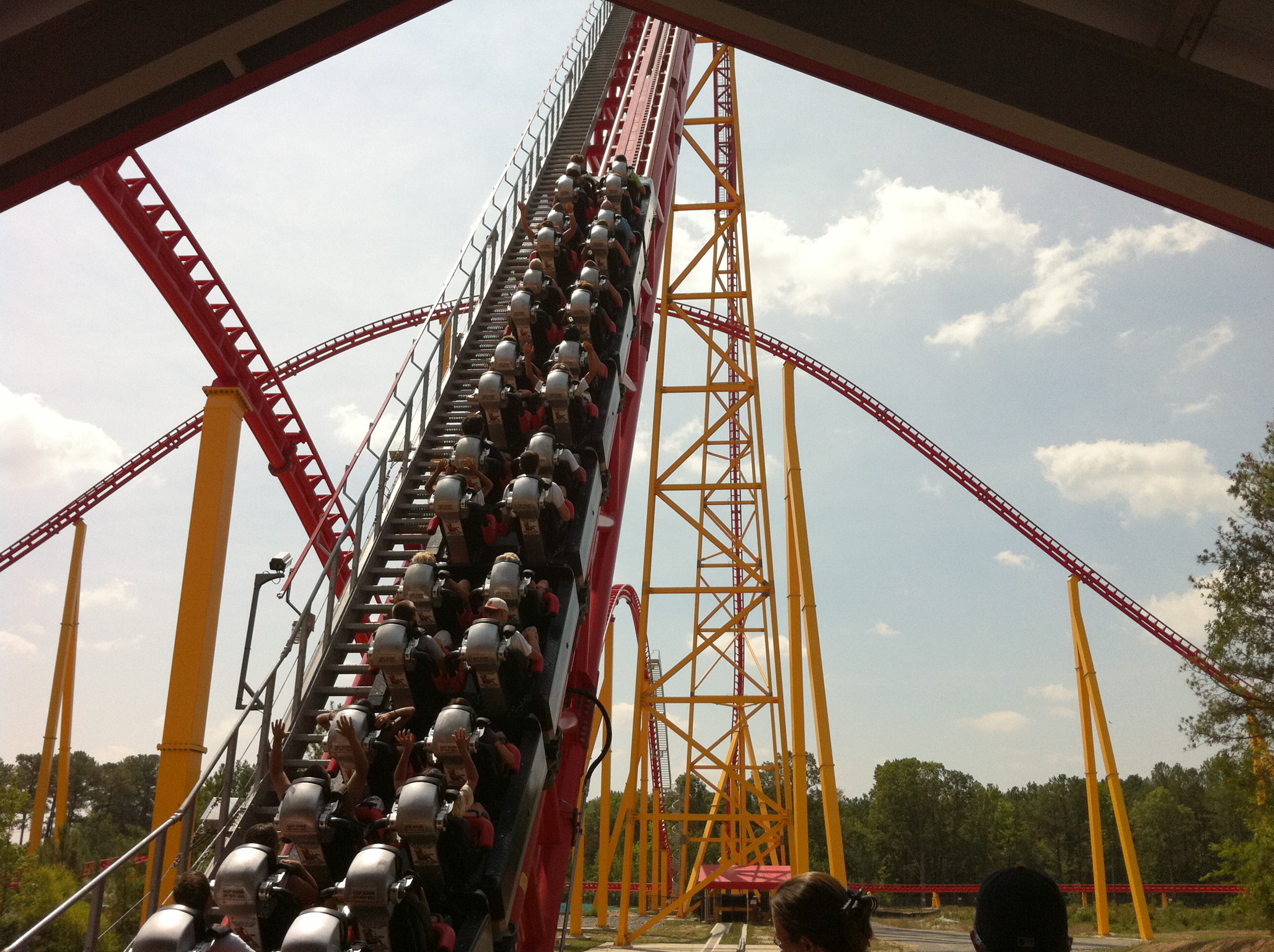
all metabolism processes release heat - you can consume protein carbohydrates or fat.At the top of a roller coaster, you have a LOT of potential energy just before you fall. At the bottom of the hill you have lots of kinetic energy (energy of motion). Stand on that track and splat, you are mowed over my the massive car. Chemical reactions release and absorb energy in much the same way.  Hold some explosive in your hand, you have potential energy, light the fuse and bang, release of all that stored energy at one time.

Get the picture?

The process of extracting energy from carbohydrates, proteins, and fats is metabolic oxidation.  We add oxygen to the “fuel” and “burn it” to release energy.  This is a extremely complex process, with lots of steps, but we can attack the problem from the basic energy in, energy out approach.

Let’s say you eat some glucose…or even table sugar, sucrose.  In both cases those two molecules have Carbon (C), Oxygen (O) and Hydrogen (H).  These individual atoms are all linked together with chemical bonds. Breaking these bonds requires energy (pulling the roller coaster up the hill) and then releases energy (going down the hill).

Some of the energy does work – like move a muscle, beat the heart or fire a neuron in the brain, but MOST of the energy (80%) is just waste heat energy (not temperature) that gets transferred to surrounding tissue and the tissue then increases in temperature.

What we will learn on specific posts about carbohydrates, protein, and fats is that each of them is processed a little differently by the body, but all can be used for that fundamental energy we need to live (pulling the roller coaster up the hill).

Additionally, we’ll discuss that proteins have a dual use – they can not only be burned like fuel, but they provide a store house of amino acids that are the basic building blocks of our tissue, hormones, and hair.  In that sense when you EAT protein, it is not USED by the body; rather it is broken down into amino acids and the body picks out the ones it needs to make whatever is on the “to-do” list – be it eye tissue, insulin, or keratin (hair & nails). The rest of the unused amino acids get tossed into the burn pile. We don’t store them.  When we dig into proteins, you’ll see that this word is so misunderstood, that it’s caused huge problems. We’ll find why our body doesn’t actually “burn” protein in much the same way as our body can’t burn “starch.”

On the other side of the balance, fats are places our bodies (and plants) can store energy.  We’ll talk about one other form of stored energy, glycogen, in the post on carbohydrates, but just remember that adipose (fat) tissue is a place to dump excess, non waste heat energy until you need it later (gas in the trunk).

So all of these hand-waving sentences: I need more protein to build muscles, high glycemic carbs are my problem, or it’s the good fat, are just distractions at this very basic level. If you were not fat, or competing in an intense triathlon, then really, any of these three fuel sources would do just fine for energy. All of them are acceptable for fuel. Some have more heat energy stored within and others have less.  Some can cause secondary hormonal issues, etc…but your body has evolved to process all three of these. Alcohol is another fuel we can throw in the mix – it’s digestible, but the by-products are toxic; it’s certainly energy that can be processed.

Sweet Mistakes

Ultimately, it is glucose – a simple sugar (carbohydrate) that fuels your brain and keeps the cells nourished. We monitor “blood sugar” and for most of us it stays in a pretty tight range.  Proteins and fat can be inserted into the process with some fancy tricks, but all the heat energy they contain is eventually assimilated to some part the overall system to process glucose.

What do you need to know from this to move on? Simple. These three macronutrients: carbohydrate, protein, and fat are all useful sources of energy. If you are about to run a race and are 6% body fat, you might want to stock up on energy. If you are worried about the scales and the only exercise you get is looking for the remote control, you probably have plenty.

Einstein said, “We can’t solve problems by using the same kind of thinking we used when we created them.”

Weight loss, ALL WEIGHT LOSS, is then the process of going on a naturally “high fat” diet and consuming your body fat to fuel the roller coaster of life.  For each and every heart beat, mouse click, or push up, you need some energy and you’ll want to get it out of your own reserves, not help plants and animals lose weight by eating theirs. If you only drink water, you’ll have no choice but lose body fat.

The problem with the starvation approach is that your body also has to constantly replace proteins (not necessarily your meat, but more hormones, cells, etc..) and in the next post we’ll look closer at how that complicates things and makes severe starvation, not the most appropriate form of weight loss.buy big water slides


**************

Like these  and want to help? Please take a minute to scroll up on the right side of the screen consider making a monthly donation to this program. You can also make a one time donation here:
Thanks!
Ray

With just two fingers you can prove how easy it is to adapt to cooler temperatures and lose weightIt’s a simple test to demonstrate that your body doesn’t require a perfect temperature to be comfortable, it has a range of temperatures that are comfortable.  Part of our amazing evolutionary survival is the ability to adapt. Not all adaptation happens genetically, it can be driven intellectually as well.

Changing the temperature of the environment around you is one of great examples. Read Full Article →