


 It’s hard to believe that this is only my second post for the year. Where did it go? I’ve not been sitting idle. First, a big thanks to ALL of the people that contributed to the open source fund for the Metabolic Winter Hypothesis paper. Not only did we reach the goal in under a week, but the paper has been a huge success. It broke all download records for the journal and remains their number one downloaded paper. Thank you for helping and thank you for sharing it with so many people.
I am currently working with the collaborators of the first paper, along with an expanded set of top notch new collaborators on the second and third paper. These will go much deeper into the issues of metabolism, Calorie, and assorted myths that we (yes, me too) have propagated during our quest to be the most obese human generation of all time.
Of course it can be said in a simple summary: “protein, carbohydrate, and fat” – speak doesn’t tell you much and you can’t out-exercise your mouth.
Today of course, one would believe weight loss and health requires a degree in molecular biology, but I can assure you that there are millions of words propagated in thousands of blogs by people repeating, not measuring. I don’t intend on wasting your bandwidth here and that requires a not-so-profitable diligence to do science first and promote second. For this I appreciate your patience and support.
But it is FALL!
At least in the northern hemisphere and that means mild cold stress season. Let’s take a few minutes to talk about some great papers that published in the last few months and some practical tips for easing into metabolic winter and getting the most out of it. Rather than plunging into shivering water or eating buckets of ice, it’s more important to focus on achieving mild exposure over longer durations. As the summer ends, we are warm adapted and we have an exaggerated response to cooler temperatures. 65F/18C might very well seem cool in the middle of the summer, but in the middle of the winter coming in from a ski run that same temperature is comfortable and warm. I explain more in Ch-Ch-Changes (you need to be a registered user to see archives – it’s free and I don’t send you junk mail to buy stuff).
The take home summary here is that we don’t really sense/judge absolute temperature very well and we can become accustomed to a warmer/cooler environment without much effort; this isn’t akin training for a marathon. One IDEAL way to become more accustomed to the warm-cool “shock” and acclimate is through contrast showers. I highly recommend these to everyone getting started. Check out Mitochondrial Anarchy for details on why, but I’ve included the photo here if you just want to jump right in.
As we explain in Metabolic Winter Hypothesis, there seems to be a strong interdependence with mild cold stress, caloric restriction, and sleep. These not only impact higher level interaction like found in the HPT-Axis, but also seem to play a strong role at the cellular biogenesis level. It seems that our circadian clocks are intertwined with both the season and energy management. That’s not a surprising idea, but we currently seem to be one seasoned in our approach to health: bright, active, and warm. For example, it’s well known that Seasonal Affective Disorder may be addressed by bright light therapy (thinkla spring/metabolic summer) and yet widely unknown that cold stress can have similar results. The question one then brings up: is it too little light or too much warmth that is causing the problem? No one can answer for certain, but our “fear of cold” learned response is to reach for the bright, happy light. We do the same thing with the “fear of hunger” and sugar, salt and fat.
Not everything we crave is necessarily what we “need.” Alcoholics and heroin addicts are just two examples of this change from have to have not that inserts a craving that is neither healthy or natural. We see it’s the sudden change that seems to rock the boat and contrast showers are one way to not only mute your response to that change, but further to begin an easy, comfortable adaptation to the lower temperatures ahead.
Una Siesta Fresca
We discussed in Beauty Sleep the wonderful advantages of cool sleep and some scientists at National Institutes of Health (NIH) , National Institute of Diabetes and Digestive and Kidney Diseases have beautifully demonstrated this in a recent study. Impact of Chronic Cold Exposure in Humans (ICEMAN) is a bit misleading (everyone wants to make it sound extreme), looked at 5 men ranging in age from 19-23 and looked at metabolic response. Over a 4 month period they were subjected to sleeping in rooms that varied from 66°F (19°C) and 81°F (27°C). Daytime activities were normal. BAT and metabolism was measured at the end of each month and researchers concluded that the warm, 81°F (27°C), suppressed BAT and metabolic activity, while the mild cold 66°F (19°C) increased the men’s BAT and metabolic rates.

Figure 1 Map showing the 100 clusters included in the study grouped according to their mean annual temperature. from S. Valde
A second study that I haven’t seen reported much was conducted by researchers in Spain. They found, after adjusting for lifestyle (physical activity, Mediterranean diet score, smoking) and socio-demographic (age, gender, educational level, marital status) that a clear association in obesity with mean annual temperature existed. The first question many ask me when I discuss my research is, “well, why aren’t people fat in that live in cold climates?” I typically respond, because we avoid the cold by layering and ubiquitous warm shelter and transportation. What is interesting about this study is that it’s somewhat a homogeneous culture and diet and the temperature range is 10.4-21.9C (50.7-71.4F). This is a perfect span of mild cold stress – reinforcing the point I always make here (and yet the media NEVER quotes me correct on) extreme is not necessary. Cool, not cold is the best approach. This was a final sample size of 5061 men/women and there is clearly a significant trend.
From the warmest to the coolest quartile, obesity prevalence rose from 26.9% (Q1)…30.5% (Q2)…32% (Q3)…33% (Q4). I think these both underscore the power of mild cold stress and also reinforce the metabolic winter hypothesis. I doesn’t take much over a long time to make a huge difference. As well, lipids are likely prefered in non shivering thermogenesis over glucose, conserving precious glucose to fuel red blood cells (they have no mitochondria and can’t metabolize lipids or ketones). If you ever see my name associated with an article or quoted in one that discuss crazy cold stuff, please know right then that I told the journalist, perhaps pleaded with them, to not make this article about extreme. They rarely listen, but just know I NEVER have a conversation with one that I don’t emphasize that point.
Gloves before sweater makes you look better – cover your symptoms of cold (nose, face, ears, feet, and hands) first and carry layers with you. Layer as needed and don’t layer and remove. Use caution in long duration exposures and don’t fool with water temperatures below 60F (15.5C) or air 32F (0C). Be safe as you can have a big impact without resorting to epic extreme.
Open Source Body
Besides writing, one of my main activities the last couple of months was setting up a non-profit 501(c)3 foundation to fund continued research. Having selected a founding board and kicked it off with an initial investment, it’s underway. We’re working on setting up a website and establishing a working relationship with several other organizations. We have the founding board in place and are actively seeking our science advisory board.
Our Mission is simple:
 With worldwide pandemics of chronic disease and obesity, Open Source Body is a network created to facilitate the collaborative research that might halt or reverse this trend. All data submitted or research paid for by OpenSourceBody.org will be available for public access.
The mission of Open Source Body is to extend the successful open source efforts that fueled the internet revolution to areas of health, fitness and nutrition. We operate under the simple principle that good health can be found in every body.™
I am encouraged by the participation and support you have given me and I think this can be scaled. The internet is loaded with blogs that preach health under a never ending drum beat of selling supplements, plans, and you name it. I’m certainly not against anyone making a living, but it doesn’t play well when they turn out to be wrong and have an entire business built on a house of cards. That ends up in senseless attacks or bullying and really, I don’t want to participate in this sort of fiasco. We only learn when we are wrong – every good scientist understands this. What I seem to encounter more often than not on blogs are people with science backgrounds that just repeat, repeat, repeat. The story is now down to such a reductionist level that one needs a degree in molecular biology to keep up or go grocery shopping. It appears to be a never ending contradiction to the public. This ever increasing techno talk bodes well as people end up being easily bamboozled with techno-talk.
Carl Sagan had this to say:
“One of the saddest lessons of history is this: If we’ve been bamboozled long enough, we tend to reject any evidence of the bamboozle. We’re no longer interested in finding out the truth. The bamboozle has captured us. It’s simply too painful to acknowledge, even to ourselves, that we’ve been taken. Once you give a charlatan power over you, you almost never get it back.”
So rather than rant more about this, I want to do something proactive to make a difference and my first self test is under way. I’m trying not to be tricked and I know the human brain, more importantly my brain, is biased to patterns. It’s tough to escape it, but with good measurement it is possible. About a year ago you might remember I did a small, 6 week self test and it was an incredible success with some unexpected outcomes. Knowing I didn’t have enough data to fully capture what was going on, I decided to repeat it and up the ante a bit. I have a team of researchers that helped me design and carry out this test and it’s been pretty damn exciting.
 To start, I gained (0ver 3 months) 15 lbs and held that weight for over 2 months before I began. I have been weight stable for nearly 6 years outside of the couple of short experiments I did over a year ago. That stable weight was about 20 lbs above my ideal weight. The goal was simple: track it all and lose 30 lbs in 6 weeks without exercise or supplements and test some of the fundamental notions of the “nutritional emergency/deficiency” everyone seems to bellow on about in an endless onslaught of advertisements.
I began the Phase 3 on November 8, coincidentally my 50th birthday, and as of today I haven’t eaten for 11 days. Over the weekend, we did full amino acid profiles every 4 hours over 24 hours. I look like a junkie with track marks in both arms and both hands. It required me to pack my lab and drive 2400 miles to California. I’ve measured my metabolism daily throughout this 6-week test and despite losing 30.3 lbs already and not EATING for 11 days, my body is not going into “starvation mode” >gasp<, which is oft reported by fitness, blogs, and media (and researchers, physicians and dietitians). I suspect most that proclaim these metabolic doomsday have likely never measured a single metabolism in their lives; they might not even know a person that has. Am I a genetic freak? I’m not betting on it as my data matches almost identically the results of the great scientists of the 19th century that studied this subject back when this was actually cutting edge research.
There are too many repeaters.
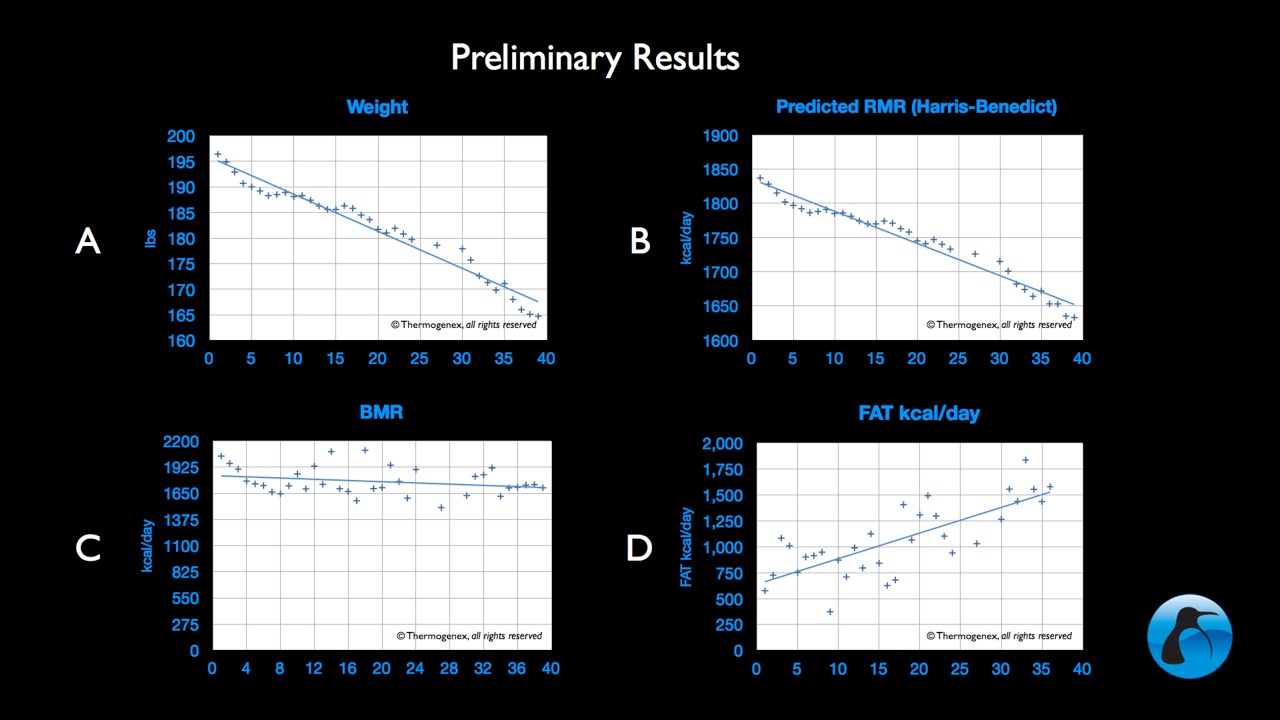 Today I decided to plot some data, after all I have to do is take needles and drink water and how much of that can one take? I exceeded my goal of 30 lbs today with 3 days of water left, but it’s pretty exciting to share this with my blog followers. If you are new to the blog, I highly recommend you stop now and go back to the Muscling Your Metabolism posts and work your way though. Once again, it’s respiratory quotient that everyone leaves out of the “broken metabolism” drama that is key to understanding what is happening.
Take a look at the graphs. You see my weight loss (A) is is pretty constant and of course if one just goes by the RMR of the Harris-Benedict equation (B), it predicts a declining metabolism. Remember, metabolism scales with MASS not lean mass. The bigger you are, the more calories you’ll burn. It’s similar to the riddle, which weighs more, a ton of feathers or a ton of bricks? Likewise, whether you lug around an extra 30, 50 or 100 lbs of fat or steel all day long, it’s going to amp up metabolism. More on this in our next paper.
Okay, this is where the FUN begins. As you can see (C) my BMR does drop over the first 8 days or so. Can this be the dreaded “starvation mode” that we are warned about? Will it crash to zero and cause me to balloon back to 230 lbs? What if I skip breakfast???? There is an ever so slight downward trend of BMR as you see in the linear curve fit, but as I have have often warned, the magnitude of metabolism is almost irrelevant. Think of it like a business. What do annual sales tell us about the health of a company? Not much. They could be making $100 million a year and losing $25 million a year in a slow (fast) bleed. We need to see the balance sheet. Tell me about net income or EBITDA.
The same is true with metabolism and we need to know how the metabolism is partitioned between carbohydrate or fat so take a look (D). Clearly my FAT metabolism is not staying level, in fact it’s zooming up. That’s because starvation mode is BURNING OUR RESERVES. How simple can this be? I mean, why do we have fat anyway if not to burn it in times of caloric scarcity. As we point out in Metabolic Winter Hypothesis, that used to be an annual stressor. Now, winter never comes. We need to stop making things so difficult.
More Work To Do
I’m so excited by the results and it’s been an incredible journey and learning experience. There’s a lot more, but I wanted to share that with our community now and ask for your help. I am raising $15,000 to help defer the costs of the testing and travel associated with this test. As well I’d like to begin the Open Source Body website development and design. I am done self testing (at least for weight loss) as I intend on staying within my ideal weight from this point forward. I’ll finally put exercise back into my regular activity and continue to work with mild cold stress and calorie restriction to help define ways more people can practically adopt it into their lifestyle.
As always I am grateful to all of the regular donors, emails, FaceBook Friends, and commenters for allowing me to pursue this passionately for the last 5 years. It’s been such an unexpected adventure and there’s much more work to get done. I’m going to get back to my water now – have to be well hydrated for that massive amount of blood to be drawn tomorrow morning.
Thanks!
Ray
References
Lee, Paul, et al. “Temperature-acclimated brown adipose tissue modulates insulin sensitivity in humans.” Diabetes (2014): DB_140513.
Valdés, Sergio, et al. “Ambient temperature and prevalence of obesity in the Spanish population. Di@ bet. es study.” Obesity (2014).


