Currently viewing the category: "Blog"

I hope that everyone feels a little more enlightened on macronutrients and I’ll try to refrain from using the “protein, carbohydrate, and fat” dietary jabberwocky  unless there is a biological/technical reason for pointing it out. If you SEE those words, please note that I am not describing food  groups (like meat or potatoes).

I really believe everyone’s health would be greatly improved if you simply didn’t use these three words in any way in making food choices.  It may seem trivial, but it’s not. Our image of these words and the cascading, general inadequate explanations of what happens when these are ingested cause a major distortion of reality.

We need to cover one more area to wrap up the macronutrient misdirection.

There is absolutely no question that macronutrients come in packages called “food” and after these last two posts, you should understand why it is futile to try to balance these in some mythical ratios. If you do, don’t be surprised if you end up with the same results of the last 40 years.  I want to challenge another notion and that concerns our evolutionarily power-hungry brain.  The computer analogy says that the brain is the CPU – it controls and makes all the decisions.

It has the master plan; but wait, I thought the big revolution of the last decade was solving our genome – the blueprint for life?

It turns out that the computer analogy, while being ‘good enough,” sort of fails when compared to reality. Every single cell has your blueprint. We were all once just a single cell and then two..and four…and fingers, toes, and nose. Much of it before the brain seized intellectual control. My daughter is 16 and I don’t think hers has taken over yet. Sometimes I wonder about mine.

The point of discussing this is many of our daily maintenance functions happen at the cellular level without the brain’s interaction. More importantly some of these functions TELL the brain what to do not the other way around.

Enter Addiction

Let’s do a simple test. I want you to vividly imagine that you are walking into a movie theater. You give your ticket to the attendant and  suddenly it hits you. That smell. Do you smell it? Popcorn, buttered popcorn, salted butter popcorn – large bucket.  As you walk over to the counter the lizard brian take over and, BAM, you plop $20 down for popcorn and a drink. Now scoop up that first bite in your hand to find it warm, greasy and it smells delicious – Are you with me? It goes into your mouth only to realize that your over zealous hand grabbed a little too much and you stuff that in there too… Can you imagine it? Can you taste it? Can you smell it?

salt. fat. sweet. Nature’s survival flavors.

Most people can make their mouth water just thinking about this scenario. So, maybe we aren’t in as much control as we like to believe. Our brain is certainly involved in all of those decisions, but there is something else at play if we dig a little deeper.  Our gut. You see, before your brain ever “learned” that these were good things, you were imprinted through your digestive system. Sweet is one of the first things and happens in the very early days of life through nursing and breast milk. Put a little sugar on a newborn’s pacifier, give it to them while standing close staring, and  you’ve made a an instant friend. It doesn’t end there and digestive system, from chewing to defecation, is important.

I want to argue that there is something much more important going on in your battle of the bulge. I believe over the next decade we’ll see that it is at the root of our surge in chronic disease and obesity. It’s our digestive system.  It’s extremely complex with a lot left to be understood.  In The Second Brain (Gershon, 1999), he lays out an incredible story of the control between the brain<–>gut. What is fascinating is it is a two-way control system.

NASA KC-135 aka - The Vomit Comet

I saw some of this first hand. When I flew on NASA’s Zero-G plane (aka the vomit comet) for a decade, I was one of the fortunate that never got sick (if you are ever with me in person, remind me to tell you about the “teacher flight” – I’d rather not write about it). For those not familiar, we take a large plane and fly a roller-coaster like flight, which basically drops you 10,000 ft.  You feel weightless for 20-30 seconds.  It was a lot of fun.  Eventually, with my business partners, we commercialized it  (gozerog.com) but, we created a flight profile that cause very few to get sick (many “lost their cookies” on the NASA flights).  The root of sickness is in the conflict between your inner ear and eyes. Your eyes see one thing, your ears tell you there’s no up and down and blahhhh in the bag (hopefully you don’t miss).

Govt-issued puke bag

The interest here is that the body somehow interprets dizzy as an evolutionary sign of eating something poisonous and invokes the “empty the stomach” command. Once people were imprinted with that experience, just the smell of the plane was enough to start them on the path over the edge.  Similarly, think about when you are sick – do you feel hungry? In fact, don’t  you nearly always lose your appetite?

All of this is a complex, two way path between your gut and brain and what we are learning is that the gut is not just a sensory organ, but in fact send signals and the brain obeys.  How have the relatively recent advances of transportation and refrigeration changed what we eat in week, a day or even a meal? Do we think our evolutionary past was really as diverse as it is today?  All of this is only how our own digestive processes impact food.  It get’s even more complex enter:

Trillions and Trillions of Bacteria

It’s always interesting to learn something that just doesn’t fit our world view or is hard to comprehend.  I was drawn to space exploration by thinking about the magnitude and grandeure of the universe – you know, Sagans “billions of stars” (he never really said it, but it stuck).  Well here is a new thing to consider: There are 100 trillion microbes in and on your body, but “you” are composed of only 10 trillion cells. That’s right, “you” are only about 1/10th the cells moving around in your mass – the rest is THEM.

The gut is one of the places these microbes reside. Without them, you would die.  In fact, our microbiome, as it is called, is one of the next great mysteries to unravel. The Human Microbiome Project was launched by the NIH to identify and characterize the microbiomes that exist in various parts of the body. Each of us has a different microbiota, or bacterial gut make up, and this profoundly influences how you process food. The microbiome is the total genetic “fingerprint” of these microorganisms.

Understand we have to “feed” the organisms that reside in the gut and the exact balance can be related to diet. For example, Researchers at the Copenhagen University Hospital recently identified a correlation between antibiotics given in the first 6 months to infants and being overweight by the age of seven (1). When you take antibiotics you kill the good bacteria with the bad.

Thinking about just taking a “probiotic” to fix the problem?  These contain 4, 5, maybe 10 types. You likely have 500-1000 species and some estimates are ranging up to 35,000.  In April 2011, researchers defined three enterotypes, or clustered ratios of Bacteroides, Prevotella, or Ruminococcus species. Looking at individuals from Europe, Japan and Unites states, these enterotypes not only cross international and continental borders, but also race, ethnicity, age, and sex.

Beside the general information found on the HMP page of the NIH, one of the best open-source papers I found is this 2010 review article in Physiological Reviews. It’s long, but if this subject interests you, there is a lot of information. In terms of your microbiota influence on you, the authors point out:

“Nutrient metabolism by resident microbes is not carried out strictly for the host’s benefit; part of the energy extracted from luminal nutrients is designated for the microbiota itself, to maintain its numbers and fitness. It has been shown that members of the gut microbiota are able to adapt their metabolism to the conditions of the intestine, responding to substrate availability.” (3)

Of course these populations of little metabolisms all have their own byproducts, some good, some bad and we have to live with what they do. This is where food could provide a very key role in molding your microbiota make up.   While this research is expanding exponentially, one has to rethink the old saying – YOU are what you eat. What about them?

The Scoop on Poop

This is a part that edges on TMI, but unfortunately, there’s a lot of information lurking in this not so fun subject, so here it goes.  I used to love reading “The Holes in Your Nose,” The Gas We Pass” and “Everyone Poops”  to my kids. The truth is despite the stink and embarrassment of letting one go in a silent room, this is all vital to a properly functioning body. Your poop matters. In fact, it’s a great sign of what is going on inside you every day.  How long does it take to get through (transit time)? How is it shaped? Color? Smell? it all actually matters and can be a sign of healthy or not so healthy microbiota and diet.

I don’t want to get into this too much (I guess technically that would put me in deep-shit), but I do want to at least draw your attention to the daily bathroom visit. At the very minimum and I am probably going to regret writing this so don’t give me shit, but corn is a GREAT tracer particle if you want to figure out transit time from mouth to toilet.  Pick your favorite meal and swallow a tablespoon of corn, midway through. Wait and eventually there it is.

It’s sort of interesting to note that that time changes depending on meal size, frequency of eating and even hydration.  As well, it changes SIGNIFICANTLY with diet. When diet changes, for example when I began eating a mostly-vegan diet, I saw significant changes for about 6 weeks. On the other hand, if I occasionally have chicken wings or ribs, bam, it can change dramatically with one meal.

In one direction meat->vegan, gas was TERRIBLE for a time.  This is because the make up of my intestinal tract allowed a lot of undigestible oligosaccharides (remember our carbohydrate posts?) pass through the small intestine.  These saccharides are more complex than simple sugars, but less than a starch. When not broken down in the small intestine,  they make perfect food for some of the critters living in the colon and fuel these gassy tagalongs.  These are often referred to as prebiotics – including digestive resistant starch and fermentable fiber.

It is now believe these are all helpful in forming B vitamins along with short chain fatty acids. They can even promote calcium and magnesium absorption.  In the next (AND FINAL) post on the intestines, we can look at the various intestinal sections and the feed forward response.  I think you’ll see why a change in diet can really have an interesting side effect. Note that these changes need to be long enough for the beasts inside to fight among themselves and come to a new equilibrium.  For example meat/fat microbiota can be thought of as looking different than starch/zucchini.

It’s not that simple, but suffice it to say that it DOES matter. So much so, that (I’m not making this up) fecal transplants are now being looked at to control type 2 diabetes (4)!  So eat right or get a transplant – you decide what’s more pleasant: Calorie Rich And Processed (CRAP) food or taking a donation from Aunt Catherine?

All crap-jokes aside, we are only beginning to understand the implications of just how important these symbiotic beasts are in our health.  What is more important is that you will see that much more is going on than one might think, and how one digests foods is critically important to health and weight loss success.

Maybe we should be saying THEY are what we eat.

…to be continued.

**************
Do you like these blogs and want to help me? Please take a minute to scroll up on the right side of the screen to consider making a monthly donation to this program. You can also make a one time donation here:

Thanks!
Ray
(1) Childhood overweight after establishment of the gut microbiota: the role of delivery mode, pre-pregnancy weight and early administration of antibiotics, International Journal of Obesity (2011) 35, 522–529; 
(2) Enterotypes of the human gut microbiome, Manimozhiyan Arumugam, et al., Nature 473, 174–180 (12 May 2011)
(3) Gut Microbiota in Health and Disease, Inna Sekirov, et al., Physiol Rev July 1, 2010 vol. 90 no. 3;
(4) The therapeutic potential of manipulating gut microbiota in obesity and type 2 diabetes mellitus, R. S. Kootte1, et al., Diabetes, Obesity and Metabolism Volume 14, Issue 2, pages 112–120, February 2012 


After 4 months we are finally nearing the end of our dietary journey.  We discussed the basic context of Macronutrients (protein, carbohydrate, and fat) as “fuel.” We learned that there is a group of Micronutrients – vitamins, minerals and phytochemicals that all constitute “service” or biological maintenance.  We understand that fat has more energy density (2x) than protein or carbohydrate.

Our body uses primary fuel glucose/glycogen through the TCA or krebs cycle to obtain energy (brain biggest single user, followed closely by liver and muscle)  and the body stores a glycogen (a special muscle protein with a carbohydrate shell) and fat (adipose tissue) for rainy day “reserves.”

If you are REALLY starving, or consume an excess, protein is (inefficiently) converted to be used in the sugar cycle through gluconeogenesis (creating new glucose from protein).  The body protects protein a bit, because there’s no sense in digesting the muscle tissue when there is plenty of fat or glycogen around to tap into. Fat on the other hand goes through a different pathway from protein/carbohydrate to derive energy (beta oxidation), but after that are dumped into the same krebs cycle.

Proteins DO NOT = Flesh. There are many very important proteins from enzymes like insulin to blood proteins like hemoglobin, which are recycled and recreated every day.  Proteins are macromolecules, unique sequences of amino acids that are defined by our genes. New proteins are created every second in your body and others are eliminated.  Protein is NOT a food group that you need to “manage.”

You should now recognize that when we break down the bonds of a starch (a carbohydrate) into glucose (a simple sugar) it happens through an enzyme (e.g. amylase created by the AMY1 gene) and we don’t have the enzyme to break down fiber (cellulose). Remember that both starch and cellulose are long chains of glucose – only one is digestible by Humans. Termites and cows eat cellulose in wood and grass to obtain glucose.  Similarly, agave and corn syrups are both high fructose (a 5 carbon sugar) syrups and one is squeezed from corn, the other from Agave plants. Fructose is fructose and I’m not a big fan of simple sugars of any kind as a main dietary source of energy.

We discussed fat as a storage container for energy and it’s necessary role in the diet. We touched on cholesterol – the bold blood biomarker advertised as an indicator of health – and its role as a basis for Vitamin D and all cell walls. We know that to lose weight we MUST go on a naturally high-fat diet (consuming our own).

Finally we figured out that proteins have a bit of an identity crisis in that they CAN be digested for energy, but what we actually need from them is the 10 essential (indispensable) amino acids that our body can’t synthesize. This causes the protein conundrum and is what sends everyone into a “pass the protein” muscle-head mindset.  Ultimately our body needs energy and amino acids to repair or build muscle that has been biologically stressed from a workout. “Protein” does not have to be the source of both the energy and the amino acid. It’s only required for half of the 20 amino acids (the 10 essential/indispensable).

To be clear about our need for amino acids, I want to dig deep, to the very OTHER end of this dialog, because it will be far easier for you to let go and follow along.  So please, set aside your bias and what you may believe about “protein” and let’s look at it from a very different perspective.

Roots

Roots - A California Redwood is a MASSIVE living organism full of "protein"

Let’s take a trip back to grammar school science class. The plants use chlorophyll and CO2 (carbon dioxide) along with energy from the sun for photosynthesis (photolight + synthesisputting together) .  Plants make sugars – sugar cane? Fruits? Tubers/rice starches (poly sugar)? All from carbon dioxide and sunlight. When you see the giant redwoods in California we KNOW they didn’t eat anything at all to grow that big. they absorbed a little carbon dioxide (okay a LOT) from the air, sprinkled sunshine, and presto.

These are MASSIVE living organisms with complex biochemistry and structure. They are full of all sorts of regulatory proteins and cells. Trees create cellulose (remember – long chains of glucose with beta amylase bond) to reach enormous heights. How about all the chlorophyll protein in the leaves? More massive and more protein in one of these single trees than your biggest meat-head on Venice Beach – don’t you think? In fact, did you know scientist are devising new ways to classify trees based on Phylogenic analysis – looking at  molecular structures of  DNA, RNA and protein to group closely related organisms (like trees)?

Where do they get the protein?

Nitrogen Cycle: source - wiki commons

The roots. They form these amino acids (remember Nitrogen?) from the “fertilizer” we put on the ground around them. Farmers often refer to the fertilizer as nitrogen or nitrates and while there are a few more things they get, understand that the nitrogen is critical for both protein and DNA/RNA.  They need these same building blocks, but can’t seem to get the “perfect protein” of an egg into their system.

Guess what – Plants can synthesize ALL 20 amino acids. A potato has every single amino acid. So does rice, but wait, aren’t these “carbs?” Not only that, you’ll remain in POSITIVE nitrogen balance  even if that’s all you eat [Nitrogen Balance is a measure excreted excess nitrogen from protein not needed in urine/feces]. I’m not suggesting an all potato diet, but if this is true, how does that impact how you think about food?

Where do you get your protein?

Even venus flytraps  and other carnivorous plants derive some of their nitrogen from fertilizer and ALL of their energy from the sun. They shun protein as a fuel.

The nitrogen cycle is well known and there’s no need to go into in in great detail, but  just understand we can eat animals that eat plants or we can eat plants.  We can get complete, sufficient compliment of the 10 amino acids that we don’t make either way. There’s no debate. Everything else is simply ideological arguments and I gave up politics when I retired from my government job.  Everyone can debate it, but the science isn’t going to change.

Tie Me Dinosaur Down, Sport.

Herbivores eat plants (maybe not redwoods) and they get essential amino acids and energy from grasses, leaves, and even fruits.  We are talking about some of the largest animals on the planet and even herbivore dinosaurs out numbered carnivorous dinosaurs.  We have discussed that a “grass fed” cow that has “complete protein” (amino acid profile) and gets its protein from…grass. If we ingest the beef, we get the amino acids (synthesized by the plants) use some for repair and burn the rest.  We don’t store amino acids, we just use them.

Potato - Vitamins, minerals and protein - OH MY! There are many foods with protein that we unwisely categorize by the dominant macronutrient (e.g. potato = carbohydrate). This is a mistake. source: http://www.potato2008.org/

I would have to say my “beef” with all the protein double-talk is that it’s not hard to understand. Why do we complicated it? Why don’t we talk about foods to eat instead of vilifying/praising the macronutrient de jour.  I don’t want to convert anyone and I don’t want to be converted. I just want to understand a pattern of eating and how it fits in with basic caloric and nutrient needs.

This is really not difficult science and yet everyone pauses at a vegetarian or vegan diet with an incredulous question, “where do you get your protein?”  By now, hopefully that is sounding pretty ridiculous to everyone.  It’s not difficult to eat complete amino acid profiles or sufficient quantities. You don’t have to mix and match sources.  The fact is that we are flooded with a massive excess of protein/amino acids every day and most of them are inefficiently burned as fuel putting loads on our other organs to screen, sift and sort.

This is NOT an appeal to get you to “switch” a diet. It’s simply a basis for a rational understanding of what you eat and why.  It’s a foundation of information and review of things we know to be true so that you may then ask yourself a basic question: why would anyone educated to any advanced level be recommending or suggesting that “protein” is a necessary “something” you actually have to manage day to day?

This kind of thinking isn’t limited to protein pandering by diet gurus, physicians, and nutritionists. Remember, the sun once rose in the east and set in the west and that was PROOF that the sun revolved around the Earth – can’t you see it right there every day, you idiot? So democracy doesn’t win in science, at least not for long.

This protein argument is not much different and it’s most likely rooted in economy of agriculture, ideology, and cultural bias.  I can’t believe how I have been attacked for just EXPERIMENTING with a vegan diet.  It’s a “label” – oh, so you are a VEGAN? NO, I am not a vegan.  No one  should have to bow to such social labels, but we all know it happens on all sides of the debates.

I don’t want to engage in this debate of a pragmatic vegetarian (for health) vs an ideologic vegetarian (don’t eat animals), because it has all sorts of dimension, but none of the debate needs to be about protein, carbohydrates or fats.  Food doesn’t need to be described that way and everyone seems to have an ideology that drives their view of the science, rather then letting the data speak for itself.

If you want to deal in ideologic vegetarian arguments, I heard the most persuasive argument against eating animals (carnism) in my life recently by Dr. Melanie Joy and she does make some good points. I wan’t persuaded for those reasons, but it was the most compelling argument I’ve heard to date.   This is not my mission, but then again, I don’t see the difference between eating your house cat, a salmon or a cow in terms of basic food macronutrients. They would all provide fat/amino acids with a few fat soluble vitamins from a strictly scientific perspective. When you pause to think about it, other than fish and perhaps the seals eaten by Inuitsboost meat consumed is from herbivoires. Generally speaking, we don’t farm carnivores and I think for good reason.  These are all available from plants as well. These are not mutually exclusive arguments.

Kathy Freston - The Veganist

I’m not advocating eating cats or avacados right now, just making a point. We all have some sort of ideology that is brought to the table to justify what we do and reject what we “believe” is wrong. Kathy Freston (the veganist) talks about “leaning into” a vegan diet in her new book, The Lean. Her husband eats meat. She does not, but she can tell you all sorts of reasons (like her personal ideology and ridding herself of life-long acne).  She and I have discussed this and we both have to laugh, because her book or cause isn’t a discussion about protein.

On the other side of the table, there are many “Vegans” that parade unproven health benefits to disguise ideological arguments.  That is no more correct than the USDA misrepresenting food calories (like fat) on labels using a ridiculous per weight reporting system combined with recommended daily values of nutrients described per calorie. Of the two issues (vegan health or food labels), the latter is probably more responsible for deleterious health of the world.

So, to everyone reading – I am openly experimenting (with good results) with a nutrient dense, calorically restricted diet and I have been working on limiting protein consumption and biosimilar macromolecules by eating a vegan diet. I get plenty of protein.

I needed to understand how to burn fat quickly and eventually it challenged everything I knew about food.  I learned that when you cut down to a “naturally high-fat diet” of love handles, beer bellies and thunder thighs, it’s amazing how well it goes.  Sprinkle a little micronutrient on there and get your game on. Adding thermal loading takes it to an entirely different level.

Got Milk?

Finally, how much amino acid  (protein) do we need? I decided to do a little research to look at protein, carbohydrate and fats in various milks.  I mean, would anyone argue that a growing baby isn’t best fed by its mother’s milk for at least some period of life? This is not by any means the final word, but it certainly might give us some clues; although sometimes I feel like I’m living in the nutritional equivalent of National Treasure. I found sources everywhere and put them into a giant spreadsheet so I could plot protein, lactose (carbohydrate), and fat.

I won’t do a lot of interpretation, but instead let you take a look. How do Human infants stack up to other species? We learned last year (BATgirl 1 & 2)  that human infants are born with more fat and BAT than nearly any other species. We know that there are many factors in determining the “perfect food,” but one would think that good ole Mother Nature might get something right. So how does it look?

[Click to Enlarge]

Percent Protein in various species of animal milk © Ray Cronise

Percent Protein in various species of animal milk © Ray Cronise

Percent Fat in various species of animal milk © Ray Cronise

I think right away you should recognize species of arctic or aquatic environments as having a lot of energy and “leaning” on fat (sorry Kathy, damn that’s a good term). Then there are the fast growers, like rats, that have enormously high protein requirements.  I haven’t plotted some of the other things I have in the table like “time to sexual maturity” (do men ever get there?), but there is a lot to learn.

Also, I’m not suggesting that this is the holy grail of diets – you all know that I believe balancing protein, carbohydrates and fats is not only futile, but is exactly how we created this entire mess in the first place.  I just want to point out a few obvious confused facts in the diet lore that abounds. Is goat milk REALLY a closer to Human milk than cow milk? I’ve heard that before.  What species matches ours most closely and if we are to consume milk past weaning, why don’t we drink THAT? Am I sounding like an Ass? Wait, what about the fat?

Marketing is way ahead of knowledge and I too stayed in the dark for WAY too long.

We are basically starchivoires. It’s how we derived our calorie needs for millennium and it really helped us evolve this tremendously energy-hungry brain. Underground storage organs, Tubers, corms, rhizomes, and bulbs, are available year round in the areas where Humans are shown to evolve (my ancestors: maternal – Haplogroup J1b and Paternal – Haplogroup R1b1b2a1a2 as I had my genotype analyzed along the way). With that said, we can eat other things too and they may prove to be better in the long run, but starches are not “evil” and I’ve seen direct proof of diabetes reversal on a starch-based diet.

I think you’ll see the work of Dr Nathaniel Dominy move ahead of Dr. Loren Cordain in the future and yet both have something to important to contribute to evolutionary biology foundation.  I have absolutely no doubt that meat has played a significant role in our evolutionary past and feel equally certain that excessive dairy consumption has been part of the energetic demise.

Many Paleo and Vegan proponents agree on the deleterious health effects of milk, but is it the protein, carbohydrate, or fat that’s the reason? What about other biomimetics (biosimilar compounds) in dairy (let’s lump cheese, yogurt,  ice-cream in while we ware whipping) and what role do they play? Is it an immune response to whey are casein that is similar as the oh-so-popular evil wheat-gluten protein? We just aren’t sure and yet there are THOUSANDS of good, peer-reviewed papers on the negative effects of dairy consumption and none of it ends up on the “got milk” posters in the school cafeterias.

We know, for example, that bovine (cow) insulin is only different by three amino acids (out of 51) from human insulin. If you believe that human infants get very important enzymes and protective hormones from ingesting their mother’s breast milk, can you at the same time reject that you might be getting harmful ones by drinking the milk of another species decades after you would have been naturally weaned? What health impacts occur due to these biologically active compounds? What if we package it up as “solids” and feed it to our kids three times a day as cheese? Why is it so damn hard to walk away from eating it???

Did I mention how much I LOVE to eat cheese and yogurt? Well, I do and I still do even after not eating it regularly for nearly three years. I’m guilty, but I have that evolutionary big brain and I want to use it to inch my health along.

There are plenty of successful groups of people (like the inuits) that have moved into more energy demanding environments (like cold) and have been able to adapt the diet to eating higher levels of fat to make up energy deficits. The same is true of the original mediterranean studied in the late 50s (now the basis of the olive-oil craze).  We can eat energy dense foods when we NEED the calories. Are they really more important?

I know that calories count. The discrepancy is in the counting and labeling.

I hope this has been informative. Again, the take home is that when we are trying to run a calorie deficit, don’t fall for all of the little tricks – you’ll have to get over the addiction to calories one way or another whether they originate as ingested carbohydrate or fat.  No one knows for certain what the “real answer” will be, but I hope all of you feel a little more well-equiped and begin talking about FOOD not protein, carbohydrate or fats. What I’ve learned first hand through mild cold stress is that the Human body is amazingly adaptive. You can’t fool it easily and there’s no need to do it.

Note on comments – Let’s not diminish this to a vegan-paleo debate, nor talk about co-founding variables in the china study. What I am more interested in help is in the foundation of FOOD and food groups in lieu of protein, carbohydrate and fat.  I want you to see that food is typically a mixture of two or all and that we end up in traps by the “majority macronutrient” classification scheme.

I will touch on the feed forward response, satiety and absorption next and then we’ll return to the regularly scheduled program on mild cold stress – already in progress. Thanks to EVERYONE for support (paypal) and acting so incredibly civilized.  I think this blog is starting to take root over in the paleo and vegan worlds, let’s hope they all remain as respectful as everyone has here. I really appreciate it and apologize that we had to veer off mild cold stress for foundational material. It will be necessary information for the next step in thermal loading.

And last, but not least, having just spent a week with Wim Hof over at his home in Amsterdam planning our next chapter, take a few minutes to look at these hysterically funny commercials by Columbia Sportswear:

https://www.youtube.com/watch?v=17Pc85ypazE

You can see them all at:  Columbia Sportswear Omini Heat

and let’s NOT forget our very own Andrew Stemler at Crossfit London:

**************
Do you like these blogs and want to help me? Please take a minute to scroll up on the right side of the screen to consider making a monthly donation to this program. You can also make a one time donation here:

Thanks!
Ray


NASA Protein Crystal Growth (PCG). High quality crystals grown in microgravity to determine 3 D structureCan you pass the protein? I’ll have a little protein with that. I’m dragging a little, I think I need some protein. I’m really trying to bulk up, what are you eating for your protein?

Okay, I admit I was of the same mindset. I once recommended “one serving of protein and one serving of carbohydrate with every meal.” I lost 50 lbs on that advice and yet when challenged by a 11 year old girl with a simple question my “belief system” was stopped in it’s tracks. I took biochemistry in undergraduate and graduate school. I worked in the Biophysics Branch at NASA’s Marshall Space Flight Center.

While there, I even participated in research on protein crystal growth. We wanted to grow these crystals in the quiescent environment of microgravity (weightlessness) to determine the 3D structure – a lock and key approach to the many complex biological systems sustaining life.  Back then I studied the growth of hen egg-white lysozyme and also had my blood drawn weekly to extract hemoglobin to developed liquid-liquid chromatography techniques to resolve separation of from other model proteins like horseradish peroxidase and whale myoglobin.

My goal of telling you that is not to establish credibility or to boast. It’s for you to consider after we go through what should have been an obvious understanding to anyone that has studied biochemistry or protein chemistry in detail. It’s to demonstrate just how profoundly ignorant EVERYONE seems to be about this subject when it comes to food. I’m as guilty of it as anyone.  It’s as if there is a mysterious wall put up and we all just blindly follow the common explanation in a trance marching one by one over a cliff.

I had all of the information and background necessary and could not answer the simple question from that 11 year old girl on the spot:

“if you’re eating beef for protein, where do cows get protein, because they eat grass?”

I honestly couldn’t completely answer the question. I left that day back in 2009 and headed to attend my first TEDMED conference. There I met some of the most amazing scientists from  Nobel prize winning Biochemist, Kary Mullis, to Apple Co-Founder, Steve Wozniak. The list goes on and among that list was Cardiologist, Dr Dean Ornish and his wife, Anne. They’ve been involved in helping heart patients for years. His work has been featured and ridiculed, but it’s never been disproven. They run a successful practice in beautiful Sausalito California and were even named the 2012 top heart-healthy diet by U.S. News and World Report a few weeks ago.

TEDMED is about being vulnerable and asking questions. I’d been working on lowering my total cholesterol. It started at 240 and had come down to 220 with diet, exercise, and weight loss. I had a debate with a female, “rock-star” friend in late 2008 that convinced me to try Pescetarian (fish, dairy, and eggs only).  This did result in a change in my cholesterol taking it from 220 to 209.  My  “protein” was reduced to dairy (mostly yogurt and occasional cheese) and Fish (mostly salmon) – no “red meat” and no chicken.

Dean was quite clear, “Ray, cut the dairy and limit the servings of fish until you reach your goal and then, if you want, you can add some fish back, but it’s not necessary. I would steer clear of the dairy.”

Crap, I LOVE yogurt. I LOVE cheese. I was drinking WHEY “protein supplements.” Additionally, I LOVE eggs, but stick to egg whites. You know, I like lamb with mint sauce, but I’m a scientist and quite frankly I had never even considered eliminating ALL animal products.

This brought me full circle to that question posed by this very bright 11 year old girl in California: where would I get my “protein?”

Bohemian like you..

Dean didnt say it, but I was thinking it. No, not the V-word. Eat vegan? AYFKM? How would I get my protein? Wow, do I need to mix up vegetable protein sources to get complete protein?  I don’t want anyone to jump to conspiracy theories. I have mentioned I ate a completely vegan for fourteen months (for the record, a year after my 50 weight loss with using cold exposure) as a self-experiment and I can’t explain away the results:

My total cholesterol dropped to 135.

It was a self-test no different than the work on mild cold stress. I’m not here to simply “advocate veganism,” nor am I particularly motivated by pushing animal rights. I’ve hunted and I grew up with 200 head of cattle on our family farm. I am not a “reformed meat eater,” but a scientist that wants to understand the basic facts about nutrition. I am fascinated by what happens on a “plant-based diet” and I lived it completely for 14 months, so I do understand it – the difficulties, traveling, activist agendas, and ridicule. It was quite clear that I saw results with a plant-based diet that simply never happened when I was eating meat and dairy. Even my adult acne (mainly on my back and triceps) completely vanished.

Have I offended everyone yet?

My motivation is to understand why the explanation of the food I eat was clashing with what my text books taught, but most importantly this question from an 11 year old girl REALLY puzzled me. After all, some of the biggest animals, hippopotamus, rhinoceros, elephants, elk and even my own “protein” sources (cows, pigs, lambs and chickens), are all herbivores. Big fish eat little fish, but what do little fish eat?

I am driven by understanding the energy. We must follow the thermodynamics, because I don’t believe for one minute that the second law is wrong. To understand what I learned, I am going to have back up a little and help you learn, or refresh your memory, on the fundamentals of proteins in biochemistry. Let’s learn about proteins, but we’re not talking about Turkey or Tofu. We are going to discuss REAL protein not a classification for food.

Protein: it’s part of a complete breakfast.

cellulose, glucose, starch

Starch and Cellulose are made from the same building block, Glucose. They have a different saccharide bond that holds them together.

Remember when I outlined carbohydrates? Do you recall that starch (bake potato) and cellulose (e.g. wood fiber) are the same thing: long chains of glucose or sugar? When we digest starch we break it down into units of glucose. The same is true when termites eat wood. We discussed long and short chained fatty acids, which also get broken down.

The energy in ALL of these molecules are in the bonds that hold them together. For example, fiber doesn’t have calories, because you don’t have the enzyme to break the beta-linkage between the glucose. Bacteria in the rumen (a stomach) of a cow CAN do it. The bacteria get the energy from breaking down the fiber and then the cow absorbs the resulting glucose. A baby calf grows 600-800 lbs in a year on grass we can’t digest.

Protein is also made up of a fundamental unit called an amino acid (see figure). These amino acids are the building blocks of all proteins from the “meat” we eat to enzymes, specialized proteins like amylase and pepsin, we used to break down food into absorbable nutrients. Scientists call these large strings of amino acids or glucose (as in starch/fiber) macromolecules. Plants, fungus, animals and bacteria – all living things – depend on macromolecules. Even a non-living virus is composed of genetic material and a protein coat.

Proteins are repeating units of various amino acids (R varies). We can grow protein crystals and determine the 3D structures.

Proteins are repeating units of various amino acids (R varies). We can grow protein crystals and determine the 3D structures.

A single cell contains between 100,000 and 1,000,000 different kinds of molecules and a little over half of these are macromolecules such as protein, nucleic acids (RNA/DNA) and polysaccharides (carbohydrates)

For today, understand that protein is to an amino acid as Starch is to glucose (sugar). Our body doesn’t need starch or protein. Our body needs glucose and amino acids. We don’t bolt  oyster protein onto our biceps after we slurp them down. Equally important is that pasta isn’t shoved into a marathon runner’s quads when he carb-loads before a race.

Digestion (we’ll study this further after finishing protein) breaks down these macromolecules from the plants and animals we ingest and it is the base units – the amino acids and sugars – that are then reassembled by our body into useful macromolecules. Protein is synthesize from amino acids in ribosomes of the cell cytoplasm and glycogen (remember it’s the animal version of “starch”) is manufactured primarily in the liver and muscle tissue from glucose in the blood.

Do you see the big picture here? We take in this complex food, with all the proteins, carbohydrates and fat contained within, and then it is completely broken down to its individual components (e.g. amino acids and glucose) during digestion.  At that point your body creates the specific macromolecule it NEEDS (proteins and glycogen) from these little lego-blocks.

This is indisputable and yet our idea of eating “protein, carbs and fat” does not really capture this at all. What REALLY is happening at the most basic level is:

1) The body needs ENERGY (carbohydrate, fat or protein are all used) to keep warm, move, build tissue, activate the many biochemical reactions of life
2) The body needs NUTRIENTS (amino acids, vitamins, phytochemicals and minerals) for components/catalysts (lego blocks) to create the 50,000-500,000 macromolecules that form each cell in your body.

The confusion comes in because dieting, particularly weight loss, is about minimizing macronutrient energy consumption (fuel), while continuing to provide sufficient micronutrients (service) for repair and function. It’s further complicated by the fact that protein is both a source of amino acid nutrients AND can be used as a back up fuel.

Lego of protein to understand

The best thing you can do, and I am not splitting hairs here, is to substitute the words “amino acids” every time you say, I need “protein.” Chances are you don’t “need” it, but at least it will help remind you what your body really needs. You likely don’t crave it at all – it’s a myth. The body does not store amino acids – cells grab them from the blood stream all the time. Our body needs 20 different amino acids to build all proteins and half, the 10 nonessential amino acids, our body manufactures without the need to ingest. The other half, 10 indispensable or essential amino acids, we must ingest in our food. The truth is, whether a body builder or growing child, you don’t need “protein” at all. You need amino acids so that the body can synthesize or manufacture its OWN protein.

Plant cells are made up of proteins as well. There is nothing more “plantish” then chlorophyll (the green photosynthesis lifeblood of leaves) and each plant cell contains the complex organic molecule chlorophyll along with MANY proteins. Insulin is a protein. Milk casein is a protein. Wheat gluten is a protein. Amylase is a protein. Egg whites are about 10% protein (13 different kinds, balance is water). Some are allergic to bee venom proteins. We all react to protein neurotoxins in snake venom bites. If you are allergic to pollen, strawberries, shellfish or cats…your body is reacting to PROTEINS.

Our body NEEDS amino acids, but it is set up to DEFEND against foreign protein. The entire immune system is based on recognition of protein which cloak a virus, attacking and then eliminating identified invaders from the body. HIV is a particularly difficult virus because it’s protein coat goes through a change as new copies are produced – like trying to chase a criminal with a mug shot that changes after each crime. Autoimmune diseases is simply when our immune systems starts think “us” is “them.”  It goes on a rant – attacking your own protein and destroying vital biological function.

Protein: useful in journal articles, useless for menus

The body and it’s ability to produce  unimmaginably complex proteins that literally create life is astonishing and we all should know better than to trivialize it. Scientists all know that we don’t “need to manage protein” in our diet and yet I was guilty of the same psychobabble as the rest of them. It was a convenient way of categorizing food that has reached it’s limit.  We don’t have to use this very imprecise word, protein, quoined in 1838.  It even confuses physicians and most nutritionists. We all just want to know what to eat and yet our NEW government plate no longer says “meat,” because that is simply not true and so they have gone in reverse semantically and now say protein.

On the next post, I will delve more into protein and continue to give you a new way to think about it. The answers will be obvious. Until then, please take a look at this amazing video, originally produced by a world-renowned medical illustrator that happens follows this blog.

Hi-res narrated version here: Harvard Multimedia site


Perhaps you too will see the astonishing beauty in the complexity of protein in all life. If you are familiar with cell biology, maybe you’ll even recognize some of the many chemical reactions that keep us alive. Make no mistake about it – no one that truly thinks about it would EVER ask: So, where are you getting your protein?  Protein is ubiquitous in everything we eat. We’ll discuss more about amino acids, but keep in mind that proteins lay at the very heart of our immune system.  The many chronic issues we face today could in fact be lurking in the massive quantities of foreign protein we are exposed to routinely.

Btw, I don’t want to debate vegan vs paleo vs slowcarb, etc… It’s boring and irrelevant and I have experimented with all of them.  What I am interested in are questions comments about amino acids and hearing what you have to think about this explanation. There is a lot to…digest…so, after some time for discussion, I will post Part 2 and we’ll explore the various sources of amino acids and how that may have impacts on health.

**************
Do you like these blogs and want to help me? Please take a minute to scroll up on the right side of the screen to consider making a monthly donation to this program. You can also make a one time donation here:

Thanks!
Ray


Irisin transforming fat to BATWe take a quick break from our macronutrient discussion to talk about some really exciting news in the hypothermics world that showed up in the last two weeks. It’s great when new data shows that old thoughts might be wrong.  This one comes from researchers at Harvard Medical School (and a host of other institutions).(1)  These scientist discovered a new hormone, irisin, named after the greek goddess iris – the personification of the rainbow and messenger of the gods.

What is most exciting is that this hormone could be another piece of the “calorie” controversy – the irritating paradox of calorie in, calorie out.  So let’s take a look at what they found.

Only the Good Die Young

In the past we have discussed the role of the uncoupling protein, UCP1, that instructs the mitochondria to generate excess heat instead of producing ATP.  This protein is mediated by another very important co-activator, PGC1-α. You may have heard about it in connection with what are called the Sirtuin proteins. If not, let’s back up and review a little on these before getting into this new discovery.

By regulating the production/activation of this family of molecules, scientist have not only been able to vastly alter obesity in mammals, they also are able to affect animal longevity.  You’ve heard of Resveratrol by now and these are the very same metabolic pathways altered by that molecule. (2-4)

PCG1-alpha altered mice show dramatically different aging.

Increased PGC-1α expression in skeletal muscle prevents age-associated weight gain and improves exercise capacity during aging. (A) Comparison of mice expressing the PGC-1α transgene in skeletal muscle (MCK-PGC-1α) and wild-type littermates (control) at different ages. (B and C) Lean and fat mass of 22-month-old wild-type and PGC-1α animals as determined by DEXA scans, (D) Relative hindlimb mass of 22-month-old wild-type and PGC-1α animals (E) Treadmill performance test at different ages for wild-type and PGC-1α animals; Source: Proc Natl Acad Sci U S A. 2009 Dec 1;106(48):20405-10. Epub 2009 Nov 16.

For example, if you look the the photo to the right, you’ll see a pair of mice. One mouse (left),  was genetically modified to have enhanced PGC1-α and compared to a normal control mouse (right).  Just a scan of the photos and you will quickly see that the modified mouse ages “gracefully.”  Its control cage-mate gets plump like the rest of us even though it’s in the same environment. The genetically modified mouse stays healthy.

It doesn’t stop there. Take a look at graph “E” to on the bottom right.  That is the difference in performance of Treadmill tests (I wonder if they used Livestrong?).  Look at the difference of performance at 22 months! Like a fine red wine, these mice get better with age.  In addition to the lack of weight gain and increased running skills, these mice showed no age-related bone loss or insulin resistance and the typical systemic inflammatory response was mitigated.

Despite what people might say, you’re not going to get these results from drinking red wine (sorry), but these are incredible first steps to unlocking the mystery of aging and metabolic syndrome.

Message to My Blubber

The new research identifying the irisin hormone is just as exciting.  This hormone was hidden as part of a much larger molecule and these researchers were able to  isolate it.  Irisin is secreted as a result of exercise in both these transgenic (modified) mice and Humans.  It turns out that this is way for the muscle to “communicate’ with the forming white adipose cells, signaling them to become the more energetic brown adipose tissue (BAT).  The concentration of this hormone jumped sharply after exercise (Human and mice).

The researchers went a step further.

By doing experiments in cultures, they discovered that nano molar levels (tiny amounts) of this hormone cause a 50-fold increase in the UPC1 protein. When delivered in vivo (in the animal) they still saw a 10-20 fold increase of in UCP1, which resulted in an increased energy expenditure and improvement in the glucose tolerance of mice fed a high fat diet.  But a nagging question remained. What purpose would be served by a hormone being released in response to exercise that INCREASED energy consumption?  One might thing that the opposite would be true – evolution would dictate conservation of energy.

Cavemen Didn’t Exercise

A long time before 5-toe shoes and grown men (and women) running through NYC Central Park beating their chest and throwing boulders, we were far more like the bird sitting on your back porch (unless you are looking at a pigeon – they don’t count); we starved.  If you look all around you and ignore domesticated animals (including pigeons and rats), you will find that every animal is starving.  They live to eat every day and it is a struggle to find calorie.  It is THE struggle that anthropologist are still trying to unravel with Humans.

Where did we get the energy to become the modern-day intellectual giant?

You should see the conflict. If we were starving and now find that a hormone is released in response to strenuous activity, which turns energy storing white fat into energy burning brown fat, that would be a NEGATIVE not a positive evolutionary trait. The quest to find food would be a downward energy spiral.

Ah, but we really had no reason to run through the park or roll giant tires around. Why would our ancestors need to exercise?  It turns out that there is one activity that WOULD cause a lot of muscle activity, yes it’s shivering.  It was a way for animals to keep warm and in response to the biological stress of cold, muscle secreting a hormone to create more BAT to keep warm was a GOOD thing.  It meant staving off hypothermia.

A further interesting fact is that PGC1-α was originally discovered by scientists, because it was unregulated by cold exposure.  We also know that in addition to caloric restriction, mild cold stress is the only other way that we have demonstrated longevity in mice. Even more exciting is that recent tests (unpublished) have show a nearly 5-fold increase of BAT output of a 52 year old man vs 20 year old controls.  This increase was even though they had similar levels of BAT, so there is even more energy to tap into. You can adapt and cause increased metabolic activity.

Un-wrapping it All

I think we are seeing just the tip of where all of this is going. In the last decade we have moved from the idea that we lose all of our BAT with aging, to we have a fixed amount of BAT, to now understanding there are hormonal mechanisms to create new BAT.  Further the exact pathways that are responsible for longevity through caloric restriction also are affected by mild cold stress.  These systems respond to biological stress of starvation and cold, like a muscle responds to the stress of weight training,  by creating a more resilient biology.

Mild cold stress does not have to be miserable, or even cold.  It can come in a lot of different forms. In the David Agus new Book, The End of Illness, he discusses at great length the role of inflammation in aging. He even gives an example of a one of his “all-star” cancer patients. Diagnosed with prostate cancer at the age of nearly 80, he decided to make a life changes that include swimming every day. He is now almost 90 and doing incredible.

I have documented the profound ability to thermal load through swimming.  In addition we know that mild cold stress starts in warm water (27C/80F).  Today we have learned that a hormone has been identified that is not only increases PGC1-α, it’s causes all the benefits of longevity seen through sirtuin activation. It’s exciting to see this all come together and I know we’ll only learn more. This is not the ice cube diet or really even “freeze your ass off,” it’s a basic adaptation with millions of years of evolutionary excellence.

Turn the heater off, go for a walk, let go of a few layers, move,  or just swim – do something.  You have nothing to lose and we all look funny as hell in shorts, gloves and face masks.  If laughter is the best medicine, worse case is you’ll make someone live longer by laughing.

Ray


(1) Boström PA, et al.,  “PGC1-α-dependent myokine that drives brown-fat-like development of white fat and thermogenesis,” Nature. 2012 Jan 11. doi: 10.1038/nature10777. [Epub ahead of print]

(2) Wenz T, et al. “Increased muscle PGC-1alpha expression protects from sarcopenia and metabolic disease during aging,”Proc Natl Acad Sci U S A. 2009 Dec 1;106(48):20405-10. Epub 2009 Nov 16.

(3) Tong Shi, et al. “SIRT3, a Mitochondrial Sirtuin Deacetylase, Regulates Mitochondrial Function and Thermogenesis in Brown Adipocytes,” J. Biol. Chem., Vol. 280, No. 14, Issue of April 8, pp. 13560–13567, 2005

(4) Marcia C. Haigis and Leonard P. Guarente, “Mammalian sirtuins—emerging roles in physiology, aging, and calorie restriction,” Genes Dev. 2006 20: 2913-2921.

**************
Do you like these blogs and want to help me? Please take a minute to scroll up on the right side of the screen consider making a monthly donation to this program. You can also make a one time donation here:

Thanks!
Ray

the facts on Fat and weight loss. In Fat – Part 1 I explained some details about our body’s use of lipids (fat) and the role it plays in both survival and diet.  The most important concept to take away is that you MUST go on a naturally “high-fat diet,” digesting your OWN adipose tissue, to lose weight.  This may seem so incredibly obvious, but if you take a few minutes each day to think about it, I believe it will have profound impact on your results.

Why? because every calorie you put into your mouth will fuel your body and that will result in the part you WANT to lose remaining safely in place – the rainy day fund. You can juggle macronutrients (protein, carbohydrates and fat) to your heart’s desire and still it will not make any difference unless you run a caloric deficit.  No matter how frequently you pay your credit card bills, if you keep spending, you’ll never reduce the balance.

There is a yin yang to carbohydrate and fat and that is why they are presented as the evil sisters of the macronutrient triplets: protein carbohydrate and fat.

As we learned in the Carbohydrate posts, these starchy foods (natural starches – not french fries and chips) are not evil things to be “completely avoided.”  Glycemic index has a role, but it’s far from absolute. Fat is much the same.  It got its bad wrap in the 80s and became synonymous with weight gain.  When we look back in 100 years to the chronic obesity epidemic created at the end of the 21st century, the focus on fat in the 1980s will be shown to have started the health decline and launch us into record chronic illness. It will be our amazing mastery of calorie (food) that will be shown to have caused a decline in health after millions of years of battling starvation.

In fact, once fitness experts, media, and even physicians became obsessed with a “low-fat diet,” the food industry surged with advertisements: FAT FREE, low FAT, reduced FAT, no trans-FAT, saturated FAT-free and the list goes on and on. Of course you and I were lead to believe that fat-free = healthy, but all the food industry did was load up our food chain with simple sugar (high fuctose corn syrup, honey, sucrose, agave, etc…) and processed starches (flour, corn meal, wheat flour, etc).

Voilà, we began stuffing our mouths with healthy, low-fat “carbs” and now here we are 2 decades later and suddenly the new enemy is the carbohydrate. Can you sense the pattern here? It’s incredible to think our body’s entire energy economy is based on blood-sugar and yet the “new and improved” diet experts are now telling us our primary energy source is bad for you.

The Lizard Brain

You see, all of these concentrated energy foods give us that “lizard-brain” hit.  Simple sugars, processed starch, and fats (even OLIVE OIL) are all nothing more that concentrated energy with very little nutrient value. Ok, stop right there with the Omega-3 “good fats” thoughts.  Sure, we need omega-3s and we NEED fat (and carbohydrate) in our diet. The problem comes when it’s over processed, think concentrated and readily available.

If you’ve been reading this blog from the beginning (if not, start here), you should start to recognize a pattern and it doesn’t matter if you are paleolithic, vegan, body for life, The Zone, Atkins, Mediterranean or Ornish. No matter WHAT diet you decide to go on, the way you lose will be a caloric deficit.  It was clear to me after a few months of blogging on “boosting” your weight loss with mild cold stress that there was no way to boost, if everyone was confused about the primary issue at hand – burning ones own body fat as fuel.

So let’s think just a little more about fat and compare it to simple sugar.  In both cases you have something that is relatively unavailable in nature in it’s pure form. Rather, you find it in nature combined with other micronutrient your body needs.  Just try eating 250 lbs a year of sugar by gnawing on sugar cane – knock yourself out.

Your body needs more than energy and perhaps it’s seeking the plant-derived minerals, amino acids vitamins and other phytonutrients (light produced nutrients such as antioxidants) or maybe the amino acids found in meat.  Either way you will note that ENERGY (fuel) is ALWAYS packaged in nature with micronutrients or fiber – it just doesn’t exist in its pure form of simple sugars or fat.

We can go ahead and throw out the Inuit now as the exception that survived on seal and whale blubber. I might point out, selfishly, that they also had an ENORMOUS thermal load on their body, which called for extreme caloric intake (in excess of 5000 cal/day); they are not the healthiest culture despite their popularity to justify excessive fat consumption.

Low-carb and low fat diets are one in the same. Both limit ENERGY (fuel) and attempt to maintain the flow of micronutrients (maintenance) your body needs to function and repair while simultaneously living off your fat stores.

If it’s really that easy,  then why is it so difficult to resist?

It’s that damn lizard brain. Eat. Survive. Store. I don’t know when I might get a chance to drive through McDonalds again. WTF? That is the problem.  Your body is the result of millions of years of evolutionary starvation and we have been thrust into a world of plentiful, no EXCESSIVE calorie.

You know what is even worse than this excessive calorie? You are intelligent and you WANT to listen to all the experts that tell you it is okay to eat __________ and still lose weight. Here is what we can all be absolutely certain of: unless you begin to live off of the fat in the stomach, thighs, buttocks, or hips that you so desperately want to part ways with, no amount of macronutrient “juggling” will work.

Oh, and you can’t out-exercise your mouth.

If it Jiggles and Wiggles – Eat It.

So rather going into yet another scheme to juggle good fat from bad fat or good carb from bad carb, just know that simple sugars, processed carbs, and extracted fat/oils (including meats and excessive nuts) all contain a ton of energy (fuel) and will slow down the rate of loss. Its YOU and YOUR FAT that you want to digest. Don’t screw it up with olive oil and bacon. They might taste good and really give you that lizard brain hit, but it is only short lived. It’s only lasts as long as you are eating.

The reason I enjoy a vegan diet is that I  LOVE to eat and eating stops after you swallow.  I can simply eat a tremendous volume of food and not have to worry. Unlike most “vegans” (I use it as an adjective, not a noun), I don’t use oils (gasp – even olive oil) or  excess simple sugars, because I am focused on the maximum micronutrients with minimum calories and the MOST food I can joyfully stuff into my mouth (sorry – it’s true, I love to cook and eat). Besides, there are a lot of fat vegans and vegetarians. Just because it doesn’t have eyes or a mother, doesn’t make it automatically healthy.

For others you might still be addicted to simple sugars, or fat and so The Zone, BFL, paleo approach or Mediterranean might appeal. Just understand that if you tinker too much with fat (or simple sugars and processed carbs) you can easily over consume calories. If you do, your body will not be teased into burning “stomach, hips and thighs.”

So Fats, are necessary for good health, skin, nails, and brain function, but they contain a lot of calories per serving. What is worse is that one can EASILY hide an entire Snickers bar in the dressing on your salad…or cheese sauce on your broccoli…or the butter/sour cream on your baked potato without you even knowing it. Compounding this are the dopamine hits your lizard brain will get from these calorie-dense foods that did not exist when it evolved; eat more. eat more. eat more…thunder thighs.

Don’t kid yourself, sucking down loads of refined oils – even plant oils – are not going to help you in your battles. Afterall it was the vegetable oil and margarine surge of the 60s and 70s that lead to the 1980s “low fat” products that put us on the fast track to obesity.  Refined oils and fats and simple refined carbohydrates and highly processed starches (breads, crackers, chips, and milled grains) are both at the heart of the obesity surge and chronic illness we face today. The french fry, donut or potato chip are iconic images for me – fat-fried (even the “good fat” – LOL), sugar (oh yes, agave – the new, trendy “high-fuctose syrup”) and processed  starches. 

Is the answer protein? well, we will see about that in the next post.

Happy New Year to everyone and thanks for an amazing year in 2011!

Ray

**************
Do you like these blogs and want to help me? Please take a minute to scroll up on the right side of the screen consider making a monthly donation to this program. You can also make a one time donation here:

Thanks!
Ray

What an incredible month and I can’t believe November came and is gone.  “Fat bottom girls, you make the rockin world go round…”  It’s time to dive into Fat.  It’s sort of the original sin of food. Unlike proteins and carbohydrate, most of us know when we have too much of it around.  We covered some material in the BATgirl posts – predominately the “brown” flavor, so now let’s talk about the “white version.” After we discuss a little bit about how we get it and how to lose it, we will pick up with the dietary forms of fat.

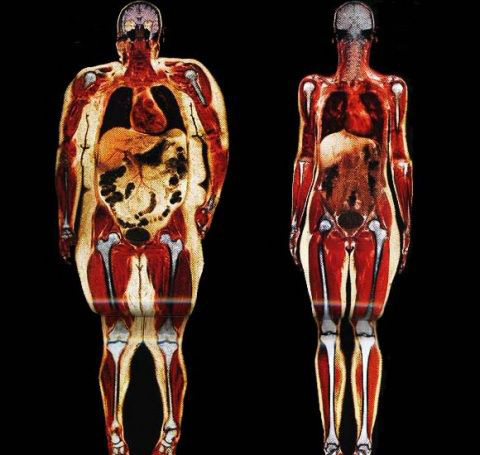
Look at this image. Do you feel your fat suit? I did when I was 50 lbs heavier and I do right now as I gear up to take the last 15 or so off.

Everyone by now has heard me say, “you can’t out-exercise your mouth.”  I think most realize that movement is amazing for health, but relative to how many calories one can stuff into their mouth on any given day, movement is probably only a small part of the weight loss plan.  Here is the corollary to that quote: You must go on a high fat diet to lose weight.

It’s ALWAYS true. Let’s see why.

Saving For a Rainy Day

I hope everyone came away understanding that carbohydrate is neither bad, nor unhealthy.  We have been taught in the last few years to fear carbs and before that it was fat.  The reality is that our bodies run on a carbohydrate based economy – Glucose.  When we consume too much energy, the evolutionary survival trait kicks in and we naturally store this energy as fat in adipose tissue to use at a later day.

Our problem is the later day never comes.

In organic chemistry we refer to this class of compounds as Lipids. They are mostly carbon and hydrogen, but are very different than carbohydrates. For one, they are typically insoluble in water – you’ve seen the oil floating in vinegar and oil dressing.  Lipids act in the same way.  There are three main categories of Lipids: Fats, phospholipids, and steroids.

We have  discussed  Free Fatty Acids (FFA) being used by the mitochondria to produce ATP (or heat in presence of up regulating proteins). In general, fatty acids are how we store fat in chains of about 18 carbons long. In some sense they look a lot like the chains of glucose in starch, but are typically shorter in length. FFA are just the units of these that have been mobilized to use as energy,  analogous to the free glucose that is freed from starch/glycogen.   The bonds in these fat molecules have a LOT of energy, which is why our bodies use them to store for a rainy day.

When the rainy day never comes and we continue to go back to the table to refuel, there’s no hiding where it goes.

Cholesterol is a steroid of fat that is produced by the liver and intestines and is used as a starting material to produce other important materials in our body like Vitamin D and cell Membranes.

Phosopholipds are manufactured to create the “lipid bilayer” of cell membranes. One end is the fat we are discussing – it wants to repel water (hydrophobic – phobos Greek for fear) and the other end is REALLY attracted to water (hydrophilic – philia Greek for love). These form a sandwich with the water loving side pointed to the inside and outside of the cell and the “fatty part” in the middle. This keeps things from freely passing from one side to the other.

I won’t get into any more details, but I hope you have a taste of how this range of lipid molecules are related. Many don’t know that cholesterol is a steroid or that it is a form of fat. Others might not know that very important molecules, like Vitamin D come from cholesterol our bodies (and other animals) make.  As well, every single cell in your body is absolutely dependent on fat for it’s membrane as are many of the bioactive molecules.

Fats are important and it is a shame that we now use the word “fat” to monolithically categorize food. Like “carbs,” it’s simply a bad idea. It leads to many people becoming confused and obsessed with managing something in hopeless ways.  Our results in managing our weight speak for themselves. We have used the “macronutrient shuffle” to move society into unprecedented chronic disease. When your body NEEDs fat, it can make it.  Now, if it has enough ability to manufacture all of these necessary components like cholesterol and fatty acids, what do you think happens when it is simply OVERRUN with the stuff by consuming excess amounts of it in your diet?

System break downs. Oh, but I eat the HEALTHY kind. I need more Omega-3s. Yeah, right.

Heart disease, diabetes, and other chronic illness end up consuming your health, but managing “fat” alone is not the answer. I am not certain that eating it in massive excess trains the body to deal with it any better.  A commenter on Carbohydrate Part – 3 tried to count (a very small list) of fat regulating hormones to justify why we don’t need to eat carbohydrate. Since most hormones, all cell walls, and the primary energy storage is all based in a FAT economy, don’t you think we would have a few extra processes hanging around?  Eating is one activity and our preferred, day to day, economy of energy is carbohydrate – glucose.

I understand his confusion. In fact I think one of the most profound statements at TEDMED 2011 was, “molecular biology has failed.” What was meant by the speaker is that there is not just one genetic pathway to health – identify the bad gene and eradicate it was the naive thought we had pre-Human genome knowledge. Now we understand that there exists a “symphony” of reactions that are going on and we don’t have to understand each one to manage them. Instead we can manage in a more holistic approach.

Your body CAN shift over and stuff fat into that primarily energy economy if that is what it is given (or you are starving), but it is not our primary operating mode (glucose, glycogen, blood sugar).  When you run out of glucose/glycogen your body naturally starts metabolizing fat. This is why the Atkins-type diets are so effective short term. They mimic starvation mode.  When this fat is gone (and we’ll see sometime before) the body can metabolize protein (your muscle).  These are the phases of starvation.  Deplete short term energy, move to long term, and then go into complete survival to “protect the brain and organs” and sacrifice the arms, lets, etc..

Not too unlike what we learned about getting cold – stop flowing blood to the extremities and protect the core.

Under a NORMAL diet, we get alarmed when excess ketones (byproducts of this fat metabolism)  show up in urine.  ketogenesis is the result of going into a fat-based economy and often looking for ketones in the urine is a sign that you have switched over.  As the two of the main ketone groups, acetoacetate and beta-hydroxybutyrate, are very acidic, blood pH can drop, which results in ketoacidosis.  The other ketone formed is acetone – fingernail polish remover, well, before they removed it because it was unhealthy.

All in all, these byproducts are a natural part of Fat metabolism. You have to go through this process to shed those love handles.  I think doing it like I did in yo-yo dieting probably has a very unhealthy effect – I just don’t like the idea of acetone running through my system.  This is one of the issues that is unresolved in eating – is long term ketosis detrimental to health?

It seems to me that living in this mode is not healthy long term even though short term it is VERY effective in losing body fat. I think the positive longevity benefits associated with caloric restriction are from nutrient dense, calorically poor diets.  While on the surface these two forms of  “starvation” may share a common name, it’s likely the outcome is very different. Just my speculation.

Your High Fat Diet

photo: Issac Hinds bodybuilding.com

So, this might come as a complete surprise, but the way you lose weight is to go on a natural high-fat diet. In fact it is EXCLUSIVELY the way you lose, because it is YOUR fat that you need to digest.  At it’s basic level weight loss is actually quite simple in theory: eat enough micronutrients (the maintenance stuff – vitamins, minerals, essential amino acids) to keep the system running and then consume your “gas reserves” for energy.

If you want want a 6-pack (btw, everyone has one) you have to remove enough fat to SHOW it. You just can’t see it through your “fat suit.”  lose body fat (without muscle atrophy, or break down) and stay toned with a moderate amount of exercise and you WILL look fit.

Now some of us don’t have as much muscle mass and putting that on is a completely different topic.  As any bodybuilder will tell you there are two steps to their sport: 1) Putting on mass (excess calorie combined with muscle stress/exercise) and 2) dropping body fat for competition (right Christy?) .

While some level of fitness can be maintained (you don’t need to become obese), putting on muscle mass typically comes with some extra body fat (and water) that are normally shed just before competition.  Most body builders would be hard pressed to stay at this extremely low (some unhealthy) level for much time.

The point here is that the way you shed fat is to restrict caloric intake (of any kind) and just focus on high nutrient food.  This is most easily accomplished with plants/fiber, but there are other ways to do it as well.  The part I want you to keep in mind with EVERY BITE is that if you are putting calories IN, then the body does not  have to tap into calories OUT of your fat reserves. Remember the gas station analogy?

There are very healthy ways to create caloric restriction and stay satiated throughout the process.  Remember this point as well – the body does not KNOW it is fat.  Therefore, anything you do to push it away from its CURRENT set point (reduce calories) it will see as starvation and most likely turn on hunger.

There is a base to metabolic restriction that the body can’t get around and we will see in Part 2 that increasing cold exposure with added exercise will preferentially send free fatty acids out to be metabolized  by mitochondria for heat and can create a one-two punch on the love handles.

**************
Do you like these blogs and want to help me? Please take a minute to scroll up on the right side of the screen consider making a monthly donation to this program. You can also make a one time donation here:


Thanks!
Ray

glycogen is key to running long distance. When we bonk, it's because we are running low on glycogen and must switch to fat reserves.We’ve covered a lot of ground. What we’ve discussed  is that carbohydrates come in the form of simple sugars (monosaccharides) and more complex carbohydrates (polysaccharides). We know that the sugar names all end in “ose” (glucose, fructose, lactose, etc…). Polysaccharides are many of these monosaccharides linked together in a chain and are a common way plants store energy (similar to our fat) for later use.

I’m suggesting you stop thinking about “Carbs” as a food group; instead categorize meat, vegetables, grains, dairy, etc… Starch (potato) and Cellulose (wood) are made from IDENTICAL glucose molecules. They have a different saccharide bonds, only one of which we have the enzyme (amylase) to digest.

So in Part 3, I want to talk about another pseudo-carbohydrate that is critical for you – glycogen. Many of you are familiar with glycogen from athletics. It’s the “load” part of carb-loading in preparation for a race. It’s also the center of your glucose-centric metabolism and the reason I personally don’t think “carbs” are bad or unhealthy.

What is unhealthy is the way we process high-energy foods with even more empty calories and then consume them in excessive quantities.

So, let’s take a little step back to understand what glycogen is and why it’s important to your performance and your life. Your body has three basic storage points for energy: ATP (adenosine triphosphate), glycogen, and fat. the most immediate energy – what is behind the muscle explosion is ATP. You have about 250 grams of this stuff, about the same amount of energy as is contained in a AA battery, energy comes form popping off one of the phosphates to form ADP (adenosine diphosphate + energy)(1). We then use this other enzyme many of you will be familiar with, creatine kinase, to shuttle these phosphates back and forth.

Save the Liver

glycogen is key in energy of muscle tissue. When you run out fat must be utilized. ATP is at the very basic level of your energy utilization. Just above this in the “energy food chain,” is our friend, glycogen.  Think of  glycogen as a “fuzzy protein.”  It is made of a core protein, glycogenin, surrounded by fuzzy starch (poly glucose) hairs. It is located throughout your body.  You have about 2000 calories at any given time; 500 or so is stored in your liver and the rest packed among your muscles where it can be readily accessed. I’m using approximate numbers because everyone is slightly different, but here is an interesting side fact.

It takes (about) 2600 calories to run a marathon.  2000 calories/2600 calories = 77%.  Now using that number and knowing a marathon is 42.2Km/26.2M we see that 77% is 32.5Km/20.2 miles.  Anyone that has attempted to run a marathon can tell you about that number: THE WALL.  If you are like me and would rather freeze your ass off than run a marathon, that is the point where ATP can no longer be generated by glycogen stores (you’ve run out) and you MUST resort to stored fat.

Fat is then the highest level and quantity of stored energy in your body and the body has to work to get it into a primary glucose-based energy system.  Conversely, fatty foods (Oils, lards, etc)  have the densest energy reserves. It’s simple: fat is there for long term storage.  Plants, and Humans have carbohydrate based reserves for the most immediate needs and that is in your blood sugar level and glycogen reserve.

Record marathoners have trained their bodies to dip into fat reserves much earlier and they use fat throughout the race.  When we get back to fat metabolism and thermal loading, you’ll find this is a side benefit of conditioning your body to withstand cold – free fatty acids (FFA) liberated from your fat stores. You may remember from BATGirl, that the mitochondria of BAT and other tissue can use FFA in the presence of a special up-regulating proteins to create HEAT instead of generating ATP.

Your ability to regularly engage in this FFA economy can be significantly influenced by running marathons – extreme milage  volume causes this switch as does mild cold stress.  People make fun of me about cold all the time, but I just think this is far easier than running 50 miles/day. You may see it different.

What happens in Protein-rich diets is you have depleted your glycogen reserves and it’s energetically costly to refill glycogen from converting protein. Your body switches over to fat metabolism and voilà, you start losing weight. That’s how it works and the ultimate decision one should consider is what will be the long term health effects by using your body’s tertiary macronutrient, protein, to drive it into a secondary reserve, fat, by depleting it from it’s primary energy, glucose. The other direction works just as well and in a glycogen replete state, Chris  Voigt lost weight eating 20 potatoes a day – all bad carbs.  This is an interesting contrast to the high-fat approach and I think it’s far more important than a silly PR stunt.

Seems complicated, but I just want people to discuss this factually and make informed decisions.

We can equally manage 1) hunger (satiety) and 2) total caloric intake, while maintaining correct micronutrient intake, living permanently thin as opposed to yo-yo dieting.  This does require modifications to your lifestyle and I won’t tell you it is trivial, but neither is bypass surgery, insulin shots, high blood pressure, or lugging around an extra 50-200 lbs.

So, there really is not debate that carbohydrate, particularly starch, is a perfectly natural food.  As we process with cooking (or over process) ANY carbohydrate, the energy becomes more readily available and then we damn “starch” as the bad-calorie; it’s simply not true.  What is interesting is there are many ways to put your body into “survival mode” and only two that have ever demonstrated longevity in laboratory animals: caloric restriction and mild cold stress.

We still have to cover proteins and fats and we’ll keep the rules engaged, neither are food groups. As well, I want you guys to jump in on new commenters in the future and explain when we discuss carbohydrate here, we are primarily discussing high-starch foods that are relatively unprocessed (heated, with no added fat, dairy, or sugar).  If you don’t believe me, TRY to go find food in a restaurant that 1) contains a starch and 2) is not loaded with sugar, fat, or dairy. I did it as an experiment for 14 months and know first hand the difficulty.

Brain Drain

We are fat, but let’s not damn potato, squash, and rice – the very staples of Humankind – as the punching bag for of our epidemic obesity. Let’s acknowledge that preparation and added empty calories play the MAJORITY role.  When I construct a new paradigm to consider for eating at the end, you’ll see that there is plenty of room for carbohydrate (starchy-foods) on the plate.

Starches are an EXCELLENT food option and contain glucose, the only fuel used by the largest energy consumer of your body: The Brain.  When you run low on glucose (and glycogen), gluconeogenesis creates glucose from amino acids by stripping off the nitrogens and using what is left to synthesize glucose.  Energy for this is driven through beta-oxidation of FFA. If you have a lot of  beta-oxidation is occuring (untreated diabetes or starvation), acetyl-CoA builds up, and is converted to the ketone bodies. That’s the basis of ketosis and why ketones are found in your urine.

The brain-blood barrier is the separation of this distinctly different glucose metabolism from the rest of your body. So, I think is at least it is easily questionable to say carbs are “bad” or even the cause of obesity. At the same time, throwing your body completely into starvation mode, while certainly effective to lose weight, might not be the best long term. Of course we have to consider the implications of caloric restriction too. I just raise the question.

With that is it fair to ask if “carbohydrate” was so bad for you, why did we evolve one of the most advanced, energy-conuming brains of any species to use only a carbohydrate fuel?

Think about it.


(1) “On the prebiotic potential of reduced oxidation state phosphorus: the H-phosphinate–pyruvate system,” David E. Bryant, Katie E. R. Marriott, Stuart A. Macgregor, Colin Kilner, Matthew A. Pasek and Terence P. Kee, Chem. Commun., 2010, 46

**************
Do you like these blogs and want to help me? Please take a minute to scroll up on the right side of the screen consider making a monthly donation to this program. You can also make a one time donation here:


Thanks!
Ray

carbohydrates, like potatoes need not be your enemy. These can be good sources of nutritionIn Part 1, we began the process of distinguishing the difference between a food group and a macronutrient. Carbohydrates (Carbs) are probably the most vilified of the macronutrients. This is probably due to the ubiquitous availability of starch foods throughout human history. For the most part, oils, fats, and meats were the food of the rich. Everyone else ate beans, rice and potatoes.

If we listed the many staple foods: grains, rice, beans, squash, quinoa, potatoes and corn we see a high amount of starch. Remember, starch is simply a long chain of glucose. We all need glucose to live and our primary energy is derived from glucose and stored glycogen or fat (more later).

I want you to know that a carbohydrate need not be fattening, nor lead to diabetes.  In fact, Carbohydrates can be very satiating (1) for 4-5 hours after meals. What seems to be the big diversion, where the “bad carbs” come in, is the processing (blending, frying, flouring, pasting, etc) of carbohydrate.  When we break down starch too much in the food preparation process, it leads to lots of simple sugars. These are both easy to overeat and can have other deleterious health effects.

Starch digestion begins in the mouth with the amylase in the saliva. The starch begins to break down to glucose.  A great way to experience this first hand is to take a unsalted cracker and just hold it in your mouth. You will begin to generate a lot of saliva and as you hold it there, begin to taste sweetness as the glucose is formed. Remember, a termite can do exactly the same thing with cellulose in wood.

From an evolutionary biology perspective, the AMY1 gene that is responsible for making amylase is so important  that you have as many as 12 copies of it (2).  It was extremely important to our hunter-gather predecessors. While there’s been much put forward on the “hunting” side of the equation, some of the most recent anthropology suggest that the “gathering” side dominated.  Underground storage organs (USOs – tubers, bulbs, corms, and rhizomes) played a significant role in our energy management of times past.

Men like the idea of beating their chest and running through the woods hunting and they write a lot of the stories, but gathering is actually a better (less sexy) explanation of our survival. It even allows the elderly to participate productively in the group, even grandmothers would have a significant role in the earliest tribes. Anyone can dig up a potato, they aren’t very fast, and they grow in predicable places.

The naked mole rat is found with archeology of hominid population explosions and points to USOs as a gathered food source. click photo for NPR Story

Many of the early tools used to process USOs were probably made of wood and didn’t survive in the archeological records, but the early Hominid starch crystals in teeth have. Also there are also fossilized populations of mole rats that surge with every human population expansion (3). We’ll also learn that the mole rat has some FASCINATING genetics that impacts thermal loading.

I don’t want to get into the Paleolithic debate. What I want everyone to see is that starch IS an important evolutionary part of your fuel system, but at the same time recognize french fries are NOT the starch I am talking about.  Your view of carbohydrate has been jaded since the beginning of diets. In the earliest of diets (Banting) it was simple breads combined with butter/sugar that caused the excess energy to creep in. Processed starch (sugars) of all kinds can lead to excess caloric intake; it’s just easy to digest and pleasurable to overeat, especially when combined with salt and fat.

For today, understand that primary complex carbohydrates: squash, legumes, onions, carrots, whole corn, whole rice, and potato are all good bases of energy. They are satiating ways to make up for caloric deficit, but don’t confuse those items, “items your great grandmother would recognize as food,” Michael Pollan might say, with the “carbs” served at school lunch.

Most importantly understand that many of these “starchy” foods also contain significant proteins with complete compliment of the essential amino acids your body will use to synthesize your own protein. These complex carbohydrates are broken down by amylase to glucose: the fuel for your brain and many cells in the body.  If they aren’t consumed with excessive alternate energy sources (like excessive fat or simple sugar), your body will tap into it’s own fat reserves.  If too much pre-processing is performed, then you might see increased problems managing blood sugar.

Eating carbohydrate is convenient and pleasurable, and know there is room for “carbs” in your diet if you make the correct choices.

So, when we are putting this all together and I say carbohydrate, I want you to think about these whole, starchy food items that enter YOUR kitchen/cooking reasonably resembling how they came out of the ground or off the plant. Sugar, raw, brown…whatever, is refined. I challenge you to eat the 250 lbs of sugar a year  gnawing on sugarcane, however; you might be able to do it with grapes or beets.

Others have commented on fructose, a simple sugar in fruit, and I think there is merit to the issues that come from too many simple sugars, especially highly processed. This likely includes high fructose corn syrup, apple juice, sucrose, agave nectar, etc…).  Fruits are not found in nature year round, but USOs are. Similarly, think about what is easily stored (beans vs beets).  It’s amazing to hear people rave about “natural agave nectar” (inulin/fructose squeezed from agave) and then begin to lambast the food industry for high fructose corn syrup (fructose squeezed from corn). Yes there are some differences, but we’ll debate it in 5-10 years.  It’s all simple sugar  to me and best avoided.

These simple sugars are energy without the fiber or micronutrients. Others, like Robert Lustig, have covered the issue of fructose in far better detail than I will, but likely our problem as a nation is probably more related to drinking, for example, too much apple juice, rather than eating too many apples. The same is true of french fries vs potatoes. The larger group health statistics just don’t separate the issues (e.g. apples vs apple juice or fries vs potato) with enough granularity and it is all complicated with saturated fats and other compounding, synergistic concoctions we now call food.

Many energy dense foods are now available year round (like fruits or avocados) and so we must be careful with these foods.  We’ll see a similar trend with fats, oils, and nuts.

Starch is a wonderful molecule and has been around for millions of years. Starch is just one bond different from wood.  You are designed to eat starch, with back ups systems in place (AMY1).  We can identify paleolitic starch in teeth, even knowing the plants that produced it, and so there is nothing wrong with carbohydrate as a food – it highly processing it and combining with other energy-rich processed product that causes much of the issues.

You will inevitably hear more about the amazing work anthropologist, Nathaniel Dominy is doing with starch and USOs.  I personally believe the depth and thoroughness of his work will have an impact on what many, like Loren Cordain, believe to absolute. Nate has a very uncanny ability to see past the obvious. For the record, he’s a meat eater, despite what he’s uncovered in the last few years about starch in anthropology.

In terms of the thermodynamics, most natural starches come with a compliment of other micronutrients that are beneficial.  These are “energy foods” and so we absolutely CAN lose weight by eliminating them from your diet.  I am not suggesting diets higher in fat or protein (atkins, paleolithic, slow carb) cannot be used to lose weight – I am diet agnostic. What I can explain is on whole the overall management of energy, heat (not temperature), that is responsible for your success.

If we stop isolating these foods based on our perceived/suggested notations of macronutrient content and return to simple food, A calorie will be a calorie.  Once you learn to recognize what you are consuming at every meal (and snack) you’ll see the results you’ve been after. It doesn’t even take discipline once you understand the underlying principles.

Gauging on the comments/questions, I might dig in a little more (Part 3) on carbohydrate. Eventually I will post the overall biochemistry and some have written asking me to explain the TCA cycle (that complex part in the middle of a Lustig presentation if you’ve seen one).  Otherwise, I will move onto fat and catch sugars in the wrap up.

Next week is TEDMED in San Diego. It’s hard to believe a year has past.  I’ll probably have at least one update on what I learn there, but will *try* to write two posts on fat before I leave so they can post next week.

(1)  Carbohydrates and human appetite, Blundell, JE, et al.,Am J Clin Nutr 1994;59(suppl):728S-34S.

(2) Diet and the evolution of human amylase gene copy number variation, Perry, G.H., et al., Nature Genetics 39, 1256 – 1260 (2007)

(3) Communication/presentation with Dr Nathaniel Dominy, Dartmouth University Dept of Anthropology

**************
Do you like these blogs and want to help me? Please take a minute to scroll up on the right side of the screen consider making a monthly donation to this program. You can also make a one time donation here:


Thanks!
Ray

carbohydrates slow carb diet, thermogenex, thermal loading As we have been discussing, macronutrients are the basic energy, or fuel, our bodies need for all biological processes. This can be used for exercising, thinking or synthesizing the many biological molecules that keep the system smoothly operating.

Micronutrients are the building blocks – the stuff our body uses to create the many cells, tissues, and hormones.  Like we discussed in our car analogy, macronutrients are the gas and micronutrients are the routine maintenance service for the car .

Today we are going to begin the discussion of Carbohydrates. What I hope to do, is change your reaction to that word.  I don’t want you to say “carb” or think french fries, potatoes, or rice.  I don’t want you to think about ANY food group.  Forget glycemic index.  Those are all useful bits of information for diet schemes, but not to understand how your body works.  When we are done, we’ll move onto the other macronutrients: fat and protein.

So, do we have a deal? No discussion of FOOD for the conceptual understanding of carbohydrates, but I will give examples carbohydrates contained food so that we can understand the bigger picture.

Thermodynamics is the study of heat and energy and how these systems interact. We derive energy from the basic three macronutrients.  Later, there will be detail of this complex process, but for now, it’s just a game of “pass the electron.”  Every whole food you eat contains some amount of the three macronutrients. We call something a Protein or a Carb in response to its greatest portion of macronutrient by weight.

Now, we are discussing energy, the thermodynamics, and really weight has nothing to do with energy other than some means of quantifying the amount you eat.  We’ll see that this macronutrient/weight is extremely useful for food labels, but not very indicative of either the amount energy or macronutrient you might derive from a given amount of food.Telt

Let’s dive into what a carbohydrate is and why we need it.

A Carbohydrate is a Carbohydrate

We’ll see that all this fuss about calorie a calorie is going to be a simple accounting issue, but if you have a negative reaction to the word carbohydrate, if you think that there are good carbs and bad carbs, if you’re worried about blood sugar, then fret no more.  We aren’t going to discuss any of that here.  Not going to even take questions on it.

Instead, I want you to return to 4th grade and think about that simple view of the world. You breath in oxygen, it’s combined with fuel (“burned”)  to give energy and then you exhale carbon dioxide.  That is in turn used by plants in photosynthesis, to yield sugars and other biologically active compounds and they return the oxygen.

See it?

We are all confused about the breathing oxygen and burning part, remember, a calorie isn’t a calorie? So, let’s start with the plant side of the circle. There aren’t many obese plants, maybe they’ve figured something out.

Plants take in carbon dioxide and form sugars, fats, complex carbohydrates (e.g. starch) and structural cellulose. With the exception of venus fly traps and pitcher plants, they just don’t eat.  They also take in Nitrogen from the soil (fertilizer) creating proteins and even even psychoactive alkaloids, like mescaline (peyote buttons). It seems plants are a trip.

In fact plants synthesize every single protein, fat and carbohydrate you need to live.  We eat them or we eat animals and bacteria that eat them and here we are. Perhaps this is what they didn’t tell us in 4th grade. Food and Macronutrients are somehow separated at birth of the concept, but we are here to discuss Carbohydrates, like starch and really understand what they are and how they work.

We all know the word sugars. There are natural sugars, bad sugars, processed sugars, and high glycemic sugars, but really, a sugar is just the simplest molecule that makes up the long chains of stored energy in plants.  It’s their way of saving for a rainy day (literally).  They all named to end in “ose” – glucose, galactose, lactose, fructose, maltose, etc.  Once ingested, you extract energy from them to fuel ATP/ADP through electron transport chain.

For now, just know that your body MUST have glucose. That’s what we measure when we measure “blood sugar” and that is what your brain runs on as a fuel.  It’s chemical formula, C6H12O6 is the building block of two very familiar compounds: Starch and Cellulose. Both of these “polysaccharides” (poly = many, saccharide = sugar) are simply long chains of the EXACT same sugar: Glucose.

House of Potatoes

cellulose, glucose, starch

Starch and Cellulose are made from the same building block, Glucose. They have a different saccharide bond that holds them together. Since many animals don't make the enzyme to break down cellulose, the fiber passes through. If you ever wondered how hippopotamus, rhinoceros, cows, and giraffes grow lean and muscular as herbivores, here's your answer.

That’s right, a baked potato and a wood are essentially the same thing.  So why aren’t we whipping a wonderful Mahi-Mahi dusted in a fine pepper-birch sawdust and parchment-baked? It’s because we happen to be protein deficient.  Yes, it’s true, a polysaccharide like cellulose or “poly-glucose” must be broken down by enzymes, proteins, into glucose so we can use them.

Cellulose is put together in just a slightly different way and we can’t break it down. To a termite, or the bacteria in the rumen (a stomach) of a cow, that piece of wood or grass fiber works as food JUST like a baked potato does for you.  These bacteria and insects create  the protein, cellulase, to extract glucose from cellulose.  We create another protein, amylase, that breaks down the starch.  You have as many as 4-12 copies of the gene that creates amylase enzyme, because it’s so genetically important for your survival.

Carbohydrate, fats, and proteins all enter the electron transport chain to deliver energy to your body in a set of reactions designed around glucose, the building block of carbohydrate.

What do I want you to take away? first, “Carbs” aren’t food groups and neither are proteins and fats. Theses very defined terms in organic/biochemistry, but have been popularized in order to help you “eat healthy.  The irony is we’ve never been more unhealthy as a world.  Proteins aren’t meat; there are also other bioactive proteins, for example enzymes like amylase or cellulase, that participate nearly every metabolic process keeping you alive.

We will eventually come back to food, and calories, and see that nearly every food you eat is a combination of these. You don’t “need a complete protein” and can’t “avoid carbs.”  The truth is that what you need is energy to run the process, fuel. You  probably have a few weeks (months?) supply of fuel you’ve been lugging around for some time. We need to find creative ways to burn it.  None of them involve schemes of putting MORE energy in your mouth. You’ll never run empty if you fill up three times a week.

For today, here is what I want you to take away: carbohydrates are polysaccharides ( “many” “sugars”) that provide the basic energy currency precursor of your body, glucose.  We’ll discuss some of the other (evil – lol) simple carbohydrates in the next blog.  We use and need carbohydrate in our diet.  There is a big difference between starches, like rice, squash and potatoes and donuts. Fruits, on the other hand, contain simple sugars as well and those come with their own issues.  It is key to separate carbohydrates, especially complex carbohydrates, from simple sugars.

We’ll then turn to the other macronutrients, fat and protein, to fill in the basic metabolism energy cycle.

You shouldn’t feel uncomfortable with the idea that ultimately, cows eat grass, gain glucose and amino acids, and grow tasty, “grass-fed” beef. That beef is laden with amino acids.  When you eat it, you can in turn use the amino acids (no significant glucose in beef) to create insulin or pus in pimples (also a protein), whatever protein you need,  and metabolize the left over to supplement your daily energy requirements. You can even store it for “later.”

Perhaps,  it’s not as simple as the CO2->Sun->O2 symbiotic respiration we learned in 4th grade, but it is plenty understandable.  When you no longer see protein, carbohydrate or fat as food groups, your mind will be opened to lots of different options.

Equally important, we’ve all learned the hard way, you can’t out-exercise your mouth.  It is simply put, impossible.

Until next time…

**************
Like these  blogs and want to help me? Please take a minute to scroll up on the right side of the screen consider making a monthly donation to this program. You can also make a one time donation here:


Thanks!
Ray

chains of energy. Carbohydrates, protein, fat are all the building blocks of energy. The picture says it all. We are going to talk about chains, not of steel, but of the basic energy units that keeps your body going and make you fat.  I hope it is a new beginning, a bridge to a new way of thinking. Once you understand how the body processes food, it’ll take away mystery and magic.

The reality is actually far more simple than all of the crazy schemes you’ve followed in the past; the beauty is every one of them can be easily explained – with no contradictions.

The beginning of the story actually starts at the end. It is an interesting circle. You are here primarily because you have fat to lose.  That fat is stored, in the form of Triacylglycerols (fancy term don’t worry about it) in the adipose cells.  These “fat cells” are a place so this high-energy can be stored for “later use.” As we learned last week, our problem is that later never comes before we return to the gas station. You know the rest of the story.

Other animals, and even plants, store slightly different forms of energy for the exact same reason; it’s stored for later use. This is energy to sustain life when fuel (food/light) is not around to keep the animal/plant functioning. We’ll learn of some other special types of storage in addition to fats, glycogen and starch, and how it fits into the  puzzle.  When we are done, you will see ALL food with a new view – from ingestion to use or from ingestion to storage. I want you to FORGET about the association of carbohydrates, protein and fat with particular foods (e.g potatoes = carbs) – most (real) food has all three sources of macronutrients.

The Evolutionary Shuffle

So here is the picture that should be etched in your head:  Stumble around, find food, eat as much as you can, starve for a while living off of reserves, and find food again.  That is how it worked for nearly 7 million years. Even in the last 10,000 years, when Humans became far more useful with respect to their hunting and gathering, we still mostly starved.  If we go back to the first recorded agriculture (5000-6000 years ago) we are still talking a mere blip on the evolutionary scale.  Genetically speaking, we are still programmed to stumble, eat, starve and eat again.

Genetically speaking, we haven’t changed that much in the last 5000-6000 years.  To put that into evolutionary perspective if all hominid development of 7 million years was represented by a mile, our dominion over agriculture was the last 4 feet – barely a step.  You are  genetically programmed to store energy for times of famine. So are your skinny friends.

The problem? Famine never comes.

So when we eat animal or plant fat, we take that stored energy and either convert it to useful energy or extract the energy from it and store it ourselves. The same goes for carbohydrates. We use the energy directly or just convert the excess to fat for later.  Proteins, we’ll see, are  just a little different. We can break them down and use the nutrients (amino acids) to build other proteins (e.g. insulin, enzymes, antibodies, or hair) or we can burn them and use the energy or store it in fat for later use.

In case you didn’t notice, I didn’t say MUSCLE in that list, because we’re over focused on the muscle/protein connection – both on intake and body nutrient use. It keeps you from really digesting these concepts. Put it away for now.

Each of these macromolecules: Carbohydrates, Proteins and Fats contain smaller “packages” of energy, but are stored like the links on the chain.  As we dive into the each of the individual chains, you will see the similarities, and differences, but right now the BIGGEST obstacle to understanding this is to stop associating proteins, carbohydrates, and fats with specific foods.  These are not food group labels like meat, dairy, or vegetables. These are basic collections of molecules of similar chemistry and function and the vast majority of unrefined food has all three.

To define a particular food by what macronutrient it has “most of” or to reject it because it’s a macronutrient that you believe you should consume less/more of is THE problem.  It starts a chain of events and you end up inextricably linked to the latest fad diet. They make money; you stay fat.  These macronutrient-based diet schemes all invoke an enormous amount of generality and in doing so, well, the results speak for themselves the world is getting fatter despite record spending on diet/fitness.

We have excess energy not bad genes. Can anyone argue with this logic? can you possibly get fat if you don’t eat?

Think Different

Steve Jobs, an extraordinary man that challenged status quo - all the time.

This photo takes you to the 2005 Stanford Commencement Speech - please take 14 minutes to watch it.

So, in memory of Steve Jobs, I want you to THINK DIFFERENT beginning today. Steve taught us in his amazing 2005 Stanford commencement speech, “Don’t be trapped by dogma — which is living with the results of other people’s thinking.”  You CAN understand this in a way that you will no longer be trapped by dogma. I’ll take the time to explain the difference between protein and meat or potatoes and carbohydrate, if you’ll keep an open attitude.

Why am I splitting hairs on this? Because you can’t recognize or even taste a protein and yet, you’re probably convinced you need more. It’s not limited to protein, Harvard professors (1), even an outrageous story on NPR YESTERDAY, can’t seem to differentiate between a potato and a french fry and therefore group them together with the resulting blame for childhood obesity going to the poor potato. A food that has been around in some form for millions of years is now THE problem de jour. It doesn’t stop there as the USDA is probably the worst place for information.

When you get to the end of the news report note that the kid get’s it right: who wants to eat a dry potato just for the fun of it? The answer: your starving ancestors did. They were hungry and you’re fat. But until you get past that it has nothing to do with carbs, glycemic index or fat, you’ll stay stuck in the yo-yo cycle. That continues to fuel another jiggleflex sale, a deal a plate, or a bypass surgery. Everybody wins, right?

I will stop ranting now.

Today, make a step in the right direction. Forget food for a moment. We are going to dive into the three macronutrients. We are going to understand the difference between starch and cellulose – why cows can eat grass and termites can eat wood. Does your current idea of food explain where the cows get protein or how termites digest and get energy from undigestable fiber  Probably not, but once you truly understand carbohydrates, proteins and fats, you can rebuild from the ground up and construct a different, a RADICALLY DIFFERENT, basis for what and why you put stuff in your mouth.

I’ll even leave room for creme brûlée.

After we are finished, what I hope you’ll never do again is to try to pick your food groups based on macronutrients: carbohydrates, proteins or fats.  I hope you realize that rice, for example, has enough available protein (and a full complement of amino acids) to sustain you (2). I want you to understand why birds and wild cats aren’t fat and how an elephant can grow so much muscle mass without a single protein shake.

You see, we once understood how to survive and, ironically, didn’t even think about it. We stumbled through the world and ate what we could find. Today, with all of our macronutrient diet schemes, eat for blood type, 21 days to fight belly fat, or super secret supplement goop, we’ve lost the way. It’s unbeliveable that we have never know MORE about food and yet it’s never been more difficult to understand what to do.

Steve Jobs took everything we knew about computers, music, and computer programs and turned it into an incredible assembly of tools that…just worked.  I am suggesting that we do the same with nutrition.  I say for the group following this blog – stop debating and let’s just break this down and see what makes sense.

I’m willing to go against the mass market. I believe people are intelligent enough to figure this out. I know that I was wrong for most of my adult life – even with advanced education and a deep interest/motivation to understand it (I was FAT).  The difference, perhaps, is that when I found the contradictions – michael phelps eats 12,000 cal/day and termites eat wood – I took the time to reflect on the world and set aside my bias.

But like ts eliot observed: I’ve arrived where I started, and know the place for the very first time. I think you will too.

We’ll start with carbohydrates on the next post. See you there!


1) Changes in Diet and Lifestyle and Long-Term Weight Gain in Women and Men,  Mozaffarian D et al. N Engl J Med 2011;364:2392-2404.

2) Nitrogen retention of young men fed rice with or without supplementary chicken, Lee CJ, et al., Am J Clin Nutr. 1971 Mar;24(3):318-23.

**************
Like these  and want to help me? Please take a minute to scroll up on the right side of the screen consider making a monthly donation to this program. You can also make a one time donation here:

Thanks!
Ray