As we discussed in the last post, I want you to suspend all that you know about carbohydrates, proteins, and fat. I want you to clear notions of glycemic index and eating for blood type.  I’m asking you to not have conclusions about our paleolithic ancestors. No, let’s talk about the very basics of energy in our body, but check the Chakras at the door.

Today we’ll take a rather geeky-side step. We are going to talk about energy, oxidation, and heat (not temperature).  These are all things that we can see, measure, and repeat. Let’s reserve comments to questions and clarifications – I don’t want a similar scheme from someone else.  I am confident that what I am saying is true – to the best of our current understanding.

Quick background.  We are “homeotherms” in that our body temperature stays constant. This temperature (around 37C +/-) is the net result of waste metabolic heat. We need to stay in an environment cooler than our body for the most part, so that the waste heat can leave – else we just burn up. Cars need radiators.  We are the same. Heat (not temperature) always flows from hot to cold.  At the atomic level, that’s just lots of atoms bouncing together – just like rubbing your hands together and getting warm.

Heat (not temperature) is then the net energy in that object. Hot coffee has MORE heat than your tongue. It transfers (rapidly) when you sip it. That is what causes the discomfort. That is a very visceral picture of heat, but in thermodynamics we talk about heat in a far more general way. Most of the discussion has absolutely NOTHING to do with temperature and in fact, temperature is something that goes up and down in many cases to preserve the balance of energy when heat is transferred.

Riding The Wave
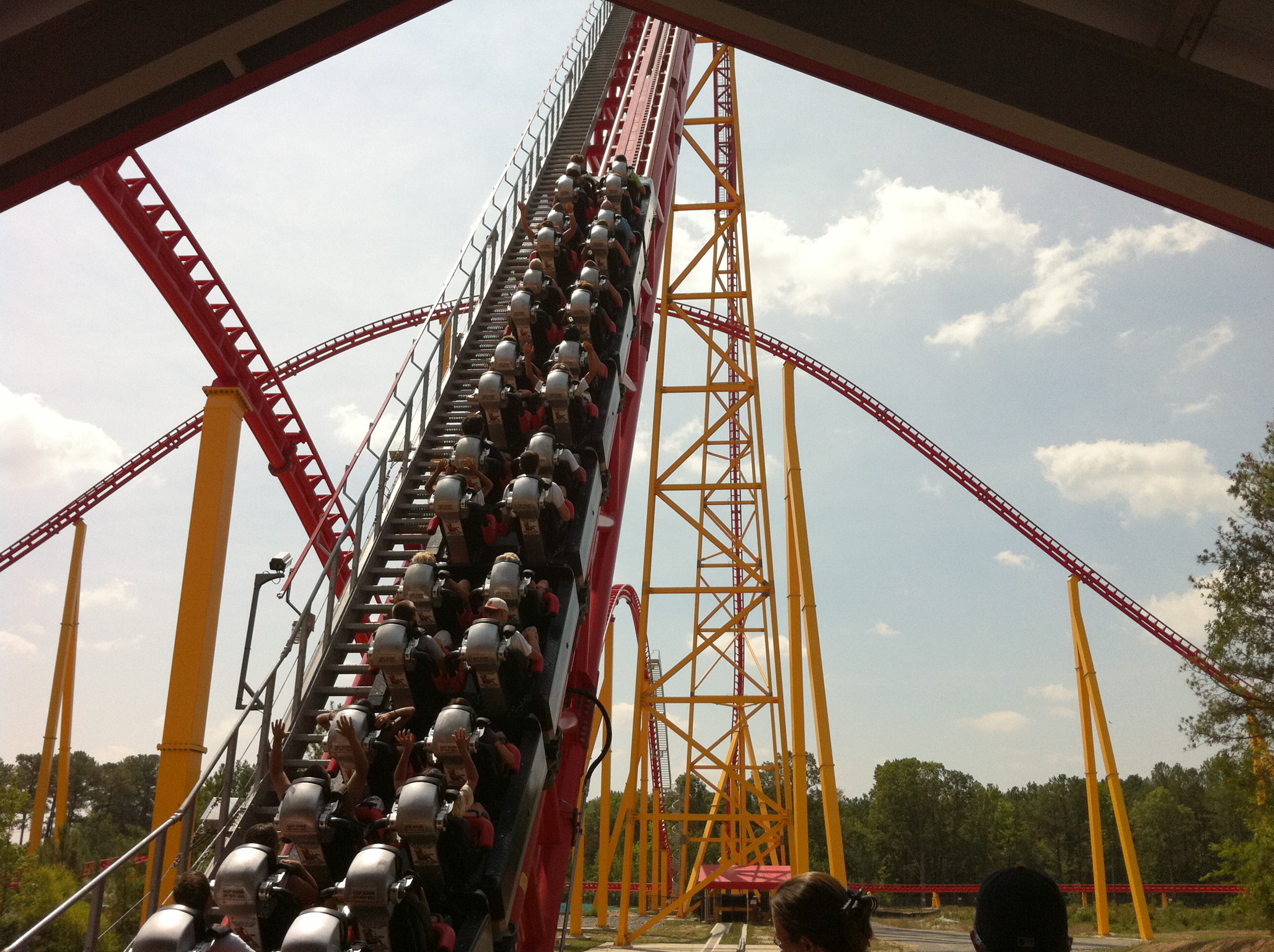
all metabolism processes release heat - you can consume protein carbohydrates or fat.At the top of a roller coaster, you have a LOT of potential energy just before you fall. At the bottom of the hill you have lots of kinetic energy (energy of motion). Stand on that track and splat, you are mowed over my the massive car. Chemical reactions release and absorb energy in much the same way.  Hold some explosive in your hand, you have potential energy, light the fuse and bang, release of all that stored energy at one time.

Get the picture?

The process of extracting energy from carbohydrates, proteins, and fats is metabolic oxidation.  We add oxygen to the “fuel” and “burn it” to release energy.  This is a extremely complex process, with lots of steps, but we can attack the problem from the basic energy in, energy out approach.

Let’s say you eat some glucose…or even table sugar, sucrose.  In both cases those two molecules have Carbon (C), Oxygen (O) and Hydrogen (H).  These individual atoms are all linked together with chemical bonds. Breaking these bonds requires energy (pulling the roller coaster up the hill) and then releases energy (going down the hill).

Some of the energy does work – like move a muscle, beat the heart or fire a neuron in the brain, but MOST of the energy (80%) is just waste heat energy (not temperature) that gets transferred to surrounding tissue and the tissue then increases in temperature.

What we will learn on specific posts about carbohydrates, protein, and fats is that each of them is processed a little differently by the body, but all can be used for that fundamental energy we need to live (pulling the roller coaster up the hill).

Additionally, we’ll discuss that proteins have a dual use – they can not only be burned like fuel, but they provide a store house of amino acids that are the basic building blocks of our tissue, hormones, and hair.  In that sense when you EAT protein, it is not USED by the body; rather it is broken down into amino acids and the body picks out the ones it needs to make whatever is on the “to-do” list – be it eye tissue, insulin, or keratin (hair & nails). The rest of the unused amino acids get tossed into the burn pile. We don’t store them.  When we dig into proteins, you’ll see that this word is so misunderstood, that it’s caused huge problems. We’ll find why our body doesn’t actually “burn” protein in much the same way as our body can’t burn “starch.”

On the other side of the balance, fats are places our bodies (and plants) can store energy.  We’ll talk about one other form of stored energy, glycogen, in the post on carbohydrates, but just remember that adipose (fat) tissue is a place to dump excess, non waste heat energy until you need it later (gas in the trunk).

So all of these hand-waving sentences: I need more protein to build muscles, high glycemic carbs are my problem, or it’s the good fat, are just distractions at this very basic level. If you were not fat, or competing in an intense triathlon, then really, any of these three fuel sources would do just fine for energy. All of them are acceptable for fuel. Some have more heat energy stored within and others have less.  Some can cause secondary hormonal issues, etc…but your body has evolved to process all three of these. Alcohol is another fuel we can throw in the mix – it’s digestible, but the by-products are toxic; it’s certainly energy that can be processed.

Sweet Mistakes

Ultimately, it is glucose – a simple sugar (carbohydrate) that fuels your brain and keeps the cells nourished. We monitor “blood sugar” and for most of us it stays in a pretty tight range.  Proteins and fat can be inserted into the process with some fancy tricks, but all the heat energy they contain is eventually assimilated to some part the overall system to process glucose.

What do you need to know from this to move on? Simple. These three macronutrients: carbohydrate, protein, and fat are all useful sources of energy. If you are about to run a race and are 6% body fat, you might want to stock up on energy. If you are worried about the scales and the only exercise you get is looking for the remote control, you probably have plenty.

Einstein said, “We can’t solve problems by using the same kind of thinking we used when we created them.”

Weight loss, ALL WEIGHT LOSS, is then the process of going on a naturally “high fat” diet and consuming your body fat to fuel the roller coaster of life.  For each and every heart beat, mouse click, or push up, you need some energy and you’ll want to get it out of your own reserves, not help plants and animals lose weight by eating theirs. If you only drink water, you’ll have no choice but lose body fat.

The problem with the starvation approach is that your body also has to constantly replace proteins (not necessarily your meat, but more hormones, cells, etc..) and in the next post we’ll look closer at how that complicates things and makes severe starvation, not the most appropriate form of weight loss.buy big water slides


**************

Like these  and want to help? Please take a minute to scroll up on the right side of the screen consider making a monthly donation to this program. You can also make a one time donation here:

Thanks!
Ray

Proteins, carbs, and fats are your body's fuel. Indiscriminate trips back to the tank can lead to obesity. IN Tim Ferriss' Four Hour Body, Scientist Ray Cronise teaches how you can use thermal loading to lose weight   It’s been a crazy couple of months of travel, research, and writing for me, but I’ve learned some incredible new things. Over the last three years of personal transformation, an amazing clarity of overall energy balance of Human metabolism has emerged. T S Eliot wrote in the Gidding:

“We shall not cease from exploration
And the end of all our exploring
Will be to arrive where we started
And know the place for the first time.”

I believe I have arrived where I started and I’ve never known it better. One of the difficulties in discussing a more unified approach is just how unbelievably misinformed we all are about the basic words involved in the discussion. The diet industry has bantered about protein, carbohydrate, fat, calorie, and many other terms to such a wide-extent that my revelation was simply going back to the basics.

In simple terms, it was necessary to purge the mental construct I had grown to rely on in the past when discussing weight gain/weight loss.

I really doubt that this confusion is driven by mass corporate conspiracy.  I also believe that most who write diet books really believe their assertions and are motivated largely, because they want to help people. Everyone wants to profit and so I don’t condemn the large corporations for giving us what we demand/buy (salt, sugar and fat) nor the diet industry for rearranging the same message ad nausem to help you resist the three.

I will say the medical community, and in the United States, the USDA and NIH, on the other hand are probably more deserving of criticism. School lunch/breakfast programs begin misinforming our children at an early age and the net result has followed us all into adulthood to create a nation full of obesity. Now, this obesity trend is being exported to the rest of the world.  Physicians are able to get a medical degree without a class in nutrition and when they do study it’s the USDA Food pyramid scheme.

I certainly appreciate the efforts of Dr. John McDougall  and others for passing California SB 380 that mandates continuing education in lifestyle and nutrition in the management of chronic illness.  Rather than mindlessly attack, I’d like to pick back up from last March and present a new foundation of the calorie and in particular, its relationship to  the  macronutrients, protein, carbohydrate and fat, so that we can all at least share a common language.

During this exploration of protein, carbohydrate, and fat, I will ask that you temporarily put aside what you believe at the moment and to the extent possible, suppress the diagnosis bias.  I know that what I am going to discuss over the next few weeks is definitely contrary to what I was taught in undergraduate/graduate biochemistry class and what I believed to be true when I started my transformation; I also am confident that it is COMPLETELY consistent with the underlying science that was the foundation for nutrition.

Today, Seth Godin had an insightful blog entry that everyone should read. He’s amazing in both his deep insight to Human motivation, but most important to me, in his phenomenal ability to simply observe. These two sentences really pique my interest:

“You are welcome to believe that aqua metals will improve your sports performance and that z-rays will cure your arthritis, but only until it collides with things that are actually true. Placebos are a good thing, and everyone is entitled to their own beliefs, but they’re not entitled to their own science.”

And that seems to be the issue we have and it’s probably why you haven’t met your goals.  He goes on to say,

“The trend I’m concerned with is the notion that we’re entitled to get upset when the truth doesn’t match our point of view.”

I’m both guilty of this and I have been the recipient of it from the other end.  Fortunately, I am not motivated by politics, popularity, nor dogma, and so I am perfectly willing to change my opinion in the face of sound new data that is contrary to the data I based my previous opinion.

What is interesting is that when one takes a thermodynamic view of calorie, nutrition, and weight loss, it all becomes very obvious how the system works. It also opens the possibilities of alternate ways to view “food” and in particular what is going on in the very complex interplay of Macro vs Micro nutrients.  Once  you look through this new pair of glasses, it won’t be necessary to understand how the watch works to tell time.

For today, let’s just start with a very basic understanding of nutrition and I will invoke the much overused car analogy.

The Drive-Thru

To keep your car running you need two things: fuel and routine maintenance. The body is no different. The fuel can be in the form of Protein, Carbohydrate, or Fat and the maintenance is provided by vitamins, minerals, phytochemicals, and antioxidant capacities of food along with routine cardiovascular and strength conditioning.  I don’t think anyone would disagree with that (long) sentence.

So, we have to routinely top-off the tank at the gas station and we also need to perform routine maintenance: change the oil, rotate the tires, check the timing belt, etc…  So what happens if you show up to the gas station three times a week, whether or not you need gas?  What if it became the center of business or social meetings, “hey, would you like to meet at the Exxon at 6 o’clock for a fill-up? or,  Wow, it’s about time for some gas, I haven’t filled up for hours?

Thermal Loading provides a method of losing weight at maximum rate.

How do we KNOW we need fuel? Now where's the gas gauge again?

Ok, these days you would go broke, but think about it. If you show up to “socially” or habitually fill up, where does it all go? Eventually the tank is full, so you put in in a can in the trunk. Then the the trunk is full and now we put it in the back seat – eventually strapping it on the roof. I mean, we are going on a LONG trip and have no idea where the next station is…

Get the picture?

Ah, but true to life, it’s far more complicated. We’ve just described macronutrients (fuel), but what about micronutrients (maintenance)? If it weren’t for the pesky maintenance side, we could just stop eating and hopefully by thanksgiving (or pick your favorite holiday – they ALL seem to involve food) we would have reached our goal in time for pumpkin pie.

Can we just take micronutrients in a pill and fast? Again, it’s just not that easy. Starvation (caloric restriction) does appear to lengthen life according to studies. Then again, I am told it is so miserable you just THINK life is longer. HCG/Starvation is one form of popular “severe” restriction diet. If you don’t eat you WILL lose weight. If you are not losing weight then you MUST be eating too much. NO exceptions.

This is the duplicity in the problem. We can’t just give up food like like other out of control habits with out all sorts of problems. When we forego calories, we ALL certainly lose weight. We need micronutrients (maintenance) and many of them come in macronutrient (fuel) wrappers. So an optimal plan would involve restricting macronutrient calories, while getting the maximum micronutrients.

What many diets suggest is simply limit calories without regard to all the micronutrients and since it is only for a short period, there is no long term impact. Still others try to promote supplements or enriched shakes to bridge the gap. These are all short-term solutions and probably the reason so many regain the weight.

So in the next few posts, we’ll take a look at the three macronutrients (fuel): protein, carbohydrates, and fat and begin to unravel this evolutionary mystery.  I’ll attempt to reframe them as fuel and give you a good way to think about not just how they the body “burns” them, but more importantly, how this ties back into the overall thermodynamic balance your body must maintain.

Fat or thin, fit or unhealthy, your body stays within a degree or so of it’s set point.  It does so by managing HEAT not TEMPERATURE and we’ll see that a lot of the issues with perceived contradictions of the calorie come back to misapplication of macronutrient  connections and an too much generalization about what your body really needs.

Thermal Loading and The Matrix. How does Weight Less and Weight Loss collide with Cold?In the eye opening scene of the Matrix, Neo learns from Morpheus that Humans had developed “machines” that possessed an artificial intelligence so advanced, they’d taking over. Humans were farmed in vast systems and spare brain processing power and heat were used to power this advanced, computer-based world.

Energy was a commodity farmed and Humans the crop used to produce this excess energy as heat. Could it be that you are leaving a major contributor to caloric out when you focus only on diet and exercise?

The Matrix is  without doubt, one of my favorite movies. To top it off, I was fortunate enough to get to work on special effects/consulting for the two sequels on the “Burly Brawl” and the scenes when Neo masters gravity. We did a week of weightlessness flights for the directors, so they could “get the science right.”

I distinctly remember working with Master Woo-Ping and the other martial arts stunt artist and being HORRIBLY out of shape. I really loved martial arts in high school and college and to be able to work with such amazing talent and feel like an out of shape blob; well it really sucked. In the end, these guys got their physics correct and for these skilled martial artists it was clear that there is a big difference in ZeroG vs Earths Gravity.

It’s somewhat surprising that such a great effort goes into producing a movie for entertainment and yet we have a medical and fitness industry that seems to discount major variables in the weight loss conundrum.

Until recently, the diet-exercise paradigm was the only game in town. We all marched in lockstep with an industry that hasn’t reevaluated  a dietary “calorie” in over 100 years.  More and more are questioning and see that it all “just doesn’t add up.” Sure, it’s opened the door for all kinds of baseless schemes for losing weight, but at least people are questioning.

In the past, we didn’t look past what wass displayed on a nutrition label and most seem to understand that is just a charade game to hide the numbers and promote sales. There are still others that doubt a “calorie is a calorie,” because of this paradoxical loss of energy. Not only do the Atwater factors need a significant overhaul, we know that other factors will play a role beyond  these crude assessments of energy. We’ve been “sold” all of the therapeutical qualities of heat, from hot tubs to yoga, and yet heat is the one thing our bodies always have in excess.

Cold Stress – The Future

The most exciting boosts in immune and cardiovascular system performance are hidden in mild cold stress.

Should we really be surprise that the caloric balance doesn’t add up when we are not accounting for the largest loss in energy – excess waste heat? Imagine doing your monthly house budget and then simply leave out the heating of your house in the winter.

Think you might get caught short changed?

What I am working to change is the idea that food, exercise and thermal load (environment) are all important. One of the most adaptive evolutionary processes for Human migration beyond the tropical zones was the development clothing and the ability to control the temperature of our environment. This allowed us to move out of the tropical zones and into environments we are biologically ill-prepared.

Not unlike the future Sci-Fi world of The Matrix, in which humans evolved smart machines that eventually destroyed them, our nutritional-based disease and obesity abundance could very well be tied to not only our ability to farm and grow an abundance of food, but our neutral thermal environment provided by nearly ubiquitous conditioned air.  What complicates this excessively caloric dense food could very well be our lack of routine exposure to mild cold stress to keep our circulatory and immune system in tip-top shape.

Thermodynamically speaking, we’ve become extremely lazy.

Routine cold stress can be helpful for exercising these autonomic systems in the same way that weight-resistance strengthens the muscles. After all, we know our body adapts to many forms of stress in a protective and positive way. We don’t heal an injured knee by isolating it until it’s perfectly fixed; we introduce physical therapy early on so that it can heal and strengthen at the same time.

Routine cold stress goes well beyond simple weight loss. It has been shown to be beneficial in depression, immune system, chronic fatigue syndrome, and even life longevity.

The biggest hurdle is really a mental game. YOU have to get over the fear and anxiety associated with mild cold stress. This return to womb mentality, where everything should be not only completely neutral in temperature, but worse, slightly warm.

So many people associate sweating with working out, that they fail to see that sweating is merely the body’s response to the excess heat generated by the activity. When the body experiences a temperature below the thermal neutral point, it has two choices: cool down or generate heat.

The processes, shivering and non-shivering thermogenesis, have been studied extensively, but what is lacking is an aggregation of the side benefits of evolutionary mild cold stress. Make no mistake EVERYONE experienced some form of mild cold stress up until about 100 years ago. In evolution’s eye, the last century is an insignificant blip.

Ok, I’ve admitted that I have never taken an ice bath.  Part of it was because I was exploring other forms of mild stress that were not as well-studied and part was, well, I don’t like cold either. While I have probably dealt with much more COOL exposure than the average person, it really isn’t that bad and anyone can adapt in just a few days.

Cold can be much more challenging. Over the last month I have been working on cold showers. There are some amazing benefits, but I think the classic video from Andrew at Crossfit London, I too was a bit challenged.

Ok, he’s a bit over the top, but I can tell you that while I didn’t  squeal, my mind was really telling me I am a complete nut.  What I have learned from some really incredible sources is that there is an adaptation methodology and that ANYONE can be completely comfortable in just a few weeks.

I’ve collected a lot of really great information on the potential benefits and we’ll be introducing both an ebook and new coaching program  in the weeks ahead.   I believe now that this is definitely worth my full time consideration, but I have self-funded most of the research to date and I need your help pushing it to the next level; I don’t have the unlimited (or limited) government research funding these days. I need to raise funds for equipment, travel and supplies. Many would just slap together a slick marketing campaign and sell nothing.  I just don’t work that way. I have to know something will work and I’ve now spent a half of a year listening, email and reading comments.

Please take a minute to scroll up on the left side of the screen consider making a monthly donation to this program. You can also make a one time donation here:

A lot of exciting times and I can’t wait to share it with all of you. It’s fantastic that with the 4 Hour Body out so much new attention is being place on this. There are some fantastic scientists I have met during the last three years following this and offering a lot of great direction and advice.  It seems after a few false starts over the last 40 years, therapeutic cold stress is here to stay.

So what will it be? the Red Pill or the Blue Pill? Really, I’d rather you just push the orange button.

Personal perspectives are always plagued with some set of bias.  For example, there are those that look at the great Egyptian pyramids as incredible acts of engineering prowess and still others that see the same building as representing a society that built with diminishing ambition (psssst, a joke). There is always an absurd way to categorize things and any time you base a theory, concept, or idea on a false premise, eventually that idea will crumble.

People can sell “snake oil” for a while, but eventually it will catch up with them and the facts (not opinions, perceptions, or feelings) will rule the day.

My Plate or Theirs?

I think it is certainly clear that the USDA Food Pyramid Scheme, is just that – a scheme and not a particularly good one.  Recently we were presented with a “My Plate.” It’s certainly a step in the right direction. Not Earth-shattering innovation, but it at least it can serve as a foundation for a wide range of nutritional dialog. It’s got catchy colors, cool design, but take a look at it closely…

it doesn’t say meat.

ChooseMyPlate.gov - Is it Industry or Health Promotion?

Look at that. Most everything else on the plate is now in plain English: Grains (not breads), Fruits (not juice), Vegetables (not low glycemic carbs).  Then there is Dairy (liquid meat – check out the nutritional labels and compare beef to milk or cheese) and Protein.

Does anyone REALLY know what a “protein” is? Isn’t that a Chicago song?  Can you distinguish between a hydrophilic and hydrophobic amino acid or understand how these might affect proteins folding? If you could, would you care?  The level of detail in macromolecular science is so incredibly complex today and yet we have many walking around with sound bites cashing in on the latest techno buzz-phrase pandering to the unknowing masses. Meanwhile, those trying to get funding for the basic research fueling this culinary renaissance struggle.

Saying protein is synonymous with meat, is like calling all rectangles squares. The good news is that there is now the foundation to separate this century old belief.

Rational Decisions

As people who know me will clearly defend. I am not AGAINST meat. I love the taste of meat, don’t have a personal issue with eating animals, nor do I focus on carbon footprints of steak.  I am not trying to discount anyone that believes these things, but rather to put out clearly that I am simply not motivated by the politics or ethics of meat.

Yet I did live on a vegan diet for a little over a year. I did it as a “radical” self-experiment; you would have thought I was attempting to join a terrorist plot or cult by the reaction of some friends and family. There were those that thought it an unthinkable personal deprivation – akin to a prison sentence. Still others were overly concerned with how I would “get my protein,” yet none of them could really tell me what protein was or more importantly, how a rhinoceros, giraffe, or even <gasp> a beef-laden steer get’s protein when they are all herbivores.

Whatever protein is, the government wants to be sure you get some and make sure you get a little dairy too – all of the industry interest at the USDA need a “little help from their friends.” Sadly, I happen to LOVE sushi and chicken wings. I’m confident neither the mercury, saturated fat, nor animal protein are all that good for me, so I’ll significantly limit these from here on out.

And yet on my last few years of self reflection and intense study, there are many of the top ailments – Multiple Sclerosis, Diabetes, pulmonary hypertension, chronic obstructive pulmonary disease, rheumatoid arthritis…the list goes on, which are all radically affected by diet and nutrition. I can’t IMAGINE having one of these and not giving this a try. I don’t understand the “I’d rather be dead then give up cheese” mindset. That sounds more like a heroin addict and less like a rational, or free decision.

My sensitivity and motivation was rooted in a looming trend towards Type II diabetes when I gave it a try. I used to have (and can more or less still induce with diet) bouts of hypoglycemia that was absolutely tied to my meal. It hit me within an hour or so and my friends saw it first hand. I was far more safe driving a car after doing four Jäger bombs, than eating a slice of cheesecake.

New World Order

Gary Taubes presents an interesting history of the media/medical PR machine in Good Calories, Bad Calories (2007) along with the political, socio-economic, scientific debates of Cholesterol-Heart Disease relations and ultimately Eisenhower’s own struggles to his nutritional-based death.

I want to change this thought by asserting two things:

1)  a calorie IS absolutely a calorie in thermodynamics and

2)  a “dietary calorie” is a very loosely determined set of averages related to a “kilocalorie” and isn’t necessarily exact.

Why this distinction? I have spent the better part of the last three years reading vociferously on food, diet, and exercise. Before that I spent a great part of the previous 15 years struggling with my weight. If you are overweight now,  I get it and really do understand. What I have also learned is that a lot of people have made a lot of money on ideas they don’t really understand that well.  Part of the issue is in the quest to make things “understandable” or generalized, it can often lead to further summaries that end up failing.

I believe that a dietary calorie is one of those things that is asserted with exacting detail when in fact it should be viewed more as an approximation.

The Art of Self Misdirection

Let’s take a quick diversion to something I am CERTAIN about, and then let’s see how these same steps might complicate the concepts around the dietary calorie.  Certainly one of the best parts of the internet is that one doesn’t have to be a multi-million dollar corporation or famous spokesperson to get a message out.  On the other hand, if you are viewed as a “reliable source,” you can unknowingly infect millions of people with incorrect information with a simple tap on the return key.

Here is a recent news piece from CBS MIami – Can “Chilling Out” On Ice Diet Help Lose Weight?

The actual news report (video) is quite accurate, even though they focus on the extreme, it covers the point made by both Tim and me. Clearly we have told everyone that these techniques are desinged to ENHANCE diet and exercise, not replace them. We point out, as do many, that “burning calories” (there’s those words again) isn’t that easy when compared to consuming them.

Having watched the video, read the story on the page. See the difference?  Despite the credentials, Dr. Stacey Ingraham, is just wrong.  In fact, this is the very point I made in my TEDtalk and unfortunately she isn’t alone.  It is surprising just how many people confuse the body’s need to dump excess waste heat resulting from exercise as the cause of the energy consumption when in fact it’s a result of the body maintaining a core homeostasis. I tried to comment, but they were all rejected accept the one post asking that a comment be posted.

Not sweating it… Just know that many people that might be help will be confused. This doesn’t just happen with the media – it’s also common when science is summarized and generalized, which brings us back to the calorie.

First, we must look at thermodynamics with great respect. The laws have worked well and while they can be disproven if there is data to do so, no one has ever found any evidence to the contrary. This is the difference between science and dogma. So this is where I can state unequivocally that within thermodynamics a kilocalorie is the amount of energy to raise 1 kg of water 1 degree Celsius. It’s a simple definition and it does not change, nor can it be avoided.  In thermodynamics, Heat (not temperature) = energy.  It’s repeatable, measurable and observable.

Where we do have good reason to doubt is that 1 “dietary calorie” = 1 kilocalorie as it was defined over a century ago.  I’ve participated in the past, and many of you still participate in nearly certain indisputable discussions about X calories of protein vs Y calories of carbohydrate. No matter what mental image you might have about a calorie of this or that, what each conversation, idea, and method involves is a basic estimate on digestibility and absorption of those macronutrients in order that it may be used, stored or excreted by the body.

This is the point where thermodynamics and food split paths. This is where I was able to achieve a thermodynamic advantage. This is where good calories/bad calories, body for life, sugar busters, slow carb, and Atkins all tweak and twist to make us all believe a “calorie is not a calorie.”

So is this all about semantics?  I don’t think so. I am not going to take issue with any of these diet schemes; I’ve used all of them and they all worked for me to restrict calories. I was the one that ultimately couldn’t stick to them or make them a lifestyle.

A Plate Full of Schemes

The My Plate scheme is probably the best the USDA has ever done in helping people move towards a good balance. I think people can lose weight with either choice of protein: plant or animal.  Plant will get you there much faster and my blood work suggests a much healthier landing.

Dairy? I think it’s seen it’s better days and yet I REALLY love cheese. When I look at the label and try to rationalize eating it, but giving up “red meat,” the rational debate goes right out the door. Liquid beef seems a better way to couch it for my mental process.

Changes in Diet and Lifestyle and Long-Term Weight Gain in Women and Men

Changes in Diet and Lifestyle and Long-Term Weight Gain in Women and Men. Bars to the right indicate these food tend to cause this weight gain over each four year period. Bars to the left are weight loss associated with that category of food.

I think most people are in fact trapped by what they THINK or are TOLD is healthy and the sales and marketing on the package, ESPECIALLY THE NUTRITION LABEL. It’s a sad case where in order to label the widest range of food, we have distilled down the categories and quantities until the point where the labels are not very meaningful.   Take for example this: “Zero Calorie Olive Oil” I have in my pantry (hint ALL oil has calories and NO ONE sprays it for 1/3 of a second).

That’s all just plain dishonest and our children are suffering because of it.

Now looking at the chart to the right is anyone REALLY surprised by the results? This study published in last week’s New England Journal of Medicine tracked 120,000 men and women during a 20 year period (1986-2006), my fat years (1).  During that same time I picked up an extra 50 lbs – go figure. Ok, don’t just rationalize your favorite junk food (cheese and yogurt looking good), but take in the entire picture. Bars to the right create a tendency to gain weight eating those foods and bars to left tend to lose. The length of the bar tells you how much on average.

Sure, you are not surprised, but what are you doing to change the trend in your life?

The Hot Points

Simply put – without some way to generate internal heat, you would assume whatever the temperature of your immediate surroundings. We don’t and it requires energy to create this heat in everyone and the energy source is food. If you control the food going in (nutrient dense, calorically poor foods – like plants) and exercise to strengthen your cardiovascular system and create excess waste heat, you’ll lose weight.

If you further expose your body to COOLER surroundings: swimming, cold showers, less layers, morning/evening walks, or just turning down the thermostat, your body MUST burn more or drop in temperature.

The resistance to change in temperature, the external thermal load on your body, depend on how large the temperature difference between your body and the environment and how fast heat (energy) is leaving your body. 40F water is a lot more drastic than 40F air, due to the increased heat capacity and thermal conductivity of water. A change of only 2-3 degrees down in water is equal to many more in air.

Swimming WILL positively effect your body’s heat loss and as such, will also trigger hunger. Resist the urge to eat and you’ll lose faster, guaranteed.

No amount of discussion changes these scientific facts; what is up for debate is how we might effectively and comfortably add these thermal loads to our lives. We don’t have to guess about calories in thermodynamics, maybe we should stick to words and food groups in diet schemes that people truly understand.

1) Changes in Diet and Lifestyle and Long-Term Weight Gain in Women and Men,  Mozaffarian D et al. N Engl J Med 2011;364:2392-2404.


I’m not much of a swimmer, but I want to be.  In 2011 it is a major personal fitness goal to try to swim more frequently. The interesting irony is that I was in the pool and spa industry for about a decade and yet I wasn’t ever a swimmer. Most are not; in fact, health and fitness isn’t very common in the industry at all.  There seems to be more focus on fountains than fitness.

It’s the first day  of summer here the the Northern Hemisphere…to all of the readers in the Southern part of the world, you are in the thermal loading sweet spot right now – enjoy.

My initial thoughts of thermal loading came from a detailed analysis of Michael Phelps and his enormous caloric intake.  I was able to talk to him for a few minutes this fall and finally thank him for the inspiration.

If you google “weight loss and swimming,” you’ll find site after site that indicates swimming is bad for losing weight or that swimmers tend to put on body fat. I’ve done an exhaustive literature review and I am confident that both of these assertions are wrong. Most of the quotes comparing  swimming, running and cycling find their root in an 1987 study by Gwinup (1). In it, he compares the three activities in the absence of caloric restriction or monitoring of any kind.

Essentially this study followed moderately obese women in one of  three activities, walking, stationary bicycle, and swimming over a 6 month period.  This is probably one of the most extensively cited papers I have seen.  The results were that walking and cycling caused a drop in weight and swimmers actually gained.  It is astounding that it’s been 24 years ago and not much more has been completed.

The problem with the study as I see it is they didn’t ask the people to restrict diet in any way. If in fact swimming could result in a greater caloric burn due to the thermal load of the water, couldn’t that explain the increase hunger? If they were not instructed on how to specifically counter this, would that account for the weight gain? This is generally applied to everyone, but wouldn’t someone that is applying swimming as part of a comprehensive diet/exercise program understand they had to keep calories restricted?

It is plausible to expect that the additional drain of energy from the thermal load of the water could cause the body to signal hunger.  Remember, the body regulates heat (energy) not temperature, so we might expect the body to simply turn on the hunger mechanism in response to the energy deficit caused by increased heat drain. Most importantly, might we expect that armed with this knowledge, we could turn off, or resist, this hunger trigger with proper diet and nutrition?

I believe the answer is yes.

Gappmaier (2) had some VERY harsh words in 2006 retort to the oft-cited Gwinup paper. He felt that while the data Gwinup suggested from his study might substantiate the opinion offered, the other labs cited in the paper have never published any data/papers supporting it. Gappmaier’s view was that most of the research on modes of aerobic exercise had gone into the cardiorespiratory changes, not weight loss.  In the end, Gwinup didn’t control the very variable that was necessary to draw his conclusions, nevertheless, it has been cited over and over for the last 24 years.

Gappmaier found that with similar frequency, duration, and intensity, swimming results are comparable in terms of weight loss. This parity is good news, but of course it likely  is based on a relatively warm and  consistent water temperature and that is where I think the big opportunities to boost the results reside going forward.

In the last year, I really wanted to find a better way to thermal load in the summer. As well, I wanted to know exactly what the truth is concerning water thermal conductivity and the Human body’s loss of thermal energy (calories). There is no doubt it happens, but there is a question of rate. A somewhat exhaustive review of the literature on the thermoregulatory side found that the simple one dimensional math model I outlined two years ago gave a pretty good fit to actual Human data of the 50s & 60s.

This data was collected to assess macronutrient requirements of military personnel in a cold stress environment; ironically they were studies on how to keep weight on, not lose it.  I know it works, but what are the best methods and how quickly can one lose?

I’ve talked with MANY people following both the TEDMED talk and 4HB and I am astonished at just how much fear we have of cold as a society. In fact, the fear is so great that people often interpret “cool” as cold and begin to bundle at what was a very comfortable room temperature just a few years ago.

Over that last 2 months I have been putting in a new lab and looking at methods to better assess my own progress. Taking one for the “Team” out there, I put about 12 lbs on and want to take it off (with interest) using a solid diet/nutrition plan and swimming. I now have the capability to go down to 45F/7C water temperature for swimming in a swim spa…we’ll see how brave I get.

What I know for sure is that there are studies that seem to verify increased hunger associated with swimming. All of the other references you see, in one way or another, lead back to Gwinup 87.  The vast majority don’t control diet at the same time and suggest that increase hunger makes swimming a futile process for weight loss.

I am not buying it.

I have spoken to so many ex-swimmers that rave about weight loss when getting back into the water. The thermal models say it should work. Most importantly, swimming is probably one the very few physical activities that one can do for a lifetime. You can start at any age or level of fitness and if it IS hot and sticky, it’s a fantastic way to relax.

I still need your help in part of this. I am going to begin collecting data in the next few weeks. Part of what I really need to add to all of the current equipment is a thermal imager.  Be sure to click the voting widget up and to the right and I’ll be sending out requests soon in attempts to get this funded.

So, if you are a swimmer, get your suit on and dive in…even BETTER if you are a swimmer going into winter in the southern hemisphere >grin<. I’ll be subjecting myself to even more extreme self-experiments over the coming months and will report back what I learn.

If you haven’t learned to swim- I feel your pain. I too had an incredibly difficult time getting instruction as an adult. I wasn’t afraid of water (once an avid scuba diver), just didn’t know how to “swim laps;” thanks goes out to Al Bayhi @ iSport.com. If you are in the Bay-area, this guy is THE best.

After much personal study of the Total Immersion techniques, as Tim describes in 4HB, I was able to move from zero ability to swimming comfortably over a 5 day period, 3 hours of instruction a day. It was sort of a brutal immersion, but I REALLY learned a lot. From the aches and pains it is clear to me that I exerted a lot of physical energy during the process.

Swimmin is a great compliment to whatever exercise/diet program you are doing, so get into the swim of things and shed some unwanted body fat.

1.  Gwinup, G. (1987). Weight loss without dietary restriction: Efficacy of different forms of aerobic exercise. American Journal of Sports Medicine, 15, 275-279

2. Gappmaier E, Lake W, Nelson AG, Fisher AG.  Aerobic exercise in water versus walking on land: effects on indices of fat reduction and weight loss of obese women The Journal of Sports Medicine and Physical Fitness 2006, 46:564-569

Scott Parazynski Repairs damaged Solar panel on the International Space StationThe last few weeks have been an unbelievable adventure. Sorry to leave you hanging on calories, but we’ll get back to that soon.  The days have been full of travel ranging from an amazing party hosted by Tim Ferriss in San Francisco to hanging out with Wim Hof (aka iceman) and good friend Astronaut, Scott Parazynski.  It’s an honor to interact with all of these incredible minds and we are all starting to see a real momentum in the power of the chill.

My home state (and city) were also hit hard by a the tornados and on a brighter note, the 4HB prescription of beans and cold showers were an unexpected preparation for 5 days of no power.

Chilling Out

Wim Hof, aka Iceman, in an over one our immersion in Ice during a May demonstration in Orlando

Wim Hof, aka Iceman, in an over one our immersion in Ice during a May demonstration in Orlando

If you haven’t seen my TEDMED video, it’s posted on the right.  What an incredible opportunity to get the word out and it’s opened some fantastic doors.  I want to give you a sneak peak at some exciting work to come.  Many have asked for a “step by step” guide on how they can use the power of cool in their everyday routine and I’ve assembled an amazing team to bring that to you. You’ll see it posted here when it’s ready, but it’s extremely exciting to me.  It was great to finally meet Wim Hof and his son, Enahm in person. We’ve been in communication for a while over email, facebook, and twitter, but spending 2 quality days deep in discussion was amazing. I got to watch Wim do a 1 hour and 15 minute full body ice immersion and it was really incredible. Wim insists anyone can do it with training.

I also want you to consider contributing to our research.  On the right, I’ve asked a question about funding a thermal imager to document some of our crazy ideas. I put this up just after my last blog post (eeek –  almost TWO months ago) and it hasn’t had much input. Please take just a few seconds to vote. I really want to create a community here and you have my promise that this is not going to be another fad diet scheme. As you will see this site is dedicated to a thorough exploration of what the human body can achieve. We’re going to look at the best we ALL can be, not just focus on the extreme or elite. We do have an unbelievable research team and you can bet we’re not putting our life-long reputations on the line for junk science. We have a drive to understand this and help ANYONE that choses to succeed.

From Weightless to Weight Loss

John Glenn, Scott Parazynski, Steve Robinson training on STS-95 Aerogel Payload with Principle Investigator, Ray Cronise

John Glenn, Scott Parazynski, Steve Robinson training on STS-95 Aerogel Payload with Principle Investigator, Ray Cronise

So Today, I want to introduce a good friend, former “office mate,” and an die hard adventurer: Scott Parazynski.  He’s got the dream resume: Astronaut, MD, and Mountain Climber and that is just a START. Scott and I met in 1998 during a training session in preparation for his STS-95 mission along with crewmate, John Glenn. He was a backup to operate a science experiment I had proposed for the space shuttle on Aerogel; ironically, it was a extremely high tech transparent INSULATOR.

Scott and I spoke frequently in the time between his two Everest climbs, because he was the most knowledgeable person I knew on the subject of human adaptation and was willing to help me explain and verify my initial 2008  results.  I’m sure in the “heat” of being cold on Everest he thought back a time or two about our frigid fat loss conversations, but Scott has been in extremely good shape as long as I knew him. he didn’t have any body fat to lose.

So let me turn it over to Scott to tell you a little about his adventure and experience with cool…

…Take it away, Scott.

A summit climb up Everest conjures up images of raging winds, breathless exhaustion and bone chilling temperatures, but rarely does one think of fad diets and dramatic weight loss. I had the (dis)fortune of spending two climbing seasons on Mount Everest, for a total of 4 months at extreme cold and altitude. Both of these seasons entailed dramatic weight loss, to the tune of 25 pounds (12 kilograms) each Himalayan foray. In the frequent keynotes I’m asked to give, I often make reference to the future New York Times bestseller I need to write, entitled “The Everest Diet!”

My first trip to Everest in 2008 was the fulfillment of a life long dream. As a climber since high school and a 17-year NASA astronaut, I’d seen and dreamt of standing atop the tallest mountain in the world for many years. My early heroes were all great adventurers, including the pioneers of space, mountaineering and deep sea exploration. Years later, my photo of Everest, taken from 250 miles up during Space Shuttle mission STS-66, is still perhaps the finest ever captured from space: it was a cloud-free day in the Himalayas on November 3, 1994, and the telephoto image reads just like a topographic map (you should post the image if possible with the article, along with one of me on the summit?). Staring at Everest from space and the framed photograph of the peak I kept above my desk, it was perhaps inevitable that I’d one day travel to the mountain for the ultimate physical and mental challenge.

Scott Parazynski on the Summit of Everest. He lost 25 lbs on this climb in part due to the extremely cold conditions

On the 59th day of my 2008 expedition to Everest, while at 24,500 feet above sea level on my summit push, I developed excruciating lower back pain. I later discovered that this was due to a ruptured disc in my lower back. Hobbling down outrageously steep terrain to base camp, and later flying in a medivac helicopter to Kathmandu, I eventually underwent surgery to remove a ruptured lumbar disc. With hard training and a personal inability to leave the job left undone, I returned to the mountain in 2009, and was successful in summiting on May 20th of that year.

The punch line of this story, however, has to do with the cold, and lots of it. BOTH of my seasons resulted in substantial weight loss, despite a concerted effort to consume mass quantities of calories, often in excess of 5000 each day. Granted, substantial physical exertion is required to climb the world’s tallest peak, and it’s difficult to choke down that many calories because of the hypoxia and poor appetite common at high altitude. That said, I certainly ascribe many of the LB’s I lost to the cold. To be clear, I went to the Himalayas each year a “hard body,” without much if any excess fat, so the pounds I ended up losing came from lean muscle mass. I’m convinced much of this loss was from the chronic cold conditions: shivering burns many calories, as does just keeping comfortable in less austere temperatures typical of mid-day and in-the-sleeping-bag rest on the mountain.

In closing, it’s no mystery to me that keeping cool means keeping lean. Not many people would go to the extreme of climbing Mount Everest to lose big time weight, but dropping the thermostat or swimming in cool water may just be the ticket to shed those unwanted pounds…

Thanks Scott!  We’ll be hearing much more from Scott as we dive into some great self experimentation on thermal loading and weight loss.

In mean time, if you want to learn a lot more about Scott Everest/Space adventures and your chance at private space travel, please take a look at Scott’s TEDMED talk here:

7 M&Ms a are all it takes takes to gain 50 lbs in 20 years. Former Nasa scientist Ray Cronise thinks he can help with Thermal LodingIt was hard to believe when I scratched out the arithmetic on my weight gain in a notebook.  It was 50 lbs over 20 years.  It seems like a lot, but when we think about this in a more scientific light, what’s quite astonishing is that I didn’t gain MORE.

If you did gain more, then let me give you a little reassurance that you’re not the only one.  Today we will start delving into the other side of thermodynamics to give you a more complete picture of my research over the last three years.

As most of you know by now, especially those who have reached out with data and emails, my life and study does not center on some malevolent plan to make you miserably “freeze your ass off.” Read Full Article →


Does infrared sauna burn more than cold exposure?Last week, one of our site members posted a comment to Ch-Ch-Changes about the benefits of heat and cold in losing weight. I think that 36 months ago I would have completely agreed with his comments; now I am not so sure. With his permission, I turned this dialog into a post, because I think there is widespread confusion on our thermoregulatory system and its effect on metabolic rate.

Read Full Article →

changing your temperature slowly will help with thermal diet and thermal loadingWe’ve just had an unseasonably warm week in my hometown. That’s not completely true, it happens this way nearly every year.  A week or two of cold and then suddenly, it’s warm.

For the last two years, I’ve been studying people and their reaction to the environment around them. Not with loads of data and analysis, but the more reflective, subjective type of observation.

The one take away is that most don’t realize just how adaptable the human body can be – if allowed. Read Full Article →

BAT, Brown Adipose Tissue, Thermal diet and weight lossWe learned in Part 1 that not only do human infants start out with more fat than any other species, a higher percentage is brown adipose tissue (BAT). Women, in general have more than men and as Humans age, BAT seems to dwindle. It’s likely if you have ever been obese, you have less BAT then your skinny friends.Custom gummibåt

I have dozens of papers here on BAT. My interest with BAT began after Tim and I discussed it at length and started exchanging ideas and data. Honestly, I came to my conclusions from the complete opposite (but complimentary) approach – it was much more of a 30,000 ft level view on the subject. Read Full Article →