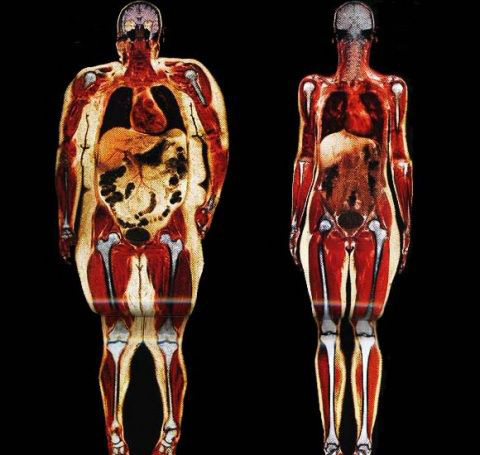
 What an incredible month and I can’t believe November came and is gone. “Fat bottom girls, you make the rockin world go round…” It’s time to dive into Fat. It’s sort of the original sin of food. Unlike proteins and carbohydrate, most of us know when we have too much of it around. We covered some material in the BATgirl posts – predominately the “brown” flavor, so now let’s talk about the “white version.” After we discuss a little bit about how we get it and how to lose it, we will pick up with the dietary forms of fat.
Look at this image. Do you feel your fat suit? I did when I was 50 lbs heavier and I do right now as I gear up to take the last 15 or so off.
Everyone by now has heard me say, “you can’t out-exercise your mouth.” I think most realize that movement is amazing for health, but relative to how many calories one can stuff into their mouth on any given day, movement is probably only a small part of the weight loss plan. Here is the corollary to that quote: You must go on a high fat diet to lose weight.
It’s ALWAYS true. Let’s see why.
Saving For a Rainy Day
I hope everyone came away understanding that carbohydrate is neither bad, nor unhealthy. We have been taught in the last few years to fear carbs and before that it was fat. The reality is that our bodies run on a carbohydrate based economy – Glucose. When we consume too much energy, the evolutionary survival trait kicks in and we naturally store this energy as fat in adipose tissue to use at a later day.
Our problem is the later day never comes.
In organic chemistry we refer to this class of compounds as Lipids. They are mostly carbon and hydrogen, but are very different than carbohydrates. For one, they are typically insoluble in water – you’ve seen the oil floating in vinegar and oil dressing. Lipids act in the same way. There are three main categories of Lipids: Fats, phospholipids, and steroids.
We have discussed Free Fatty Acids (FFA) being used by the mitochondria to produce ATP (or heat in presence of up regulating proteins). In general, fatty acids are how we store fat in chains of about 18 carbons long. In some sense they look a lot like the chains of glucose in starch, but are typically shorter in length. FFA are just the units of these that have been mobilized to use as energy, analogous to the free glucose that is freed from starch/glycogen. The bonds in these fat molecules have a LOT of energy, which is why our bodies use them to store for a rainy day.
When the rainy day never comes and we continue to go back to the table to refuel, there’s no hiding where it goes.
Cholesterol is a steroid of fat that is produced by the liver and intestines and is used as a starting material to produce other important materials in our body like Vitamin D and cell Membranes.
Phosopholipds are manufactured to create the “lipid bilayer” of cell membranes. One end is the fat we are discussing – it wants to repel water (hydrophobic – phobos Greek for fear) and the other end is REALLY attracted to water (hydrophilic – philia Greek for love). These form a sandwich with the water loving side pointed to the inside and outside of the cell and the “fatty part” in the middle. This keeps things from freely passing from one side to the other.
I won’t get into any more details, but I hope you have a taste of how this range of lipid molecules are related. Many don’t know that cholesterol is a steroid or that it is a form of fat. Others might not know that very important molecules, like Vitamin D come from cholesterol our bodies (and other animals) make. As well, every single cell in your body is absolutely dependent on fat for it’s membrane as are many of the bioactive molecules.
Fats are important and it is a shame that we now use the word “fat” to monolithically categorize food. Like “carbs,” it’s simply a bad idea. It leads to many people becoming confused and obsessed with managing something in hopeless ways. Our results in managing our weight speak for themselves. We have used the “macronutrient shuffle” to move society into unprecedented chronic disease. When your body NEEDs fat, it can make it. Now, if it has enough ability to manufacture all of these necessary components like cholesterol and fatty acids, what do you think happens when it is simply OVERRUN with the stuff by consuming excess amounts of it in your diet?
System break downs. Oh, but I eat the HEALTHY kind. I need more Omega-3s. Yeah, right.
Heart disease, diabetes, and other chronic illness end up consuming your health, but managing “fat” alone is not the answer. I am not certain that eating it in massive excess trains the body to deal with it any better. A commenter on Carbohydrate Part – 3 tried to count (a very small list) of fat regulating hormones to justify why we don’t need to eat carbohydrate. Since most hormones, all cell walls, and the primary energy storage is all based in a FAT economy, don’t you think we would have a few extra processes hanging around? Eating is one activity and our preferred, day to day, economy of energy is carbohydrate – glucose.
I understand his confusion. In fact I think one of the most profound statements at TEDMED 2011 was, “molecular biology has failed.” What was meant by the speaker is that there is not just one genetic pathway to health – identify the bad gene and eradicate it was the naive thought we had pre-Human genome knowledge. Now we understand that there exists a “symphony” of reactions that are going on and we don’t have to understand each one to manage them. Instead we can manage in a more holistic approach.
Your body CAN shift over and stuff fat into that primarily energy economy if that is what it is given (or you are starving), but it is not our primary operating mode (glucose, glycogen, blood sugar). When you run out of glucose/glycogen your body naturally starts metabolizing fat. This is why the Atkins-type diets are so effective short term. They mimic starvation mode. When this fat is gone (and we’ll see sometime before) the body can metabolize protein (your muscle). These are the phases of starvation. Deplete short term energy, move to long term, and then go into complete survival to “protect the brain and organs” and sacrifice the arms, lets, etc..
Not too unlike what we learned about getting cold – stop flowing blood to the extremities and protect the core.
Under a NORMAL diet, we get alarmed when excess ketones (byproducts of this fat metabolism) show up in urine. ketogenesis is the result of going into a fat-based economy and often looking for ketones in the urine is a sign that you have switched over. As the two of the main ketone groups, acetoacetate and beta-hydroxybutyrate, are very acidic, blood pH can drop, which results in ketoacidosis. The other ketone formed is acetone – fingernail polish remover, well, before they removed it because it was unhealthy.
All in all, these byproducts are a natural part of Fat metabolism. You have to go through this process to shed those love handles. I think doing it like I did in yo-yo dieting probably has a very unhealthy effect – I just don’t like the idea of acetone running through my system. This is one of the issues that is unresolved in eating – is long term ketosis detrimental to health?
It seems to me that living in this mode is not healthy long term even though short term it is VERY effective in losing body fat. I think the positive longevity benefits associated with caloric restriction are from nutrient dense, calorically poor diets. While on the surface these two forms of “starvation” may share a common name, it’s likely the outcome is very different. Just my speculation.
Your High Fat Diet

photo: Issac Hinds bodybuilding.com
So, this might come as a complete surprise, but the way you lose weight is to go on a natural high-fat diet. In fact it is EXCLUSIVELY the way you lose, because it is YOUR fat that you need to digest. At it’s basic level weight loss is actually quite simple in theory: eat enough micronutrients (the maintenance stuff – vitamins, minerals, essential amino acids) to keep the system running and then consume your “gas reserves” for energy.
If you want want a 6-pack (btw, everyone has one) you have to remove enough fat to SHOW it. You just can’t see it through your “fat suit.” lose body fat (without muscle atrophy, or break down) and stay toned with a moderate amount of exercise and you WILL look fit.
Now some of us don’t have as much muscle mass and putting that on is a completely different topic. As any bodybuilder will tell you there are two steps to their sport: 1) Putting on mass (excess calorie combined with muscle stress/exercise) and 2) dropping body fat for competition (right Christy?) .
While some level of fitness can be maintained (you don’t need to become obese), putting on muscle mass typically comes with some extra body fat (and water) that are normally shed just before competition. Most body builders would be hard pressed to stay at this extremely low (some unhealthy) level for much time.
The point here is that the way you shed fat is to restrict caloric intake (of any kind) and just focus on high nutrient food. This is most easily accomplished with plants/fiber, but there are other ways to do it as well. The part I want you to keep in mind with EVERY BITE is that if you are putting calories IN, then the body does not have to tap into calories OUT of your fat reserves. Remember the gas station analogy?
There are very healthy ways to create caloric restriction and stay satiated throughout the process. Remember this point as well – the body does not KNOW it is fat. Therefore, anything you do to push it away from its CURRENT set point (reduce calories) it will see as starvation and most likely turn on hunger.
There is a base to metabolic restriction that the body can’t get around and we will see in Part 2 that increasing cold exposure with added exercise will preferentially send free fatty acids out to be metabolized by mitochondria for heat and can create a one-two punch on the love handles.
**************
Do you like these blogs and want to help me? Please take a minute to scroll up on the right side of the screen consider making a monthly donation to this program. You can also make a one time donation here: