As we discussed in the last post, I want you to suspend all that you know about carbohydrates, proteins, and fat. I want you to clear notions of glycemic index and eating for blood type. I’m asking you to not have conclusions about our paleolithic ancestors. No, let’s talk about the very basics of energy in our body, but check the Chakras at the door.
Today we’ll take a rather geeky-side step. We are going to talk about energy, oxidation, and heat (not temperature). These are all things that we can see, measure, and repeat. Let’s reserve comments to questions and clarifications – I don’t want a similar scheme from someone else. I am confident that what I am saying is true – to the best of our current understanding.
Quick background. We are “homeotherms” in that our body temperature stays constant. This temperature (around 37C +/-) is the net result of waste metabolic heat. We need to stay in an environment cooler than our body for the most part, so that the waste heat can leave – else we just burn up. Cars need radiators. We are the same. Heat (not temperature) always flows from hot to cold. At the atomic level, that’s just lots of atoms bouncing together – just like rubbing your hands together and getting warm.
Heat (not temperature) is then the net energy in that object. Hot coffee has MORE heat than your tongue. It transfers (rapidly) when you sip it. That is what causes the discomfort. That is a very visceral picture of heat, but in thermodynamics we talk about heat in a far more general way. Most of the discussion has absolutely NOTHING to do with temperature and in fact, temperature is something that goes up and down in many cases to preserve the balance of energy when heat is transferred.
Riding The Wave
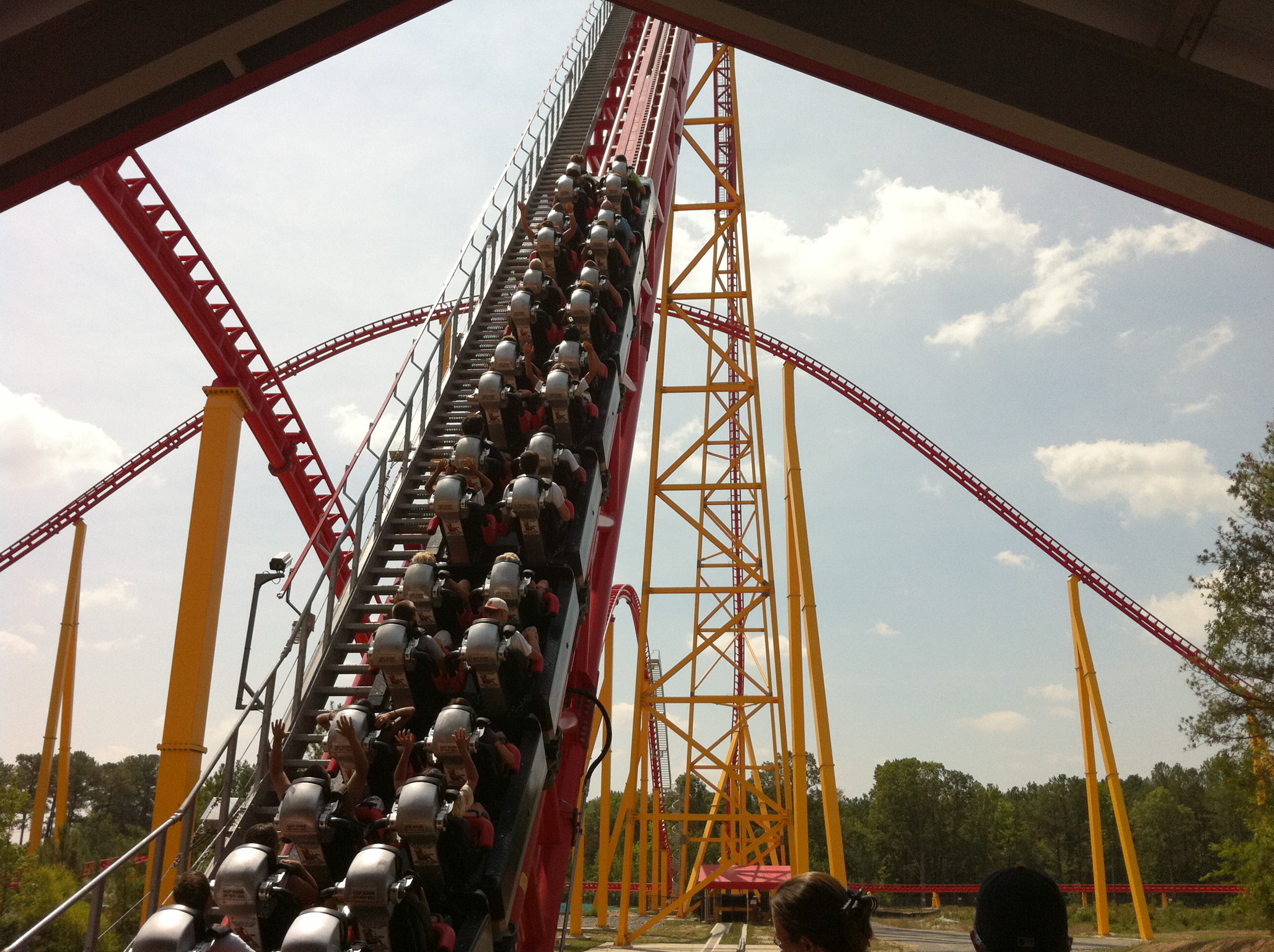 At the top of a roller coaster, you have a LOT of potential energy just before you fall. At the bottom of the hill you have lots of kinetic energy (energy of motion). Stand on that track and splat, you are mowed over my the massive car. Chemical reactions release and absorb energy in much the same way. Hold some explosive in your hand, you have potential energy, light the fuse and bang, release of all that stored energy at one time.
Get the picture?
The process of extracting energy from carbohydrates, proteins, and fats is metabolic oxidation. We add oxygen to the “fuel” and “burn it” to release energy. This is a extremely complex process, with lots of steps, but we can attack the problem from the basic energy in, energy out approach.
Let’s say you eat some glucose…or even table sugar, sucrose. In both cases those two molecules have Carbon (C), Oxygen (O) and Hydrogen (H). These individual atoms are all linked together with chemical bonds. Breaking these bonds requires energy (pulling the roller coaster up the hill) and then releases energy (going down the hill).
Some of the energy does work – like move a muscle, beat the heart or fire a neuron in the brain, but MOST of the energy (80%) is just waste heat energy (not temperature) that gets transferred to surrounding tissue and the tissue then increases in temperature.
What we will learn on specific posts about carbohydrates, protein, and fats is that each of them is processed a little differently by the body, but all can be used for that fundamental energy we need to live (pulling the roller coaster up the hill).
Additionally, we’ll discuss that proteins have a dual use – they can not only be burned like fuel, but they provide a store house of amino acids that are the basic building blocks of our tissue, hormones, and hair. In that sense when you EAT protein, it is not USED by the body; rather it is broken down into amino acids and the body picks out the ones it needs to make whatever is on the “to-do” list – be it eye tissue, insulin, or keratin (hair & nails). The rest of the unused amino acids get tossed into the burn pile. We don’t store them. When we dig into proteins, you’ll see that this word is so misunderstood, that it’s caused huge problems. We’ll find why our body doesn’t actually “burn” protein in much the same way as our body can’t burn “starch.”
On the other side of the balance, fats are places our bodies (and plants) can store energy. We’ll talk about one other form of stored energy, glycogen, in the post on carbohydrates, but just remember that adipose (fat) tissue is a place to dump excess, non waste heat energy until you need it later (gas in the trunk).
So all of these hand-waving sentences: I need more protein to build muscles, high glycemic carbs are my problem, or it’s the good fat, are just distractions at this very basic level. If you were not fat, or competing in an intense triathlon, then really, any of these three fuel sources would do just fine for energy. All of them are acceptable for fuel. Some have more heat energy stored within and others have less. Some can cause secondary hormonal issues, etc…but your body has evolved to process all three of these. Alcohol is another fuel we can throw in the mix – it’s digestible, but the by-products are toxic; it’s certainly energy that can be processed.
Sweet Mistakes
Ultimately, it is glucose – a simple sugar (carbohydrate) that fuels your brain and keeps the cells nourished. We monitor “blood sugar” and for most of us it stays in a pretty tight range. Proteins and fat can be inserted into the process with some fancy tricks, but all the heat energy they contain is eventually assimilated to some part the overall system to process glucose.
What do you need to know from this to move on? Simple. These three macronutrients: carbohydrate, protein, and fat are all useful sources of energy. If you are about to run a race and are 6% body fat, you might want to stock up on energy. If you are worried about the scales and the only exercise you get is looking for the remote control, you probably have plenty.
Einstein said, “We can’t solve problems by using the same kind of thinking we used when we created them.”
Weight loss, ALL WEIGHT LOSS, is then the process of going on a naturally “high fat” diet and consuming your body fat to fuel the roller coaster of life. For each and every heart beat, mouse click, or push up, you need some energy and you’ll want to get it out of your own reserves, not help plants and animals lose weight by eating theirs. If you only drink water, you’ll have no choice but lose body fat.
The problem with the starvation approach is that your body also has to constantly replace proteins (not necessarily your meat, but more hormones, cells, etc..) and in the next post we’ll look closer at how that complicates things and makes severe starvation, not the most appropriate form of weight loss.buy big water slides
**************
Like these and want to help? Please take a minute to scroll up on the right side of the screen consider making a monthly donation to this program. You can also make a one time donation here: