Currently viewing the tag: "ATP"

Irisin transforming fat to BATWe take a quick break from our macronutrient discussion to talk about some really exciting news in the hypothermics world that showed up in the last two weeks. It’s great when new data shows that old thoughts might be wrong.  This one comes from researchers at Harvard Medical School (and a host of other institutions).(1)  These scientist discovered a new hormone, irisin, named after the greek goddess iris – the personification of the rainbow and messenger of the gods.

What is most exciting is that this hormone could be another piece of the “calorie” controversy – the irritating paradox of calorie in, calorie out.  So let’s take a look at what they found.

Only the Good Die Young

In the past we have discussed the role of the uncoupling protein, UCP1, that instructs the mitochondria to generate excess heat instead of producing ATP.  This protein is mediated by another very important co-activator, PGC1-α. You may have heard about it in connection with what are called the Sirtuin proteins. If not, let’s back up and review a little on these before getting into this new discovery.

By regulating the production/activation of this family of molecules, scientist have not only been able to vastly alter obesity in mammals, they also are able to affect animal longevity.  You’ve heard of Resveratrol by now and these are the very same metabolic pathways altered by that molecule. (2-4)

PCG1-alpha altered mice show dramatically different aging.

Increased PGC-1α expression in skeletal muscle prevents age-associated weight gain and improves exercise capacity during aging. (A) Comparison of mice expressing the PGC-1α transgene in skeletal muscle (MCK-PGC-1α) and wild-type littermates (control) at different ages. (B and C) Lean and fat mass of 22-month-old wild-type and PGC-1α animals as determined by DEXA scans, (D) Relative hindlimb mass of 22-month-old wild-type and PGC-1α animals (E) Treadmill performance test at different ages for wild-type and PGC-1α animals; Source: Proc Natl Acad Sci U S A. 2009 Dec 1;106(48):20405-10. Epub 2009 Nov 16.

For example, if you look the the photo to the right, you’ll see a pair of mice. One mouse (left),  was genetically modified to have enhanced PGC1-α and compared to a normal control mouse (right).  Just a scan of the photos and you will quickly see that the modified mouse ages “gracefully.”  Its control cage-mate gets plump like the rest of us even though it’s in the same environment. The genetically modified mouse stays healthy.

It doesn’t stop there. Take a look at graph “E” to on the bottom right.  That is the difference in performance of Treadmill tests (I wonder if they used Livestrong?).  Look at the difference of performance at 22 months! Like a fine red wine, these mice get better with age.  In addition to the lack of weight gain and increased running skills, these mice showed no age-related bone loss or insulin resistance and the typical systemic inflammatory response was mitigated.

Despite what people might say, you’re not going to get these results from drinking red wine (sorry), but these are incredible first steps to unlocking the mystery of aging and metabolic syndrome.

Message to My Blubber

The new research identifying the irisin hormone is just as exciting.  This hormone was hidden as part of a much larger molecule and these researchers were able to  isolate it.  Irisin is secreted as a result of exercise in both these transgenic (modified) mice and Humans.  It turns out that this is way for the muscle to “communicate’ with the forming white adipose cells, signaling them to become the more energetic brown adipose tissue (BAT).  The concentration of this hormone jumped sharply after exercise (Human and mice).

The researchers went a step further.

By doing experiments in cultures, they discovered that nano molar levels (tiny amounts) of this hormone cause a 50-fold increase in the UPC1 protein. When delivered in vivo (in the animal) they still saw a 10-20 fold increase of in UCP1, which resulted in an increased energy expenditure and improvement in the glucose tolerance of mice fed a high fat diet.  But a nagging question remained. What purpose would be served by a hormone being released in response to exercise that INCREASED energy consumption?  One might thing that the opposite would be true – evolution would dictate conservation of energy.

Cavemen Didn’t Exercise

A long time before 5-toe shoes and grown men (and women) running through NYC Central Park beating their chest and throwing boulders, we were far more like the bird sitting on your back porch (unless you are looking at a pigeon – they don’t count); we starved.  If you look all around you and ignore domesticated animals (including pigeons and rats), you will find that every animal is starving.  They live to eat every day and it is a struggle to find calorie.  It is THE struggle that anthropologist are still trying to unravel with Humans.

Where did we get the energy to become the modern-day intellectual giant?

You should see the conflict. If we were starving and now find that a hormone is released in response to strenuous activity, which turns energy storing white fat into energy burning brown fat, that would be a NEGATIVE not a positive evolutionary trait. The quest to find food would be a downward energy spiral.

Ah, but we really had no reason to run through the park or roll giant tires around. Why would our ancestors need to exercise?  It turns out that there is one activity that WOULD cause a lot of muscle activity, yes it’s shivering.  It was a way for animals to keep warm and in response to the biological stress of cold, muscle secreting a hormone to create more BAT to keep warm was a GOOD thing.  It meant staving off hypothermia.

A further interesting fact is that PGC1-α was originally discovered by scientists, because it was unregulated by cold exposure.  We also know that in addition to caloric restriction, mild cold stress is the only other way that we have demonstrated longevity in mice. Even more exciting is that recent tests (unpublished) have show a nearly 5-fold increase of BAT output of a 52 year old man vs 20 year old controls.  This increase was even though they had similar levels of BAT, so there is even more energy to tap into. You can adapt and cause increased metabolic activity.

Un-wrapping it All

I think we are seeing just the tip of where all of this is going. In the last decade we have moved from the idea that we lose all of our BAT with aging, to we have a fixed amount of BAT, to now understanding there are hormonal mechanisms to create new BAT.  Further the exact pathways that are responsible for longevity through caloric restriction also are affected by mild cold stress.  These systems respond to biological stress of starvation and cold, like a muscle responds to the stress of weight training,  by creating a more resilient biology.

Mild cold stress does not have to be miserable, or even cold.  It can come in a lot of different forms. In the David Agus new Book, The End of Illness, he discusses at great length the role of inflammation in aging. He even gives an example of a one of his “all-star” cancer patients. Diagnosed with prostate cancer at the age of nearly 80, he decided to make a life changes that include swimming every day. He is now almost 90 and doing incredible.

I have documented the profound ability to thermal load through swimming.  In addition we know that mild cold stress starts in warm water (27C/80F).  Today we have learned that a hormone has been identified that is not only increases PGC1-α, it’s causes all the benefits of longevity seen through sirtuin activation. It’s exciting to see this all come together and I know we’ll only learn more. This is not the ice cube diet or really even “freeze your ass off,” it’s a basic adaptation with millions of years of evolutionary excellence.

Turn the heater off, go for a walk, let go of a few layers, move,  or just swim – do something.  You have nothing to lose and we all look funny as hell in shorts, gloves and face masks.  If laughter is the best medicine, worse case is you’ll make someone live longer by laughing.

Ray


(1) Boström PA, et al.,  “PGC1-α-dependent myokine that drives brown-fat-like development of white fat and thermogenesis,” Nature. 2012 Jan 11. doi: 10.1038/nature10777. [Epub ahead of print]

(2) Wenz T, et al. “Increased muscle PGC-1alpha expression protects from sarcopenia and metabolic disease during aging,”Proc Natl Acad Sci U S A. 2009 Dec 1;106(48):20405-10. Epub 2009 Nov 16.

(3) Tong Shi, et al. “SIRT3, a Mitochondrial Sirtuin Deacetylase, Regulates Mitochondrial Function and Thermogenesis in Brown Adipocytes,” J. Biol. Chem., Vol. 280, No. 14, Issue of April 8, pp. 13560–13567, 2005

(4) Marcia C. Haigis and Leonard P. Guarente, “Mammalian sirtuins—emerging roles in physiology, aging, and calorie restriction,” Genes Dev. 2006 20: 2913-2921.

**************
Do you like these blogs and want to help me? Please take a minute to scroll up on the right side of the screen consider making a monthly donation to this program. You can also make a one time donation here:
Thanks!
Ray

What an incredible month and I can’t believe November came and is gone.  “Fat bottom girls, you make the rockin world go round…”  It’s time to dive into Fat.  It’s sort of the original sin of food. Unlike proteins and carbohydrate, most of us know when we have too much of it around.  We covered some material in the BATgirl posts – predominately the “brown” flavor, so now let’s talk about the “white version.” After we discuss a little bit about how we get it and how to lose it, we will pick up with the dietary forms of fat.

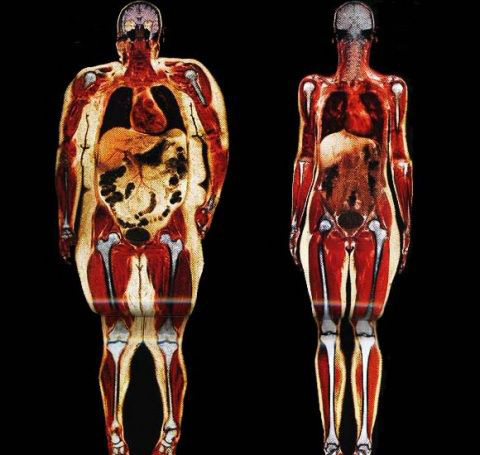
Look at this image. Do you feel your fat suit? I did when I was 50 lbs heavier and I do right now as I gear up to take the last 15 or so off.

Everyone by now has heard me say, “you can’t out-exercise your mouth.”  I think most realize that movement is amazing for health, but relative to how many calories one can stuff into their mouth on any given day, movement is probably only a small part of the weight loss plan.  Here is the corollary to that quote: You must go on a high fat diet to lose weight.

It’s ALWAYS true. Let’s see why.

Saving For a Rainy Day

I hope everyone came away understanding that carbohydrate is neither bad, nor unhealthy.  We have been taught in the last few years to fear carbs and before that it was fat.  The reality is that our bodies run on a carbohydrate based economy – Glucose.  When we consume too much energy, the evolutionary survival trait kicks in and we naturally store this energy as fat in adipose tissue to use at a later day.

Our problem is the later day never comes.

In organic chemistry we refer to this class of compounds as Lipids. They are mostly carbon and hydrogen, but are very different than carbohydrates. For one, they are typically insoluble in water – you’ve seen the oil floating in vinegar and oil dressing.  Lipids act in the same way.  There are three main categories of Lipids: Fats, phospholipids, and steroids.

We have  discussed  Free Fatty Acids (FFA) being used by the mitochondria to produce ATP (or heat in presence of up regulating proteins). In general, fatty acids are how we store fat in chains of about 18 carbons long. In some sense they look a lot like the chains of glucose in starch, but are typically shorter in length. FFA are just the units of these that have been mobilized to use as energy,  analogous to the free glucose that is freed from starch/glycogen.   The bonds in these fat molecules have a LOT of energy, which is why our bodies use them to store for a rainy day.

When the rainy day never comes and we continue to go back to the table to refuel, there’s no hiding where it goes.

Cholesterol is a steroid of fat that is produced by the liver and intestines and is used as a starting material to produce other important materials in our body like Vitamin D and cell Membranes.

Phosopholipds are manufactured to create the “lipid bilayer” of cell membranes. One end is the fat we are discussing – it wants to repel water (hydrophobic – phobos Greek for fear) and the other end is REALLY attracted to water (hydrophilic – philia Greek for love). These form a sandwich with the water loving side pointed to the inside and outside of the cell and the “fatty part” in the middle. This keeps things from freely passing from one side to the other.

I won’t get into any more details, but I hope you have a taste of how this range of lipid molecules are related. Many don’t know that cholesterol is a steroid or that it is a form of fat. Others might not know that very important molecules, like Vitamin D come from cholesterol our bodies (and other animals) make.  As well, every single cell in your body is absolutely dependent on fat for it’s membrane as are many of the bioactive molecules.

Fats are important and it is a shame that we now use the word “fat” to monolithically categorize food. Like “carbs,” it’s simply a bad idea. It leads to many people becoming confused and obsessed with managing something in hopeless ways.  Our results in managing our weight speak for themselves. We have used the “macronutrient shuffle” to move society into unprecedented chronic disease. When your body NEEDs fat, it can make it.  Now, if it has enough ability to manufacture all of these necessary components like cholesterol and fatty acids, what do you think happens when it is simply OVERRUN with the stuff by consuming excess amounts of it in your diet?

System break downs. Oh, but I eat the HEALTHY kind. I need more Omega-3s. Yeah, right.

Heart disease, diabetes, and other chronic illness end up consuming your health, but managing “fat” alone is not the answer. I am not certain that eating it in massive excess trains the body to deal with it any better.  A commenter on Carbohydrate Part – 3 tried to count (a very small list) of fat regulating hormones to justify why we don’t need to eat carbohydrate. Since most hormones, all cell walls, and the primary energy storage is all based in a FAT economy, don’t you think we would have a few extra processes hanging around?  Eating is one activity and our preferred, day to day, economy of energy is carbohydrate – glucose.

I understand his confusion. In fact I think one of the most profound statements at TEDMED 2011 was, “molecular biology has failed.” What was meant by the speaker is that there is not just one genetic pathway to health – identify the bad gene and eradicate it was the naive thought we had pre-Human genome knowledge. Now we understand that there exists a “symphony” of reactions that are going on and we don’t have to understand each one to manage them. Instead we can manage in a more holistic approach.

Your body CAN shift over and stuff fat into that primarily energy economy if that is what it is given (or you are starving), but it is not our primary operating mode (glucose, glycogen, blood sugar).  When you run out of glucose/glycogen your body naturally starts metabolizing fat. This is why the Atkins-type diets are so effective short term. They mimic starvation mode.  When this fat is gone (and we’ll see sometime before) the body can metabolize protein (your muscle).  These are the phases of starvation.  Deplete short term energy, move to long term, and then go into complete survival to “protect the brain and organs” and sacrifice the arms, lets, etc..

Not too unlike what we learned about getting cold – stop flowing blood to the extremities and protect the core.

Under a NORMAL diet, we get alarmed when excess ketones (byproducts of this fat metabolism)  show up in urine.  ketogenesis is the result of going into a fat-based economy and often looking for ketones in the urine is a sign that you have switched over.  As the two of the main ketone groups, acetoacetate and beta-hydroxybutyrate, are very acidic, blood pH can drop, which results in ketoacidosis.  The other ketone formed is acetone – fingernail polish remover, well, before they removed it because it was unhealthy.

All in all, these byproducts are a natural part of Fat metabolism. You have to go through this process to shed those love handles.  I think doing it like I did in yo-yo dieting probably has a very unhealthy effect – I just don’t like the idea of acetone running through my system.  This is one of the issues that is unresolved in eating – is long term ketosis detrimental to health?

It seems to me that living in this mode is not healthy long term even though short term it is VERY effective in losing body fat. I think the positive longevity benefits associated with caloric restriction are from nutrient dense, calorically poor diets.  While on the surface these two forms of  “starvation” may share a common name, it’s likely the outcome is very different. Just my speculation.

Your High Fat Diet

photo: Issac Hinds bodybuilding.com

So, this might come as a complete surprise, but the way you lose weight is to go on a natural high-fat diet. In fact it is EXCLUSIVELY the way you lose, because it is YOUR fat that you need to digest.  At it’s basic level weight loss is actually quite simple in theory: eat enough micronutrients (the maintenance stuff – vitamins, minerals, essential amino acids) to keep the system running and then consume your “gas reserves” for energy.

If you want want a 6-pack (btw, everyone has one) you have to remove enough fat to SHOW it. You just can’t see it through your “fat suit.”  lose body fat (without muscle atrophy, or break down) and stay toned with a moderate amount of exercise and you WILL look fit.

Now some of us don’t have as much muscle mass and putting that on is a completely different topic.  As any bodybuilder will tell you there are two steps to their sport: 1) Putting on mass (excess calorie combined with muscle stress/exercise) and 2) dropping body fat for competition (right Christy?) .

While some level of fitness can be maintained (you don’t need to become obese), putting on muscle mass typically comes with some extra body fat (and water) that are normally shed just before competition.  Most body builders would be hard pressed to stay at this extremely low (some unhealthy) level for much time.

The point here is that the way you shed fat is to restrict caloric intake (of any kind) and just focus on high nutrient food.  This is most easily accomplished with plants/fiber, but there are other ways to do it as well.  The part I want you to keep in mind with EVERY BITE is that if you are putting calories IN, then the body does not  have to tap into calories OUT of your fat reserves. Remember the gas station analogy?

There are very healthy ways to create caloric restriction and stay satiated throughout the process.  Remember this point as well – the body does not KNOW it is fat.  Therefore, anything you do to push it away from its CURRENT set point (reduce calories) it will see as starvation and most likely turn on hunger.

There is a base to metabolic restriction that the body can’t get around and we will see in Part 2 that increasing cold exposure with added exercise will preferentially send free fatty acids out to be metabolized  by mitochondria for heat and can create a one-two punch on the love handles.

**************
Do you like these blogs and want to help me? Please take a minute to scroll up on the right side of the screen consider making a monthly donation to this program. You can also make a one time donation here:


Thanks!
Ray

glycogen is key to running long distance. When we bonk, it's because we are running low on glycogen and must switch to fat reserves.We’ve covered a lot of ground. What we’ve discussed  is that carbohydrates come in the form of simple sugars (monosaccharides) and more complex carbohydrates (polysaccharides). We know that the sugar names all end in “ose” (glucose, fructose, lactose, etc…). Polysaccharides are many of these monosaccharides linked together in a chain and are a common way plants store energy (similar to our fat) for later use.

I’m suggesting you stop thinking about “Carbs” as a food group; instead categorize meat, vegetables, grains, dairy, etc… Starch (potato) and Cellulose (wood) are made from IDENTICAL glucose molecules. They have a different saccharide bonds, only one of which we have the enzyme (amylase) to digest.

So in Part 3, I want to talk about another pseudo-carbohydrate that is critical for you – glycogen. Many of you are familiar with glycogen from athletics. It’s the “load” part of carb-loading in preparation for a race. It’s also the center of your glucose-centric metabolism and the reason I personally don’t think “carbs” are bad or unhealthy.

What is unhealthy is the way we process high-energy foods with even more empty calories and then consume them in excessive quantities.

So, let’s take a little step back to understand what glycogen is and why it’s important to your performance and your life. Your body has three basic storage points for energy: ATP (adenosine triphosphate), glycogen, and fat. the most immediate energy – what is behind the muscle explosion is ATP. You have about 250 grams of this stuff, about the same amount of energy as is contained in a AA battery, energy comes form popping off one of the phosphates to form ADP (adenosine diphosphate + energy)(1). We then use this other enzyme many of you will be familiar with, creatine kinase, to shuttle these phosphates back and forth.

Save the Liver

glycogen is key in energy of muscle tissue. When you run out fat must be utilized. ATP is at the very basic level of your energy utilization. Just above this in the “energy food chain,” is our friend, glycogen.  Think of  glycogen as a “fuzzy protein.”  It is made of a core protein, glycogenin, surrounded by fuzzy starch (poly glucose) hairs. It is located throughout your body.  You have about 2000 calories at any given time; 500 or so is stored in your liver and the rest packed among your muscles where it can be readily accessed. I’m using approximate numbers because everyone is slightly different, but here is an interesting side fact.

It takes (about) 2600 calories to run a marathon.  2000 calories/2600 calories = 77%.  Now using that number and knowing a marathon is 42.2Km/26.2M we see that 77% is 32.5Km/20.2 miles.  Anyone that has attempted to run a marathon can tell you about that number: THE WALL.  If you are like me and would rather freeze your ass off than run a marathon, that is the point where ATP can no longer be generated by glycogen stores (you’ve run out) and you MUST resort to stored fat.

Fat is then the highest level and quantity of stored energy in your body and the body has to work to get it into a primary glucose-based energy system.  Conversely, fatty foods (Oils, lards, etc)  have the densest energy reserves. It’s simple: fat is there for long term storage.  Plants, and Humans have carbohydrate based reserves for the most immediate needs and that is in your blood sugar level and glycogen reserve.

Record marathoners have trained their bodies to dip into fat reserves much earlier and they use fat throughout the race.  When we get back to fat metabolism and thermal loading, you’ll find this is a side benefit of conditioning your body to withstand cold – free fatty acids (FFA) liberated from your fat stores. You may remember from BATGirl, that the mitochondria of BAT and other tissue can use FFA in the presence of a special up-regulating proteins to create HEAT instead of generating ATP.

Your ability to regularly engage in this FFA economy can be significantly influenced by running marathons – extreme milage  volume causes this switch as does mild cold stress.  People make fun of me about cold all the time, but I just think this is far easier than running 50 miles/day. You may see it different.

What happens in Protein-rich diets is you have depleted your glycogen reserves and it’s energetically costly to refill glycogen from converting protein. Your body switches over to fat metabolism and voilà, you start losing weight. That’s how it works and the ultimate decision one should consider is what will be the long term health effects by using your body’s tertiary macronutrient, protein, to drive it into a secondary reserve, fat, by depleting it from it’s primary energy, glucose. The other direction works just as well and in a glycogen replete state, Chris  Voigt lost weight eating 20 potatoes a day – all bad carbs.  This is an interesting contrast to the high-fat approach and I think it’s far more important than a silly PR stunt.

Seems complicated, but I just want people to discuss this factually and make informed decisions.

We can equally manage 1) hunger (satiety) and 2) total caloric intake, while maintaining correct micronutrient intake, living permanently thin as opposed to yo-yo dieting.  This does require modifications to your lifestyle and I won’t tell you it is trivial, but neither is bypass surgery, insulin shots, high blood pressure, or lugging around an extra 50-200 lbs.

So, there really is not debate that carbohydrate, particularly starch, is a perfectly natural food.  As we process with cooking (or over process) ANY carbohydrate, the energy becomes more readily available and then we damn “starch” as the bad-calorie; it’s simply not true.  What is interesting is there are many ways to put your body into “survival mode” and only two that have ever demonstrated longevity in laboratory animals: caloric restriction and mild cold stress.

We still have to cover proteins and fats and we’ll keep the rules engaged, neither are food groups. As well, I want you guys to jump in on new commenters in the future and explain when we discuss carbohydrate here, we are primarily discussing high-starch foods that are relatively unprocessed (heated, with no added fat, dairy, or sugar).  If you don’t believe me, TRY to go find food in a restaurant that 1) contains a starch and 2) is not loaded with sugar, fat, or dairy. I did it as an experiment for 14 months and know first hand the difficulty.

Brain Drain

We are fat, but let’s not damn potato, squash, and rice – the very staples of Humankind – as the punching bag for of our epidemic obesity. Let’s acknowledge that preparation and added empty calories play the MAJORITY role.  When I construct a new paradigm to consider for eating at the end, you’ll see that there is plenty of room for carbohydrate (starchy-foods) on the plate.

Starches are an EXCELLENT food option and contain glucose, the only fuel used by the largest energy consumer of your body: The Brain.  When you run low on glucose (and glycogen), gluconeogenesis creates glucose from amino acids by stripping off the nitrogens and using what is left to synthesize glucose.  Energy for this is driven through beta-oxidation of FFA. If you have a lot of  beta-oxidation is occuring (untreated diabetes or starvation), acetyl-CoA builds up, and is converted to the ketone bodies. That’s the basis of ketosis and why ketones are found in your urine.

The brain-blood barrier is the separation of this distinctly different glucose metabolism from the rest of your body. So, I think is at least it is easily questionable to say carbs are “bad” or even the cause of obesity. At the same time, throwing your body completely into starvation mode, while certainly effective to lose weight, might not be the best long term. Of course we have to consider the implications of caloric restriction too. I just raise the question.

With that is it fair to ask if “carbohydrate” was so bad for you, why did we evolve one of the most advanced, energy-conuming brains of any species to use only a carbohydrate fuel?

Think about it.


(1) “On the prebiotic potential of reduced oxidation state phosphorus: the H-phosphinate–pyruvate system,” David E. Bryant, Katie E. R. Marriott, Stuart A. Macgregor, Colin Kilner, Matthew A. Pasek and Terence P. Kee, Chem. Commun., 2010, 46

**************
Do you like these blogs and want to help me? Please take a minute to scroll up on the right side of the screen consider making a monthly donation to this program. You can also make a one time donation here:


Thanks!
Ray

carbohydrates slow carb diet, thermogenex, thermal loading As we have been discussing, macronutrients are the basic energy, or fuel, our bodies need for all biological processes. This can be used for exercising, thinking or synthesizing the many biological molecules that keep the system smoothly operating.

Micronutrients are the building blocks – the stuff our body uses to create the many cells, tissues, and hormones.  Like we discussed in our car analogy, macronutrients are the gas and micronutrients are the routine maintenance service for the car .

Today we are going to begin the discussion of Carbohydrates. What I hope to do, is change your reaction to that word.  I don’t want you to say “carb” or think french fries, potatoes, or rice.  I don’t want you to think about ANY food group.  Forget glycemic index.  Those are all useful bits of information for diet schemes, but not to understand how your body works.  When we are done, we’ll move onto the other macronutrients: fat and protein.

So, do we have a deal? No discussion of FOOD for the conceptual understanding of carbohydrates, but I will give examples carbohydrates contained food so that we can understand the bigger picture.

Thermodynamics is the study of heat and energy and how these systems interact. We derive energy from the basic three macronutrients.  Later, there will be detail of this complex process, but for now, it’s just a game of “pass the electron.”  Every whole food you eat contains some amount of the three macronutrients. We call something a Protein or a Carb in response to its greatest portion of macronutrient by weight.

Now, we are discussing energy, the thermodynamics, and really weight has nothing to do with energy other than some means of quantifying the amount you eat.  We’ll see that this macronutrient/weight is extremely useful for food labels, but not very indicative of either the amount energy or macronutrient you might derive from a given amount of food.Telt

Let’s dive into what a carbohydrate is and why we need it.

A Carbohydrate is a Carbohydrate

We’ll see that all this fuss about calorie a calorie is going to be a simple accounting issue, but if you have a negative reaction to the word carbohydrate, if you think that there are good carbs and bad carbs, if you’re worried about blood sugar, then fret no more.  We aren’t going to discuss any of that here.  Not going to even take questions on it.

Instead, I want you to return to 4th grade and think about that simple view of the world. You breath in oxygen, it’s combined with fuel (“burned”)  to give energy and then you exhale carbon dioxide.  That is in turn used by plants in photosynthesis, to yield sugars and other biologically active compounds and they return the oxygen.

See it?

We are all confused about the breathing oxygen and burning part, remember, a calorie isn’t a calorie? So, let’s start with the plant side of the circle. There aren’t many obese plants, maybe they’ve figured something out.

Plants take in carbon dioxide and form sugars, fats, complex carbohydrates (e.g. starch) and structural cellulose. With the exception of venus fly traps and pitcher plants, they just don’t eat.  They also take in Nitrogen from the soil (fertilizer) creating proteins and even even psychoactive alkaloids, like mescaline (peyote buttons). It seems plants are a trip.

In fact plants synthesize every single protein, fat and carbohydrate you need to live.  We eat them or we eat animals and bacteria that eat them and here we are. Perhaps this is what they didn’t tell us in 4th grade. Food and Macronutrients are somehow separated at birth of the concept, but we are here to discuss Carbohydrates, like starch and really understand what they are and how they work.

We all know the word sugars. There are natural sugars, bad sugars, processed sugars, and high glycemic sugars, but really, a sugar is just the simplest molecule that makes up the long chains of stored energy in plants.  It’s their way of saving for a rainy day (literally).  They all named to end in “ose” – glucose, galactose, lactose, fructose, maltose, etc.  Once ingested, you extract energy from them to fuel ATP/ADP through electron transport chain.

For now, just know that your body MUST have glucose. That’s what we measure when we measure “blood sugar” and that is what your brain runs on as a fuel.  It’s chemical formula, C6H12O6 is the building block of two very familiar compounds: Starch and Cellulose. Both of these “polysaccharides” (poly = many, saccharide = sugar) are simply long chains of the EXACT same sugar: Glucose.

House of Potatoes

cellulose, glucose, starch

Starch and Cellulose are made from the same building block, Glucose. They have a different saccharide bond that holds them together. Since many animals don't make the enzyme to break down cellulose, the fiber passes through. If you ever wondered how hippopotamus, rhinoceros, cows, and giraffes grow lean and muscular as herbivores, here's your answer.

That’s right, a baked potato and a wood are essentially the same thing.  So why aren’t we whipping a wonderful Mahi-Mahi dusted in a fine pepper-birch sawdust and parchment-baked? It’s because we happen to be protein deficient.  Yes, it’s true, a polysaccharide like cellulose or “poly-glucose” must be broken down by enzymes, proteins, into glucose so we can use them.

Cellulose is put together in just a slightly different way and we can’t break it down. To a termite, or the bacteria in the rumen (a stomach) of a cow, that piece of wood or grass fiber works as food JUST like a baked potato does for you.  These bacteria and insects create  the protein, cellulase, to extract glucose from cellulose.  We create another protein, amylase, that breaks down the starch.  You have as many as 4-12 copies of the gene that creates amylase enzyme, because it’s so genetically important for your survival.

Carbohydrate, fats, and proteins all enter the electron transport chain to deliver energy to your body in a set of reactions designed around glucose, the building block of carbohydrate.

What do I want you to take away? first, “Carbs” aren’t food groups and neither are proteins and fats. Theses very defined terms in organic/biochemistry, but have been popularized in order to help you “eat healthy.  The irony is we’ve never been more unhealthy as a world.  Proteins aren’t meat; there are also other bioactive proteins, for example enzymes like amylase or cellulase, that participate nearly every metabolic process keeping you alive.

We will eventually come back to food, and calories, and see that nearly every food you eat is a combination of these. You don’t “need a complete protein” and can’t “avoid carbs.”  The truth is that what you need is energy to run the process, fuel. You  probably have a few weeks (months?) supply of fuel you’ve been lugging around for some time. We need to find creative ways to burn it.  None of them involve schemes of putting MORE energy in your mouth. You’ll never run empty if you fill up three times a week.

For today, here is what I want you to take away: carbohydrates are polysaccharides ( “many” “sugars”) that provide the basic energy currency precursor of your body, glucose.  We’ll discuss some of the other (evil – lol) simple carbohydrates in the next blog.  We use and need carbohydrate in our diet.  There is a big difference between starches, like rice, squash and potatoes and donuts. Fruits, on the other hand, contain simple sugars as well and those come with their own issues.  It is key to separate carbohydrates, especially complex carbohydrates, from simple sugars.

We’ll then turn to the other macronutrients, fat and protein, to fill in the basic metabolism energy cycle.

You shouldn’t feel uncomfortable with the idea that ultimately, cows eat grass, gain glucose and amino acids, and grow tasty, “grass-fed” beef. That beef is laden with amino acids.  When you eat it, you can in turn use the amino acids (no significant glucose in beef) to create insulin or pus in pimples (also a protein), whatever protein you need,  and metabolize the left over to supplement your daily energy requirements. You can even store it for “later.”

Perhaps,  it’s not as simple as the CO2->Sun->O2 symbiotic respiration we learned in 4th grade, but it is plenty understandable.  When you no longer see protein, carbohydrate or fat as food groups, your mind will be opened to lots of different options.

Equally important, we’ve all learned the hard way, you can’t out-exercise your mouth.  It is simply put, impossible.

Until next time…

**************
Like these  blogs and want to help me? Please take a minute to scroll up on the right side of the screen consider making a monthly donation to this program. You can also make a one time donation here:


Thanks!
Ray